|
PDBsum entry 2gof

|
|
|
|
|
|

|
|

|
|

|
|

|
|
|
 |

|

|
|
|
|
|
|
|
|
|
|
|
|
|
|
|
|
|
|
|
|
|
|
|
|
|
|
|
|
|
Viral protein
|
PDB id
|
|
|
|
2gof
|
|
|
|
|
|
|
|
|
|
|
|
|
|
|

|

|

|
|
|
|
|
|
References listed in PDB file
|
|
|
Key reference
|
|
|
Title
|
|
Three-Dimensional structure of the transmembrane domain of vpu from HIV-1 in aligned phospholipid bicelles.
|
|
|
Authors
|
|
S.H.Park,
A.A.De angelis,
A.A.Nevzorov,
C.H.Wu,
S.J.Opella.
|
|
|
Ref.
|
|
Biophys J, 2006,
91,
3032-3042.
|
|
|
PubMed id
|
|
|
|
|
|
Abstract
|
|
|
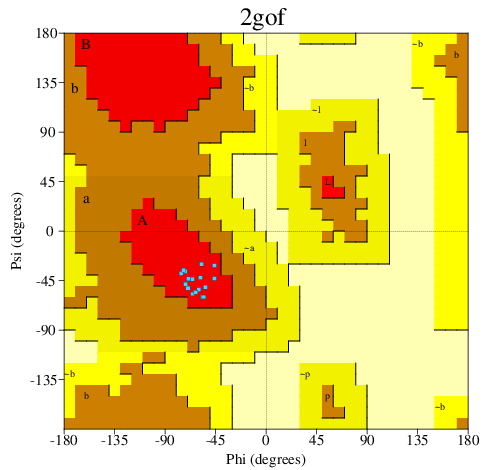
The three-dimensional backbone structure of the transmembrane domain of Vpu from
HIV-1 was determined by solid-state NMR spectroscopy in two magnetically-aligned
phospholipid bilayer environments (bicelles) that differed in their hydrophobic
thickness. Isotopically labeled samples of Vpu(2-30+), a 36-residue polypeptide
containing residues 2-30 from the N-terminus of Vpu, were incorporated into
large (q = 3.2 or 3.0) phospholipid bicelles composed of long-chain ether-linked
lipids (14-O-PC or 16-O-PC) and short-chain lipids (6-O-PC). The
protein-containing bicelles are aligned in the static magnetic field of the NMR
spectrometer. Wheel-like patterns of resonances characteristic of tilted
transmembrane helices were observed in two-dimensional (1)H/(15)N PISEMA spectra
of uniformly (15)N-labeled Vpu(2-30+) obtained on bicelle samples with their
bilayer normals aligned perpendicular or parallel to the direction of the
magnetic field. The NMR experiments were performed at a (1)H resonance frequency
of 900 MHz, and this resulted in improved data compared to lower-resonance
frequencies. Analysis of the polarity-index slant-angle wheels and dipolar waves
demonstrates the presence of a transmembrane alpha-helix spanning residues 8-25
in both 14-O-PC and 16-O-PC bicelles, which is consistent with results obtained
previously in micelles by solution NMR and mechanically aligned lipid bilayers
by solid-state NMR. The three-dimensional backbone structures were obtained by
structural fitting to the orientation-dependent (15)N chemical shift and
(1)H-(15)N dipolar coupling frequencies. Tilt angles of 30 degrees and 21
degrees are observed in 14-O-PC and 16-O-PC bicelles, respectively, which are
consistent with the values previously determined for the same polypeptide in
mechanically-aligned DMPC and DOPC bilayers. The difference in tilt angle in C14
and C16 bilayer environments is also consistent with previous results indicating
that the transmembrane helix of Vpu responds to hydrophobic mismatch by changing
its tilt angle. The kink found in the middle of the helix in the longer-chain
C18 bilayers aligned on glass plates was not found in either of these
shorter-chain (C14 or C16) bilayers.
|
|
|
|
|
|
|