 |
PDBsum entry 2gnh

|
|
|
|
|
|

|

|

|

|
|

|
|

|
|

|
|

|
|

|
|

|
|
|
 |

|

|
|
|
|
|
|
|
|
|
|
|
|
|
|
|
|
|
|
|
|
|
|
|
|
|
|
|
|
|
|
|
|
|
|
|
Transferase/transferase inhibitor
|
PDB id
|
|
|
|
2gnh
|
|
|
|
|
|
|
|
|
|
|
|
|
|
|

|

|

|
|
|
|
|
|
|
|
 |
Contents |
 |
|
|
|
|
|
|
|
|
|
|
|
|
* Residue conservation analysis
|
|
|
|
|
|
PDB id:
|
|
|
|
| Name: |
|
Transferase/transferase inhibitor
|
|
|
Title:
|
|
Pka five fold mutant model of rho-kinase with h1152p
|
|
Structure:
|
|
Camp-dependent protein kinase, alpha-catalytic subunit. Chain: a. Synonym: pka c-alpha. Engineered: yes. Mutation: yes. Camp-dependent protein kinase inhibitor alpha. Chain: i. Fragment: pki(residues 5-24). Synonym: pki-alpha, camp-dependent protein kinase inhibitor,
|
|
Source:
|
|
Bos taurus. Cattle. Organism_taxid: 9913. Gene: prkaca. Expressed in: escherichia coli bl21(de3). Expression_system_taxid: 469008. Synthetic: yes. Other_details: the peptide was chemically synthesized. The sequence of the peptide is naturally found in rabbit.
|
|
Biol. unit:
|
|
Dimer (from
)
|
|
Resolution:
|
|
|
2.05Å
|
R-factor:
|
0.198
|
R-free:
|
0.256
|
|
|
Authors:
|
|
S.Bonn,S.Herrero,C.B.Breitenlechner,R.A.Engh,M.Gassel,D.Bossemeyer
|
Key ref:

|
|
S.Bonn
et al.
(2006).
Structural analysis of protein kinase A mutants with Rho-kinase inhibitor specificity.
J Biol Chem,
281,
24818-24830.
PubMed id:
DOI:

|
|
|
Date:
|
|
|
10-Apr-06
|
Release date:
|
23-May-06
|
|
|
|
|
|
|
PROCHECK
|

|
|
|
|
|
Headers
|
|
|
|
References
|
|
|
|
|
|
|
|
|
|
|
|
Enzyme class:
|
|
Chain A:
E.C.2.7.11.11
- cAMP-dependent protein kinase.
|
|
|
|
|
|
|
Reaction:
|
|
|
1.
|
L-seryl-[protein] + ATP = O-phospho-L-seryl-[protein] + ADP + H+
|
|
2.
|
L-threonyl-[protein] + ATP = O-phospho-L-threonyl-[protein] + ADP + H+
|
|
|
|
|
|
|
L-seryl-[protein]
|
+
|
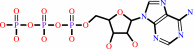 ATP
ATP
|
=
|
O-phospho-L-seryl-[protein]
|
+
|
 ADP
ADP
|
+
|
H(+)
|
|
|
|
|
|
|
L-threonyl-[protein]
|
+
|
ATP
|
=
|
O-phospho-L-threonyl-[protein]
|
+
|
ADP
|
+
|
H(+)
|
|
|
|
|
|
|
|
|
|
|
|
|
Molecule diagrams generated from .mol files obtained from the
KEGG ftp site
|
|
|
|
|
|
|
|
|
|
|
|
|
|
 |
|
|
|
|
|
|
| |
|
|
| |
|
DOI no:
|
J Biol Chem
281:24818-24830
(2006)
|
|
PubMed id:
|
|
|
|
|
|
| |
|
Structural analysis of protein kinase A mutants with Rho-kinase inhibitor specificity.
|
|
S.Bonn,
S.Herrero,
C.B.Breitenlechner,
A.Erlbruch,
W.Lehmann,
R.A.Engh,
M.Gassel,
D.Bossemeyer.
|
|
|
|
|
| |
ABSTRACT
|
|
|
|
| |
|
|
Controlling aberrant kinase-mediated cellular signaling is a major strategy in
cancer therapy; successful protein kinase inhibitors such as Tarceva and Gleevec
verify this approach. Specificity of inhibitors for the targeted kinase(s),
however, is a crucial factor for therapeutic success. Based on homology
modeling, we previously identified four amino acids in the active site of
Rho-kinase that likely determine inhibitor specificities observed for Rho-kinase
relative to protein kinase A (PKA) (in PKA numbering: T183A, L49I, V123M, and
E127D), and a fifth (Q181K) that played a surprising role in PKA-PKB hybrid
proteins. We have systematically mutated these residues in PKA to their
counterparts in Rho-kinase, individually and in combination. Using four
Rho-kinase-specific, one PKA-specific, and one pan-kinase-specific inhibitor, we
measured the inhibitor-binding properties of the mutated proteins and identify
the roles of individual residues as specificity determinants. Two combined
mutant proteins, containing the combination of mutations T183A and L49I, closely
mimic Rho-kinase. Kinetic results corroborate the hypothesis that side-chain
identities form the major determinants of selectivity. An unexpected result of
the analysis is the consistent contribution of the individual mutations by
simple factors. Crystal structures of the surrogate kinase inhibitor complexes
provide a detailed basis for an understanding of these selectivity determinant
residues. The ability to obtain kinetic and structural data from these PKA
mutants, combined with their Rho-kinase-like selectivity profiles, make them
valuable for use as surrogate kinases for structure-based inhibitor design.
|
|
|
|
|
|
| |
Selected figure(s)
|
|
|
|
| |
|
|

|
|

|
|
Figure 1.
FIGURE 1. A, detail of the substitution positions in the
ATP binding site of PKA. B, the low molecular weight inhibitors
used in this study.
|
|
Figure 9.
FIGURE 9. A, superposition of PKAR5-1077 (blue carbons) and
(1Q8W) PKAWT-HA1077 (gray carbon atoms). B, electron density map
(2F[o] - F[c] contoured at 1.5  ) of the inhibitor
binding pocket of PKAR5-1077. ) of the inhibitor
binding pocket of PKAR5-1077.
|
|
|
|
|
|
| |
The above figures are
reprinted
by permission from the ASBMB:
J Biol Chem
(2006,
281,
24818-24830)
copyright 2006.
|
|
| |
Figures were
selected
by the author.
|
|
|
|
|
|
|
|
|
|
|
|
|
|
|
|
 |
 |
 |
|
Literature references that cite this PDB file's key reference
|
|
|
| |
PubMed id
|
|
Reference
|
|
|
|
|
|
R.J.Nichols,
N.Dzamko,
J.E.Hutti,
L.C.Cantley,
M.Deak,
J.Moran,
P.Bamborough,
A.D.Reith,
and
D.R.Alessi
(2009).
Substrate specificity and inhibitors of LRRK2, a protein kinase mutated in Parkinson's disease.
|
| |
Biochem J,
424,
47-60.
|
|
|
|
|
|
|
D.R.Caffrey,
E.A.Lunney,
and
D.J.Moshinsky
(2008).
Prediction of specificity-determining residues for small-molecule kinase inhibitors.
|
| |
BMC Bioinformatics,
9,
491.
|
|
|
|
|
|
|
H.Schirok,
R.Kast,
S.Figueroa-Pérez,
S.Bennabi,
M.J.Gnoth,
A.Feurer,
H.Heckroth,
M.Thutewohl,
H.Paulsen,
A.Knorr,
J.Hütter,
M.Lobell,
K.Münter,
V.Geiss,
H.Ehmke,
D.Lang,
M.Radtke,
J.Mittendorf,
and
J.P.Stasch
(2008).
Design and synthesis of potent and selective azaindole-based Rho kinase (ROCK) inhibitors.
|
| |
ChemMedChem,
3,
1893-1904.
|
|
|
|
|
|
|
K.Gohda,
and
T.Hakoshima
(2008).
A molecular mechanism of P-loop pliability of Rho-kinase investigated by molecular dynamic simulation.
|
| |
J Comput Aided Mol Des,
22,
789-797.
|
|
|
|
|
|
|
K.H.Kim
(2007).
Outliers in SAR and QSAR: 2. Is a flexible binding site a possible source of outliers?
|
| |
J Comput Aided Mol Des,
21,
421-435.
|
|
|
|
|
|
The most recent references are shown first.
Citation data come partly from CiteXplore and partly
from an automated harvesting procedure. Note that this is likely to be
only a partial list as not all journals are covered by
either method. However, we are continually building up the citation data
so more and more references will be included with time.
|
|
|


 Links
Links


