 |
PDBsum entry 2ggd

|
|
|
|
|
 |
Contents |
 |
|
|
|
|
|
|
|
|
|
|
|
|
* Residue conservation analysis
|
|
|
|
|
|
|
|
|
|
|
Enzyme class:
|
|
E.C.2.5.1.19
- 3-phosphoshikimate 1-carboxyvinyltransferase.
|
|
|
|
|
|
|
Pathway:
|
|
Shikimate and Chorismate Biosynthesis
|
|
|
|
|
|
Reaction:
|
|
3-phosphoshikimate + phosphoenolpyruvate = 5-O-(1-carboxyvinyl)-3- phosphoshikimate + phosphate
|
|
|
|
|
|
3-phosphoshikimate
|
+
|
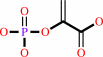 phosphoenolpyruvate
|
=
|
5-O-(1-carboxyvinyl)-3- phosphoshikimate
Bound ligand (Het Group name = )
matches with 76.19% similarity
|
+
|
 phosphate
|
|
|
|
|
|
|
|
|
|
|
|
|
Molecule diagrams generated from .mol files obtained from the
KEGG ftp site
|
|
|
|
|
|
|
|
|
|
|
|
|
|
 |
|
|
|
|
|
|
| |
|
|
| |
|
DOI no:
|
Proc Natl Acad Sci U S A
103:13010-13015
(2006)
|
|
PubMed id:
|
|
|
|
|
|
| |
|
Molecular basis for the herbicide resistance of Roundup Ready crops.
|
|
T.Funke,
H.Han,
M.L.Healy-Fried,
M.Fischer,
E.Schönbrunn.
|
|
|
|
|
| |
ABSTRACT
|
|
|
|
| |
|
|
The engineering of transgenic crops resistant to the broad-spectrum herbicide
glyphosate has greatly improved agricultural efficiency worldwide.
Glyphosate-based herbicides, such as Roundup, target the shikimate pathway
enzyme 5-enolpyruvylshikimate 3-phosphate (EPSP) synthase, the functionality of
which is absolutely required for the survival of plants. Roundup Ready plants
carry the gene coding for a glyphosate-insensitive form of this enzyme, obtained
from Agrobacterium sp. strain CP4. Once incorporated into the plant genome, the
gene product, CP4 EPSP synthase, confers crop resistance to glyphosate. Although
widely used, the molecular basis for this glyphosate-resistance has remained
obscure. We generated a synthetic gene coding for CP4 EPSP synthase and
characterized the enzyme using kinetics and crystallography. The CP4 enzyme has
unexpected kinetic and structural properties that render it unique among the
known EPSP synthases. Glyphosate binds to the CP4 EPSP synthase in a condensed,
noninhibitory conformation. Glyphosate sensitivity can be restored through a
single-site mutation in the active site (Ala-100-Gly), allowing glyphosate to
bind in its extended, inhibitory conformation.
|
|
|
|
|
|
| |
Selected figure(s)
|
|
|
|
| |
|
|

|
|

|
|
Figure 2.
Fig. 2. Three-dimensional structure of CP4 EPSP synthase.
(A) (Left) Unliganded CP4 EPSP synthase exists in an open
conformation. (Right) Upon interaction with S3P, the enzyme
undergoes a large conformational change to a closed state. Shown
in orange is a loop spanning residues 347–358, which is highly
flexible in the open conformation but becomes ordered in the
closed conformation. This loop contains the strictly conserved
EPSP synthase residues Glu-354 and Arg-357, which are involved
in PEP/glyphosate binding. Monovalent cations may influence the
conformation of this loop and facilitate binding of PEP. (B)
Stereoview showing that, in the binary complex, S3P (yellow)
binds to the enzyme residues shown in magenta through multiple
hydrogen-bonding/electrostatic interactions (black dotted
lines). In addition, the cyclohexene moiety of S3P is sandwiched
between Arg-200 and Gln-175. Residues shown in light blue
constitute the PEP/glyphosate binding site. Attracted by the
accumulation of positive charges, a sulfate ion (shown in green)
from the crystallization solution binds to the space occupied by
the phosphate moiety of PEP or the phosphonate moiety of
glyphosate in either ternary complex. Water molecules are shown
as cyan spheres.
|
|
Figure 4.
Fig. 4. Two distinct conformations of glyphosate. Displayed
are the electron densities, contoured at 3  , derived from 1F[o]
– 1F[c] Fourier syntheses to 1.7-Å resolution, omitting
the model of glyphosate during the refinement of the ternary
complexes of CP4 EPSP synthase (Left) and Ala-100–Gly CP4 EPSP
synthase (Right). (Right) The conformation of glyphosate upon
interaction with the Ala-100–Gly CP4 EPSP synthase is
identical to the one observed in the E. coli or Str. pneumoniae
enzymes. (Left) With an Ala residue in position 100, the
glyphosate molecule is , derived from 1F[o]
– 1F[c] Fourier syntheses to 1.7-Å resolution, omitting
the model of glyphosate during the refinement of the ternary
complexes of CP4 EPSP synthase (Left) and Ala-100–Gly CP4 EPSP
synthase (Right). (Right) The conformation of glyphosate upon
interaction with the Ala-100–Gly CP4 EPSP synthase is
identical to the one observed in the E. coli or Str. pneumoniae
enzymes. (Left) With an Ala residue in position 100, the
glyphosate molecule is  0.6 Å shorter,
mainly because of a rotation around the C 0.6 Å shorter,
mainly because of a rotation around the C  4
N bond next to the carboxyl group. 4
N bond next to the carboxyl group.
|
|
|
|
| |
Figures were
selected
by an automated process.
|
|
|
|
|
|
|
|
|
|
|
|
|
|
|
|
 |
 |
 |
|
Literature references that cite this PDB file's key reference
|
|
|
| |
PubMed id
|
|
Reference
|
|
|
|
|
|
J.Barriuso,
S.Marín,
and
R.P.Mellado
(2010).
Effect of the herbicide glyphosate on glyphosate-tolerant maize rhizobacterial communities: a comparison with pre-emergency applied herbicide consisting of a combination of acetochlor and terbuthylazine.
|
| |
Environ Microbiol,
12,
1021-1030.
|
|
|
|
|
|
|
Y.S.Tian,
A.S.Xiong,
J.Xu,
W.Zhao,
F.Gao,
X.Y.Fu,
H.Xu,
J.L.Zheng,
R.H.Peng,
and
Q.H.Yao
(2010).
Isolation from Ochrobactrum anthropi of a novel class II 5-enopyruvylshikimate-3-phosphate synthase with high tolerance to glyphosate.
|
| |
Appl Environ Microbiol,
76,
6001-6005.
|
|
|
|
|
|
|
M.Pedotti,
E.Rosini,
G.Molla,
T.Moschetti,
C.Savino,
B.Vallone,
and
L.Pollegioni
(2009).
Glyphosate resistance by engineering the flavoenzyme glycine oxidase.
|
| |
J Biol Chem,
284,
36415-36423.
|
|
|
|
|
|
|
T.Funke,
Y.Yang,
H.Han,
M.Healy-Fried,
S.Olesen,
A.Becker,
and
E.Schönbrunn
(2009).
Structural basis of glyphosate resistance resulting from the double mutation Thr97 -> Ile and Pro101 -> Ser in 5-enolpyruvylshikimate-3-phosphate synthase from Escherichia coli.
|
| |
J Biol Chem,
284,
9854-9860.
|
|
|
PDB codes:
|
|
|
|
|
|
|
|
D.I.Gustafson
(2008).
Sustainable use of glyphosate in North American cropping systems.
|
| |
Pest Manag Sci,
64,
409-416.
|
|
|
|
|
|
|
G.Forlani,
M.Pavan,
M.Gramek,
P.Kafarski,
and
J.Lipok
(2008).
Biochemical bases for a widespread tolerance of cyanobacteria to the phosphonate herbicide glyphosate.
|
| |
Plant Cell Physiol,
49,
443-456.
|
|
|
|
|
|
|
D.Jin,
W.Lu,
S.Ping,
W.Zhang,
J.Chen,
B.Dun,
R.Ma,
Z.Zhao,
J.Sha,
L.Li,
Z.Yang,
M.Chen,
and
M.Lin
(2007).
Identification of a new gene encoding EPSPs with high glyphosate resistance from the metagenomic library.
|
| |
Curr Microbiol,
55,
350-355.
|
|
|
|
|
|
|
M.Cai,
J.Wei,
X.Li,
C.Xu,
and
S.Wang
(2007).
A rice promoter containing both novel positive and negative cis-elements for regulation of green tissue-specific gene expression in transgenic plants.
|
| |
Plant Biotechnol J,
5,
664-674.
|
|
|
|
|
|
The most recent references are shown first.
Citation data come partly from CiteXplore and partly
from an automated harvesting procedure. Note that this is likely to be
only a partial list as not all journals are covered by
either method. However, we are continually building up the citation data
so more and more references will be included with time.
Where a reference describes a PDB structure, the PDB
codes are
shown on the right.
|
|


 Links
Links


