|
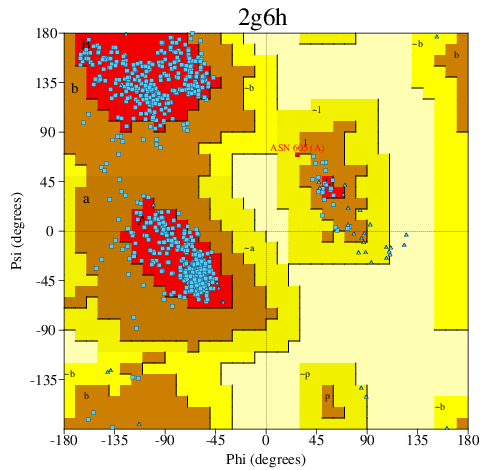
PDBsum entry 2g6h

|
|
|
|
|
|

|
|

|
|

|
|

|
|

|
|

|
|

|
|

|
|
|
 |

|

|
|
|
|
|
|
|
|
|
|
|
|
|
|
|
|
|
|
|
|
|
|
|
|
|
|
|
|
|
|
|
|
|
Oxidoreductase
|
PDB id
|
|
|
|
2g6h
|
|
|
|
|
|
|
|
|
|
|
|
|
|
|

|

|

|
|
|
|
|
|
References listed in PDB file
|
|
|
Key reference
|
|
|
Title
|
|
Structural studies of constitutive nitric oxide synthases with diatomic ligands bound.
|
|
|
Authors
|
|
H.Li,
J.Igarashi,
J.Jamal,
W.Yang,
T.L.Poulos.
|
|
|
Ref.
|
|
J Biol Inorg Chem, 2006,
11,
753-768.
|
|
|
PubMed id
|
|
|
|
|
|
Abstract
|
|
|
Crystal structures are reported for the endothelial nitric oxide synthase
(eNOS)-arginine-CO ternary complex as well as the neuronal nitric oxide synthase
(nNOS) heme domain complexed with L: -arginine and diatomic ligands, CO or NO,
in the presence of the native cofactor, tetrahydrobiopterin, or its oxidized
analogs, dihydrobiopterin and 4-aminobiopterin. The nature of the biopterin has
no influence on the diatomic ligand binding. The binding geometries of diatomic
ligands to nitric oxide synthase (NOS) follow the {MXY}(n) formalism developed
from the inorganic diatomic-metal complexes. The structures reveal some subtle
structural differences between eNOS and nNOS when CO is bound to the heme which
correlate well with the differences in CO stretching frequencies observed by
resonance Raman techniques. The detailed hydrogen-bonding geometries depicted in
the active site of nNOS structures indicate that it is the ordered active-site
water molecule rather than the substrate itself that would most likely serve as
a direct proton donor to the diatomic ligands (CO, NO, as well as O(2)) bound to
the heme. This has important implications for the oxygen activation mechanism
critical to NOS catalysis.
|
|
|
Secondary reference #1
|
|
|
Title
|
|
Crystallographic studies on endothelial nitric oxide synthase complexed with nitric oxide and mechanism-Based inhibitors.
|
|
|
Authors
|
|
H.Li,
C.S.Raman,
P.Martásek,
B.S.Masters,
T.L.Poulos.
|
|
|
Ref.
|
|
Biochemistry, 2001,
40,
5399-5406.
[DOI no: ]
|
|
|
PubMed id
|
|
|
|
|
|
|
|
|
|
|
|
|