|
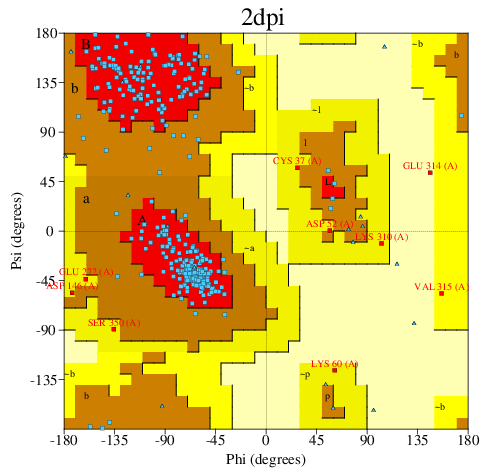
PDBsum entry 2dpi

|
|
|
|
|
|

|
|

|
|

|
|

|
|

|
|

|
|

|
|

|
|

|
|
|
 |

|

|
|
|
|
|
|
|
|
|
|
|
|
|
|
|
|
|
|
|
|
|
|
|
|
|
|
|
|
|
|
|
|
|
|
Transferase/DNA
|
PDB id
|
|
|
|
2dpi
|
|
|
|
|
|
|
|
|
|
|
|
|
|
|

|

|

|
|
|
|
|
|
References listed in PDB file
|
|
|
Key reference
|
|
|
Title
|
|
Hoogsteen base pair formation promotes synthesis opposite the 1,N6-Ethenodeoxyadenosine lesion by human DNA polymerase iota.
|
|
|
Authors
|
|
D.T.Nair,
R.E.Johnson,
L.Prakash,
S.Prakash,
A.K.Aggarwal.
|
|
|
Ref.
|
|
Nat Struct Mol Biol, 2006,
13,
619-625.
[DOI no: ]
|
|
|
PubMed id
|
|
|
|
|
|
Abstract
|
|
|
The 1,N6-ethenodeoxyadenosine (epsilon dA) lesion is promutagenic and has been
implicated in carcinogenesis. We show here that human Pol iota, a Y-family DNA
polymerase, can promote replication through this lesion by proficiently
incorporating a nucleotide opposite it. The structural basis of this action is
rotation of the epsilon dA adduct to the syn conformation in the Pol iota active
site and presentation of its 'Hoogsteen edge' for hydrogen-bonding with incoming
dTTP or dCTP. We also show that Pol zeta carries out the subsequent extension
reaction and that efficiency of extension from epsilon dA x T is notably higher
than from epsilon dA x C. Together, our studies reveal for the first time how
the exocyclic epsilon dA adduct is accommodated in a DNA polymerase active site,
and they show that the combined action of Pol iota and Pol zeta provides for
efficient and error-free synthesis through this potentially carcinogenic DNA
lesion.
|
|
|
|

|
|

|
|
Figure 1.
Figure 1. Hoogsteen pairing of  dA
with T or C. (a) Chemical structures of A and dA
with T or C. (a) Chemical structures of A and  dA.
(b) Hoogsteen base pair of syn-A in syn with anti-T or anti-C.
Jagged line represents steric clash between the N6 group of A
and the N4 of C. (c) Hoogsteen base pair of dA
with T or C. Dotted lines represent hydrogen bonds and R denotes
the sugar moiety. dA.
(b) Hoogsteen base pair of syn-A in syn with anti-T or anti-C.
Jagged line represents steric clash between the N6 group of A
and the N4 of C. (c) Hoogsteen base pair of dA
with T or C. Dotted lines represent hydrogen bonds and R denotes
the sugar moiety.
|
|
Figure 5.
Figure 5. Primer extension by Pol  and
Pol and
Pol  from
T or C opposite the dA
adduct. DNA substrate is shown above; asterisk indicates the
site of either an A or an dA
residue in the template; Y at the primer terminus denotes either
T or C opposite the undamaged A or the dA
template residue. Each protein (1 nM) was incubated with DNA
substrate (10 nM) and all four dNTPs (50 from
T or C opposite the dA
adduct. DNA substrate is shown above; asterisk indicates the
site of either an A or an dA
residue in the template; Y at the primer terminus denotes either
T or C opposite the undamaged A or the dA
template residue. Each protein (1 nM) was incubated with DNA
substrate (10 nM) and all four dNTPs (50  M). M).
|
|
|
|
|
|
The above figures are
reprinted
by permission from Macmillan Publishers Ltd:
Nat Struct Mol Biol
(2006,
13,
619-625)
copyright 2006.
|
|
|
|
|
|
|