|
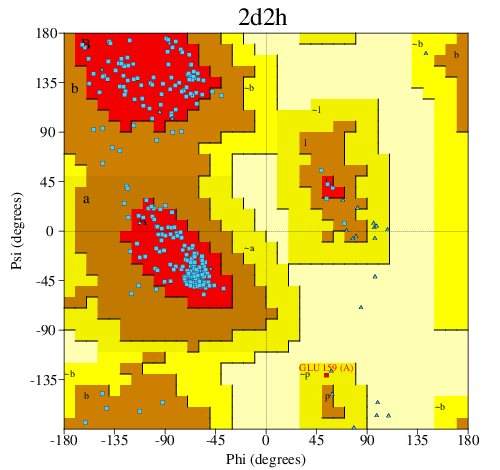
PDBsum entry 2d2h
|
|
|
|
References listed in PDB file
|
 |
|
Key reference
|
|
|
Title
|
|
The structure of an enzyme-Product complex reveals the critical role of a terminal hydroxide nucleophile in the bacterial phosphotriesterase mechanism.
|
|
|
Authors
|
|
C.Jackson,
H.K.Kim,
P.D.Carr,
J.W.Liu,
D.L.Ollis.
|
|
|
Ref.
|
|
Biochim Biophys Acta, 2005,
1752,
56-64.
|
|
|
PubMed id
|
|
|
|
|
|
Abstract
|
|
|
A detailed understanding of the catalytic mechanism of enzymes is an important
step toward improving their activity for use in biotechnology. In this paper,
crystal soaking experiments and X-ray crystallography were used to analyse the
mechanism of the Agrobacterium radiobacter phosphotriesterase, OpdA, an enzyme
capable of detoxifying a broad range of organophosphate pesticides. The
structures of OpdA complexed with ethylene glycol and the product of dimethoate
hydrolysis, dimethyl thiophosphate, provide new details of the catalytic
mechanism. These structures suggest that the attacking nucleophile is a
terminally bound hydroxide, consistent with the catalytic mechanism of other
binuclear metallophosphoesterases. In addition, a crystal structure with the
potential substrate trimethyl phosphate bound non-productively demonstrates the
importance of the active site cavity in orienting the substrate into an
approximation of the transition state.
|
|
|
|
|
|
|