|
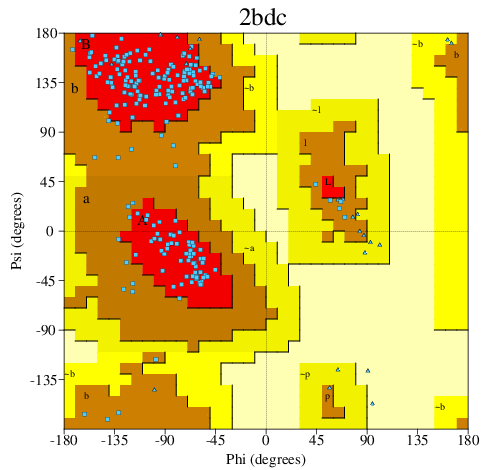
PDBsum entry 2bdc
|
|
|
|
References listed in PDB file
|
 |
|
Key reference
|
|
|
Title
|
|
Structural analyses on intermediates in serine protease catalysis.
|
|
|
Authors
|
|
B.Liu,
C.J.Schofield,
R.C.Wilmouth.
|
|
|
Ref.
|
|
J Biol Chem, 2006,
281,
24024-24035.
[DOI no: ]
|
|
|
PubMed id
|
|
|
|
|
|
|
|
|
Abstract
|
|
|
Although the subject of many studies, detailed structural information on aspects
of the catalytic cycle of serine proteases is lacking. Crystallographic analyses
were performed in which an acyl-enzyme complex, formed from elastase and a
peptide, was reacted with a series of nucleophilic dipeptides. Multiple analyses
led to electron density maps consistent with the formation of a tetrahedral
species. In certain cases, apparent peptide bond formation at the active site
was observed, and the electron density maps suggested production of a cis-amide
rather than a trans-amide. Evidence for a cis-amide configuration was also
observed in the noncovalent complex between elastase and an
alpha1-antitrypsin-derived tetrapeptide. Although there are caveats on the
relevance of the crystallographic data to solution catalysis, the results enable
detailed proposals for the pathway of the acylation step to be made. At least in
some cases, it is proposed that the alcohol of Ser-195 may preferentially attack
the carbonyl of the cis-amide form of the substrate, in a stereoelectronically
favored manner, to give a tetrahedral oxyanion intermediate, which undergoes
N-inversion and/or C-N bond rotation to enable protonation of the leaving group
nitrogen. The mechanistic proposals may have consequences for protease
inhibition, in particular for the design of high energy intermediate analogues.
|
|
|
|

|
|

|
|
Figure 3.
FIGURE 3. Stereoviews of the active site of PPE complexed
with BCM7 and different dipeptides showing the results of the pH
jump (pH 9, 30s) of the Lys-Ser structure shown in Fig. 1b (a)
and the results of the pH jumps of the Arg-Phe structure shown
in Fig. 2d (one pH jump (pH 9, 30 s) (b) and a second pH jump
(pH 9, 28 s) (c)). The color scheme and contouring levels for
the atoms and maps are as in Fig. 1a. The resolution of the
structures is 1.8, 1.7, and 1.9 Å, respectively.
|
|
Figure 5.
FIGURE 5. Two proposed forms of the first tetrahedral
intermediate (A and B) interchangeable via N-inversion and/or
rotation about the C-N bond. In A, the P1' nitrogen lone pair
projects away from His-57, and in B it projects toward it. In
intermediate B, R and R' refer to either hydrogen or the P1'
residue, depending on whether N-inversion has occurred. The
amide nitrogen of Ser-195, which forms part of the oxyanion
hole, is not shown for clarity; from the viewpoint shown, it
lies behind the plane of the picture. Note that steric
constraints mean that the conformation in which the nitrogen
lone pair is exactly coplanar with the C-O(Ser-195) bond is
unlikely.
|
|
|
|
|
|
The above figures are
reprinted
by permission from the ASBMB:
J Biol Chem
(2006,
281,
24024-24035)
copyright 2006.
|
|
|
Secondary reference #1
|
|
|
Title
|
|
Structure of a specific acyl-Enzyme complex formed between beta-Casomorphin-7 and porcine pancreatic elastase.
|
|
|
Authors
|
|
R.C.Wilmouth,
I.J.Clifton,
C.V.Robinson,
P.L.Roach,
R.T.Aplin,
N.J.Westwood,
J.Hajdu,
C.J.Schofield.
|
|
|
Ref.
|
|
Nat Struct Biol, 1997,
4,
456-462.
|
|
|
PubMed id
|
|
|
|
|
|
|
|
|
Secondary reference #2
|
|
|
Title
|
|
X-Ray snapshots of serine protease catalysis reveal a tetrahedral intermediate.
|
|
|
Authors
|
|
R.C.Wilmouth,
K.Edman,
R.Neutze,
P.A.Wright,
I.J.Clifton,
T.R.Schneider,
C.J.Schofield,
J.Hajdu.
|
|
|
Ref.
|
|
Nat Struct Biol, 2001,
8,
689-694.
[DOI no: ]
|
|
|
PubMed id
|
|
|
|
|
|
|
|
|
|

|
|

|
|
Figure 3.
Figure 3. Isotropic temperature factors in the acyl -enzyme
complex and in the tetrahedral intermediate (b) formed between
porcine pancreatic elastase and human  -casomorphin-7.
a, B-factors for the structure in Fig. 1a, where the PPE
-BCM7 acyl -enzyme complex is stabilized at pH 5. Three
N-terminal residues are disordered. b, B-factors for the
structure of the tetrahedral intermediate in Fig. 1c. This
structure was obtained in a freeze-quenched crystal following a
1 min long pH jump to pH 9. For data collection and refinement
statistics, see Table 1. -casomorphin-7.
a, B-factors for the structure in Fig. 1a, where the PPE
-BCM7 acyl -enzyme complex is stabilized at pH 5. Three
N-terminal residues are disordered. b, B-factors for the
structure of the tetrahedral intermediate in Fig. 1c. This
structure was obtained in a freeze-quenched crystal following a
1 min long pH jump to pH 9. For data collection and refinement
statistics, see Table 1.
|
|
Figure 4.
Figure 4. Structural changes within the peptide binding pocket
during catalysis. a, The active site cleft showing the
location of the peptide substrate (pink) in the acyl -enzyme
complex at pH 5. The enzyme is shown as a gray space filling
model with Ser 195 (green), His 57 (purple) and Asp 102 (brown)
highlighted. b, Model of the protein -peptide complex at pH 5
(pink) overlaid with the model of the tetrahedral intermediate
(blue) (see Methods) . A circle highlights the active site Ser
residue under the bound peptide. Both Wat 318 and hydrogen bonds
between enzyme and peptide are red in the acyl -enzyme complex
and blue in the tetrahedral intermediate. During product
release, the loop formed by residues 217 -219 (immediately below
the binding pocket) moves so as to partially fill a space
previously occupied by the peptide. Arg 217 takes up a position
similar to that found in the native unliganded structure (1QNJ)5.
|
|
|
|
|
|
The above figures are
reproduced from the cited reference
with permission from Macmillan Publishers Ltd
|
|
|
Secondary reference #3
|
|
|
Title
|
|
X-Ray structure of a serine protease acyl-Enzyme complex at 0.95-A resolution.
|
|
|
Authors
|
|
G.Katona,
R.C.Wilmouth,
P.A.Wright,
G.I.Berglund,
J.Hajdu,
R.Neutze,
C.J.Schofield.
|
|
|
Ref.
|
|
J Biol Chem, 2002,
277,
21962-21970.
[DOI no: ]
|
|
|
PubMed id
|
|
|
|
|
|
|
|
|
|

|
|

|
|
Figure 1.
Fig. 1. Structure and electron density for the
acyl-intermediate near the substrate binding cleft at 0.
95-Å resolution. A, 2F[obs]  F[calc]
electron density map contoured to 1.7 F[calc]
electron density map contoured to 1.7  (blue) and
4.0 (gold).
The blue contour level was chosen such that atoms with 60%
occupancy become visible in the active site. The structural
model for the enzyme moiety is green, with the exception of the
oxygen and nitrogen atoms of the catalytic histidine and serine,
which are colored red and blue, respectively. The acyl-peptide
moiety is colored orange. B, least square superposition of the
0.95-Å acyl-intermediate structure (cyan) and the
1.1-Å native elastase structure (green). (blue) and
4.0 (gold).
The blue contour level was chosen such that atoms with 60%
occupancy become visible in the active site. The structural
model for the enzyme moiety is green, with the exception of the
oxygen and nitrogen atoms of the catalytic histidine and serine,
which are colored red and blue, respectively. The acyl-peptide
moiety is colored orange. B, least square superposition of the
0.95-Å acyl-intermediate structure (cyan) and the
1.1-Å native elastase structure (green).
|
|
Figure 2.
Fig. 2. Detailed view of the ester bond and the oxy-anion
hole. A, stereo representation illustrating the degree of
pyramidal distortion of the ester bond. The transparent plane
passes through the carbonyl oxygen of the ester bond, the C[
 ]of
Ile-7, and O[ ]of
Ile-7, and O[  ]of
Ser-195. The displacement of the carbonyl carbon of the ester
bond from this plane is 0.05 Å. B, ball-and-stick
representation of the enzymatic ester bond within the oxy-anion
hole. The naming convention in Table III is used to identify
atoms. C, ball-and-stick representation of the ethyl-acetate
structure, providing an example of a small molecular ester. ]of
Ser-195. The displacement of the carbonyl carbon of the ester
bond from this plane is 0.05 Å. B, ball-and-stick
representation of the enzymatic ester bond within the oxy-anion
hole. The naming convention in Table III is used to identify
atoms. C, ball-and-stick representation of the ethyl-acetate
structure, providing an example of a small molecular ester.
|
|
|
|
|
|
The above figures are
reproduced from the cited reference
with permission from the ASBMB
|
|
|
|
|
|
|