The seven serologically distinct Clostridium botulinum neurotoxins (BoNTs A-G)
are zinc endopeptidases which block the neurotransmitter release by cleaving one
of the three proteins of the soluble N-ethylmaleimide-sensitive-factor
attachment protein receptor complex (SNARE complex) essential for the fusion of
vesicles containing neurotransmitters with target membranes. These
metallopeptidases exhibit unique specificity for the substrates and peptide
bonds they cleave. Development of countermeasures and therapeutics for BoNTs is
a priority because of their extreme toxicity and potential misuse as biowarfare
agents. Though they share sequence homology and structural similarity, the
structural information on each one of them is required to understand the
mechanism of action of all of them because of their specificity. Unraveling the
mechanism will help in the ultimate goal of developing inhibitors as
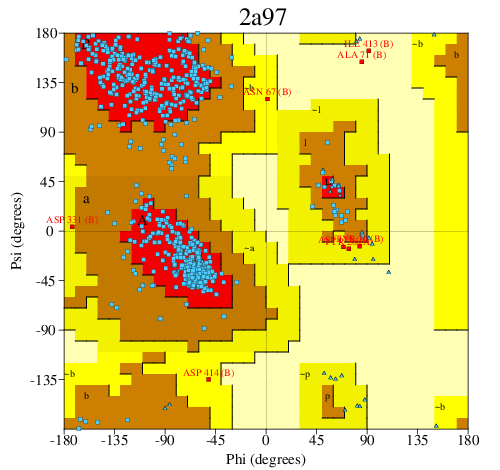
antibotulinum drugs for the toxins. Here, we report the high-resolution
structure of active BoNT/F catalytic domain in two crystal forms. The structure
was exploited for modeling the substrate binding and identifying the S1' subsite
and the putative exosites which are different from BoNT/A or BoNT/B. The
orientation of docking of the substrate at the active site is consistent with
the experimental BoNT/A-LC:SNAP-25 peptide model and our proposed model for
BoNT/E-LC:SNAP-25.