 |
PDBsum entry 1z48

|
|
|
|
|
|

|

|

|

|
|

|
|

|
|

|
|

|
|

|
|

|
|
|
 |

|

|
|
|
|
|
|
|
|
|
|
|
|
|
|
|
|
|
|
|
|
|
|
|
|
|
|
|
|
|
|
|
|
|
|
|
Oxidoreductase
|
PDB id
|
|
|
|
1z48
|
|
|
|
|
|
|
|
|
|
|
|
|
|
|

|

|

|
|
|
|
|
|
|
|
 |
Contents |
 |
|
|
|
|
|
|
|
|
|
|
|
|
* Residue conservation analysis
|
|
|
|
|
|
|
|
|
|
|
Enzyme class:
|
|
E.C.1.6.99.1
- Nadph dehydrogenase.
|
|
|
|
|
|
|
Reaction:
|
|
A + NADPH + H+ = AH2 + NADP+
|
|
|
|
|
|
|
+
|
 NADPH
NADPH
|
+
|
H(+)
|
=
|
AH2
|
+
|
 NADP(+)
|
|
|
|
|
|
|
|
|
|
Cofactor:
|
|
FMN or FAD
|
|
|
|
|
|
FMN
Bound ligand (Het Group name =
FMN)
corresponds exactly
|
or
|
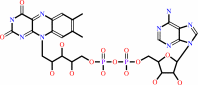 FAD
FAD
|
|
|
|
|
|
|
Molecule diagrams generated from .mol files obtained from the
KEGG ftp site
|
|
|
|
|
|
|
|
|
|
|
|
|
|
 |
|
|
|
|
|
|
| |
|
|
| |
|
DOI no:
|
J Biol Chem
280:27904-27913
(2005)
|
|
PubMed id:
|
|
|
|
|
|
| |
|
The 1.3 A crystal structure of the flavoprotein YqjM reveals a novel class of Old Yellow Enzymes.
|
|
K.Kitzing,
T.B.Fitzpatrick,
C.Wilken,
J.Sawa,
G.P.Bourenkov,
P.Macheroux,
T.Clausen.
|
|
|
|
|
| |
ABSTRACT
|
|
|
|
| |
|
|
Here we report the crystal structure of YqjM, a homolog of Old Yellow Enzyme
(OYE) that is involved in the oxidative stress response of Bacillus subtilis. In
addition to the oxidized and reduced enzyme form, the structures of complexes
with p-hydroxybenzaldehyde and p-nitrophenol, respectively, were solved. As for
other OYE family members, YqjM folds into a (alpha/beta)8-barrel and has one
molecule of flavin mononucleotide bound non-covalently at the COOH termini of
the beta-sheet. Most of the interactions that control the electronic properties
of the flavin mononucleotide cofactor are conserved within the OYE family.
However, in contrast to all members of the OYE family characterized to date,
YqjM exhibits several unique structural features. For example, the enzyme exists
as a homotetramer that is assembled as a dimer of catalytically dependent
dimers. Moreover, the protein displays a shared active site architecture where
an arginine finger (Arg336) at the COOH terminus of one monomer extends into the
active site of the adjacent monomer and is directly involved in substrate
recognition. Another remarkable difference in the binding of the ligand in YqjM
is represented by the contribution of the NH2-terminal Tyr28 instead of a
COOH-terminal tyrosine in OYE and its homologs. The structural information led
to a specific data base search from which a new class of OYE oxidoreductases was
identified that exhibits a strict conservation of active site residues, which
are critical for this subfamily, most notably Cys26, Tyr28, Lys109, and Arg336.
Therefore, YqjM is the first representative of a new bacterial subfamily of OYE
homologs.
|
|
|
|
|
|
| |
Selected figure(s)
|
|
|
|
| |
|
|

|
|

|
|
Figure 3.
FIG. 3. The flavin binding site. A, stereo view of the
flavin binding site. The final 1.3 Å resolution 2F[o] -
F[c] map is contoured at 1.5  . The flavin and the
side chains of the amino acids are drawn in ball-and-stick mode,
with FMN in yellow and the residues from monomer A in gray and
from the neighboring monomer B in violet. B, schematic
illustration of the interaction of FMN with active site
residues. The thin red dotted lines illustrate hydrogen bonds. . The flavin and the
side chains of the amino acids are drawn in ball-and-stick mode,
with FMN in yellow and the residues from monomer A in gray and
from the neighboring monomer B in violet. B, schematic
illustration of the interaction of FMN with active site
residues. The thin red dotted lines illustrate hydrogen bonds.
|
|
Figure 4.
FIG. 4. Electron density map of Cys26 and Tyr28 in the
active site. The 3F[o] - 2F[c] map is contoured at 1.2 . Amino
acids and FMN are presented as in Fig. 3.
|
|
|
|
|
|
| |
The above figures are
reprinted
by permission from the ASBMB:
J Biol Chem
(2005,
280,
27904-27913)
copyright 2005.
|
|
| |
Figures were
selected
by an automated process.
|
|
|
|
|
|
|
|
|
|
|
|
|
|
|
|
 |
 |
 |
|
Literature references that cite this PDB file's key reference
|
|
|
| |
PubMed id
|
|
Reference
|
|
|
|
|
|
H.S.Toogood,
A.Fryszkowska,
M.Hulley,
M.Sakuma,
D.Mansell,
G.M.Stephens,
J.M.Gardiner,
and
N.S.Scrutton
(2011).
A site-saturated mutagenesis study of pentaerythritol tetranitrate reductase reveals that residues 181 and 184 influence ligand binding, stereochemistry and reactivity.
|
| |
Chembiochem,
12,
738-749.
|
|
|
PDB codes:
|
|
|
|
|
|
|
|
K.Durchschein,
W.M.Fabian,
P.Macheroux,
K.Zangger,
G.Trimmel,
and
K.Faber
(2011).
Reductive biotransformation of nitroalkenes via nitroso-intermediates to oxazetes catalyzed by xenobiotic reductase A (XenA).
|
| |
Org Biomol Chem,
9,
3364-3369.
|
|
|
|
|
|
|
K.Tauber,
M.Hall,
W.Kroutil,
W.M.Fabian,
K.Faber,
and
S.M.Glueck
(2011).
A highly efficient ADH-coupled NADH-recycling system for the asymmetric bioreduction of carbon-carbon double bonds using enoate reductases.
|
| |
Biotechnol Bioeng,
108,
1462-1467.
|
|
|
|
|
|
|
N.Richter,
H.Gröger,
and
W.Hummel
(2011).
Asymmetric reduction of activated alkenes using an enoate reductase from Gluconobacter oxydans.
|
| |
Appl Microbiol Biotechnol,
89,
79-89.
|
|
|
|
|
|
|
B.A.Stenuit,
and
S.N.Agathos
(2010).
Microbial 2,4,6-trinitrotoluene degradation: could we learn from (bio)chemistry for bioremediation and vice versa?
|
| |
Appl Microbiol Biotechnol,
88,
1043-1064.
|
|
|
|
|
|
|
B.V.Adalbjörnsson,
H.S.Toogood,
A.Fryszkowska,
C.R.Pudney,
T.A.Jowitt,
D.Leys,
and
N.S.Scrutton
(2010).
Biocatalysis with thermostable enzymes: structure and properties of a thermophilic 'ene'-reductase related to old yellow enzyme.
|
| |
Chembiochem,
11,
197-207.
|
|
|
PDB codes:
|
|
|
|
|
|
|
|
C.Stueckler,
N.J.Mueller,
C.K.Winkler,
S.M.Glueck,
K.Gruber,
G.Steinkellner,
and
K.Faber
(2010).
Bioreduction of alpha-methylcinnamaldehyde derivatives: chemo-enzymatic asymmetric synthesis of Lilial and Helional.
|
| |
Dalton Trans,
39,
8472-8476.
|
|
|
|
|
|
|
C.Stueckler,
T.C.Reiter,
N.Baudendistel,
and
K.Faber
(2010).
Nicotinamide-independent asymmetric bioreduction of CC-bonds via disproportionation of enones catalyzed by enoate reductases.
|
| |
Tetrahedron,
66,
663-667.
|
|
|
|
|
|
|
M.E.Hulley,
H.S.Toogood,
A.Fryszkowska,
D.Mansell,
G.M.Stephens,
J.M.Gardiner,
and
N.S.Scrutton
(2010).
Focused directed evolution of pentaerythritol tetranitrate reductase by using automated anaerobic kinetic screening of site-saturated libraries.
|
| |
Chembiochem,
11,
2433-2447.
|
|
|
PDB codes:
|
|
|
|
|
|
|
|
S.Ehira,
H.Teramoto,
M.Inui,
and
H.Yukawa
(2010).
A novel redox-sensing transcriptional regulator CyeR controls expression of an Old Yellow Enzyme family protein in Corynebacterium glutamicum.
|
| |
Microbiology,
156,
1335-1341.
|
|
|
|
|
|
|
Y.Yanto,
H.H.Yu,
M.Hall,
and
A.S.Bommarius
(2010).
Characterization of xenobiotic reductase A (XenA): study of active site residues, substrate spectrum and stability.
|
| |
Chem Commun (Camb),
46,
8809-8811.
|
|
|
|
|
|
|
A.Taglieber,
F.Schulz,
F.Hollmann,
M.Rusek,
and
M.T.Reetz
(2008).
Light-driven biocatalytic oxidation and reduction reactions: scope and limitations.
|
| |
Chembiochem,
9,
565-572.
|
|
|
|
|
|
|
D.J.Kang,
J.M.Ridlon,
D.R.Moore,
S.Barnes,
and
P.B.Hylemon
(2008).
Clostridium scindens baiCD and baiH genes encode stereo-specific 7alpha/7beta-hydroxy-3-oxo-delta4-cholenoic acid oxidoreductases.
|
| |
Biochim Biophys Acta,
1781,
16-25.
|
|
|
|
|
|
|
D.J.Opperman,
L.A.Piater,
and
E.van Heerden
(2008).
A novel chromate reductase from Thermus scotoductus SA-01 related to old yellow enzyme.
|
| |
J Bacteriol,
190,
3076-3082.
|
|
|
|
|
|
|
P.van Dillewijn,
R.M.Wittich,
A.Caballero,
and
J.L.Ramos
(2008).
Subfunctionality of hydride transferases of the old yellow enzyme family of flavoproteins of Pseudomonas putida.
|
| |
Appl Environ Microbiol,
74,
6703-6708.
|
|
|
|
|
|
|
H.Khan,
T.Barna,
N.C.Bruce,
A.W.Munro,
D.Leys,
and
N.S.Scrutton
(2005).
Proton transfer in the oxidative half-reaction of pentaerythritol tetranitrate reductase. Structure of the reduced enzyme-progesterone complex and the roles of residues Tyr186, His181, His184.
|
| |
FEBS J,
272,
4660-4671.
|
|
|
PDB codes:
|
|
|
|
|
|
|
The most recent references are shown first.
Citation data come partly from CiteXplore and partly
from an automated harvesting procedure. Note that this is likely to be
only a partial list as not all journals are covered by
either method. However, we are continually building up the citation data
so more and more references will be included with time.
Where a reference describes a PDB structure, the PDB
codes are
shown on the right.
|
|


 Links
Links


