|
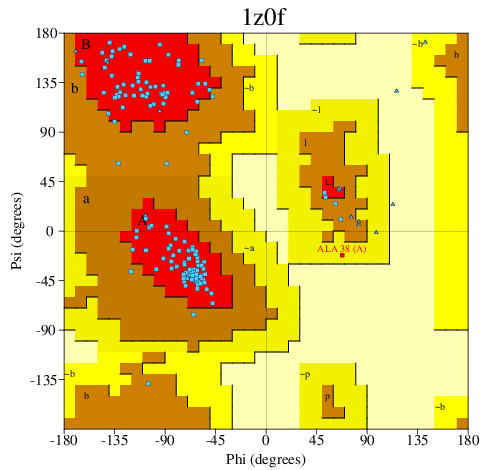
PDBsum entry 1z0f

|
|
|
|
|
|

|
|

|
|

|
|

|
|

|
|

|
|
|
 |

|

|
|
|
|
|
|
|
|
|
|
|
|
|
|
|
|
|
|
|
|
|
|
|
|
|
|
|
|
|
|
|
Protein transport
|
PDB id
|
|
|
|
1z0f
|
|
|
|
|
|
|
|
|
|
|
|
|
|
|

|

|

|
|
|
|
|
|
References listed in PDB file
|
|
|
Key reference
|
|
|
Title
|
|
Structural basis of family-Wide rab gtpase recognition by rabenosyn-5.
|
|
|
Authors
|
|
S.Eathiraj,
X.Pan,
C.Ritacco,
D.G.Lambright.
|
|
|
Ref.
|
|
Nature, 2005,
436,
415-419.
[DOI no: ]
|
|
|
PubMed id
|
|
|
|
|
|
Abstract
|
|
|
Rab GTPases regulate all stages of membrane trafficking, including vesicle
budding, cargo sorting, transport, tethering and fusion. In the inactive
(GDP-bound) conformation, accessory factors facilitate the targeting of Rab
GTPases to intracellular compartments. After nucleotide exchange to the active
(GTP-bound) conformation, Rab GTPases interact with functionally diverse
effectors including lipid kinases, motor proteins and tethering complexes. How
effectors distinguish between homologous Rab GTPases represents an unresolved
problem with respect to the specificity of vesicular trafficking. Using a
structural proteomic approach, we have determined the specificity and structural
basis underlying the interaction of the multivalent effector rabenosyn-5 with
the Rab family. The results demonstrate that even the structurally similar
effector domains in rabenosyn-5 can achieve highly selective recognition of
distinct subsets of Rab GTPases exclusively through interactions with the switch
and interswitch regions. The observed specificity is determined at a family-wide
level by structural diversity in the active conformation, which governs the
spatial disposition of critical conserved recognition determinants, and by a
small number of both positive and negative sequence determinants that allow
further discrimination between Rab GTPases with similar switch conformations.
|
|
|
|

|
|

|
|
Figure 2.
Figure 2: Quantitative family-wide analysis of Rab GTPase
-effector specificity. a, Initial screen for the interaction
of 6  His
(or GST) fusions of Rab GTPases with GST (or 6 His)
fusions of Rbsn(440 -503) and Rbsn(728 -784). For each potential
interaction, the equilibrium surface plasmon resonance signal
(R[eq]) was measured at four concentrations of the 6 His
Rab GTPase or 6 His
Rbsn construct. b, Concentration dependence of the equilibrium
surface plasmon resonance signal (R[eq]) for the binding of 6
His
Rab GTPases to GST fusions of Rbsn(440 -503) and Rbsn(728 -784).
Mean K[d] values and standard deviations for two to four
independent experiments are tabulated on the right. His
(or GST) fusions of Rab GTPases with GST (or 6 His)
fusions of Rbsn(440 -503) and Rbsn(728 -784). For each potential
interaction, the equilibrium surface plasmon resonance signal
(R[eq]) was measured at four concentrations of the 6 His
Rab GTPase or 6 His
Rbsn construct. b, Concentration dependence of the equilibrium
surface plasmon resonance signal (R[eq]) for the binding of 6
His
Rab GTPases to GST fusions of Rbsn(440 -503) and Rbsn(728 -784).
Mean K[d] values and standard deviations for two to four
independent experiments are tabulated on the right.
|
|
Figure 3.
Figure 3: Structural basis of Rab recognition by rabenosyn-5.
a, Ribbon rendering of GTP-bound Rab4(Q67L) and Rab22(Q64L) in
complex with the minimal Rab binding domains of rabenosyn-5. b,
Conservation and variability in the Rab22 -Rbsn(728 -784)
interface. Spheres covered by a semitransparent surface
represent Rab22 (left panel) or Rbsn(728 -784) (middle panel).
Hydrogen-bonding interactions are depicted in the right panel.
c, Conservation and variability in the Rab4 -Rbsn(440 -503)
interface. Spheres covered by a semitransparent surface
represent Rab4 (left panel) or Rbsn(440 -503) (middle panel).
Hydrogen-bonding interactions are depicted in the right panel.
|
|
|
|
|
|
The above figures are
reprinted
from an Open Access publication published by Macmillan Publishers Ltd:
Nature
(2005,
436,
415-419)
copyright 2005.
|
|
|
|
|
|
|