 |
PDBsum entry 1wwc

|
|
|
|
|
 |
Contents |
 |
|
|
|
|
|
|
|
|
|
|
* Residue conservation analysis
|
|
|
|
|
|
PDB id:
|
|
|
|
| Name: |
|
Transferase
|
|
|
Title:
|
|
Nt3 binding domain of human trkc receptor
|
|
Structure:
|
|
Protein (nt-3 growth factor receptor trkc). Chain: a. Fragment: ligand binding domain. Engineered: yes. Mutation: yes
|
|
Source:
|
|
Homo sapiens. Human. Organism_taxid: 9606. Expressed in: escherichia coli. Expression_system_taxid: 562
|
|
Biol. unit:
|
|
 Dimer (from
)
Dimer (from
)
|
|
Resolution:
|
|
|
1.90Å
|
R-factor:
|
0.187
|
R-free:
|
0.288
|
|
|
Authors:
|
|
M.H.Ultsch,C.Wiesmann,L.C.Simmons,J.Henrich,M.Yang,D.Reilly,S.H.Bass, A.M.De Vos
|
Key ref:

|
|
M.H.Ultsch
et al.
(1999).
Crystal structures of the neurotrophin-binding domain of TrkA, TrkB and TrkC.
J Mol Biol,
290,
149-159.
PubMed id:
DOI:

|
|
|
Date:
|
|
|
30-Apr-99
|
Release date:
|
07-Jul-99
|
|
|
|
|
|
|
PROCHECK
|

|
|
|
|
|
Headers
|
|
|
|
References
|
|
|
|
|
|

|
|
Q16288
(NTRK3_HUMAN) -
NT-3 growth factor receptor from Homo sapiens
|
|
|
|
Seq:
Struc:
|
|
|
|
839 a.a.
105 a.a.*
|
|

|

|

|
|
|
|
|
|
|
|
|
|
|
Key: |
 |
PfamA domain |
|
|
 |
Secondary structure |
|
 |
CATH domain |
|
|
*
PDB and UniProt seqs differ
at 3 residue positions (black
crosses)
|
|
|
|
|
|
|
|
|
|
|
|
|
Enzyme class:
|
|
E.C.2.7.10.1
- receptor protein-tyrosine kinase.
|
|
|
|
|
|
|
Reaction:
|
|
L-tyrosyl-[protein] + ATP = O-phospho-L-tyrosyl-[protein] + ADP + H+
|
|
|
|
|
|
L-tyrosyl-[protein]
|
+
|
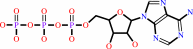 ATP
ATP
|
=
|
O-phospho-L-tyrosyl-[protein]
|
+
|
 ADP
ADP
|
+
|
H(+)
|
|
|
|
|
|
|
|
|
|
|
|
|
Molecule diagrams generated from .mol files obtained from the
KEGG ftp site
|
|
|
|
|
|
|
|
|
|
|
|
|
|
 |
|
|
|
|
|
|
| |
|
|
| |
|
DOI no:
|
J Mol Biol
290:149-159
(1999)
|
|
PubMed id:
|
|
|
|
|
|
| |
|
Crystal structures of the neurotrophin-binding domain of TrkA, TrkB and TrkC.
|
|
M.H.Ultsch,
C.Wiesmann,
L.C.Simmons,
J.Henrich,
M.Yang,
D.Reilly,
S.H.Bass,
A.M.de Vos.
|
|
|
|
|
| |
ABSTRACT
|
|
|
|
| |
|
|
The Trk receptors and their neurotrophin ligands control development and
maintenance of the nervous system. The crystal structures of the ligand binding
domain of TrkA, TrkB, and TrkC were solved and refined to high resolution. The
domains adopt an immunoglobulin-like fold, but crystallized in all three
instances as dimers with the N-terminal strand of each molecule replaced by the
same strand of a symmetry-related mate. Models of the correctly folded domains
could be constructed by changing the position of a single residue, and the
resulting model of the binding domain of TrkA is essentially identical with the
bound structure as observed in a complex with nerve growth factor. An analysis
of the existing mutagenesis data for TrkA and TrkC in light of these structures
reveals the structural reasons for the specificity among the Trk receptors, and
explains the underpinnings of the multi-functional ligands that have been
reported. The overall structure of all three domains belongs to the I-set of
immunoglobulin-like domains, but shows several unusual features, such as an
exposed disulfide bridge linking two neighboring strands in the same beta-sheet.
For all three domains, the residues that deviate from the standard fingerprint
pattern common to the I-set family fall in the region of the ligand binding site
observed in the complex. Therefore, identification of these deviations in the
sequences of other immunoglobulin-like domain-containing receptors may help to
identify their ligand binding site even in the absence of structural or
mutagenesis data.
|
|
|
|
|
|
| |
Selected figure(s)
|
|
|
|
| |
|
|

|
|

|
|
Figure 2.
Figure 2. The relationship between the artifactual
dimers and the modeled monomers. One monomer is
colored red, the other green, and the hinge segment is
shown in yellow. The residue whose position is affected
by the remodeling is shown as a green or red dot.
(a) Topology diagram of the ABED sheet observed in
the crystal structures. (b) Topology of the ABED sheet
after remodeling the AB loop.
|
|
Figure 3.
Figure 3. Models of the ligand-
binding domain of the Trk recep-
tors compared to the structure of
telokin. The b-strands are shown as
green arrows and labeled in TrkA-
d5 and telokin, a helical segment is
depicted as a red ribbon, and loops
are colored yellow and labeled in
TrkB-d5 and TrkC-d5. The exposed
disulfide bridge connecting strands
B and E in the Trk receptors is
shown in ball-and-stick rendering.
(a) TrkA-d5; (b) TrkB-d5; (c) TrkC-
d5; (d) telokin, with the cysteine
residues that usually (but not in tel-
okin) form a buried disulfide bond
shown in ball-and-stick rendering.
|
|
|
|
|
|
| |
The above figures are
reprinted
by permission from Elsevier:
J Mol Biol
(1999,
290,
149-159)
copyright 1999.
|
|
| |
Figures were
selected
by an automated process.
|
|
|
|
|
|
|
|
|
|
|
|
|
|
|
|
 |
 |
 |
|
Literature references that cite this PDB file's key reference
|
|
|
| |
PubMed id
|
|
Reference
|
|
|
|
|
|
G.Niewiadomska,
A.Mietelska-Porowska,
and
M.Mazurkiewicz
(2011).
The cholinergic system, nerve growth factor and the cytoskeleton.
|
| |
Behav Brain Res,
221,
515-526.
|
|
|
|
|
|
|
J.L.Baeza,
M.A.Bonache,
M.T.García-López,
R.González-Muñiz,
and
M.Martín-Martínez
(2010).
2-alkyl-2-carboxyazetidines as γ-turn inducers: incorporation into neurotrophin fragments.
|
| |
Amino Acids,
39,
1299-1307.
|
|
|
|
|
|
|
M.A.Wouters,
S.W.Fan,
and
N.L.Haworth
(2010).
Disulfides as redox switches: from molecular mechanisms to functional significance.
|
| |
Antioxid Redox Signal,
12,
53-91.
|
|
|
|
|
|
|
J.Bouvier,
S.Autran,
N.Dehorter,
D.M.Katz,
J.Champagnat,
G.Fortin,
and
M.Thoby-Brisson
(2008).
Brain-derived neurotrophic factor enhances fetal respiratory rhythm frequency in the mouse preBötzinger complex in vitro.
|
| |
Eur J Neurosci,
28,
510-520.
|
|
|
|
|
|
|
J.J.Watson,
S.J.Allen,
and
D.Dawbarn
(2008).
Targeting nerve growth factor in pain: what is the therapeutic potential?
|
| |
BioDrugs,
22,
349-359.
|
|
|
|
|
|
|
N.Pinotsis,
S.Lange,
J.C.Perriard,
D.I.Svergun,
and
M.Wilmanns
(2008).
Molecular basis of the C-terminal tail-to-tail assembly of the sarcomeric filament protein myomesin.
|
| |
EMBO J,
27,
253-264.
|
|
|
PDB code:
|
|
|
|
|
|
|
|
S.Posy,
L.Shapiro,
and
B.Honig
(2008).
Sequence and structural determinants of strand swapping in cadherin domains: do all cadherins bind through the same adhesive interface?
|
| |
J Mol Biol,
378,
954-968.
|
|
|
|
|
|
|
V.Freund-Michel,
and
N.Frossard
(2008).
The nerve growth factor and its receptors in airway inflammatory diseases.
|
| |
Pharmacol Ther,
117,
52-76.
|
|
|
|
|
|
|
L.Ivanisevic,
W.Zheng,
S.B.Woo,
K.E.Neet,
and
H.U.Saragovi
(2007).
TrkA receptor "hot spots" for binding of NT-3 as a heterologous ligand.
|
| |
J Biol Chem,
282,
16754-16763.
|
|
|
|
|
|
|
X.Chen,
T.D.Kim,
C.V.Carman,
L.Z.Mi,
G.Song,
and
T.A.Springer
(2007).
Structural plasticity in Ig superfamily domain 4 of ICAM-1 mediates cell surface dimerization.
|
| |
Proc Natl Acad Sci U S A,
104,
15358-15363.
|
|
|
PDB code:
|
|
|
|
|
|
|
|
F.Ding,
K.C.Prutzman,
S.L.Campbell,
and
N.V.Dokholyan
(2006).
Topological determinants of protein domain swapping.
|
| |
Structure,
14,
5.
|
|
|
|
|
|
|
L.F.Reichardt
(2006).
Neurotrophin-regulated signalling pathways.
|
| |
Philos Trans R Soc Lond B Biol Sci,
361,
1545-1564.
|
|
|
|
|
|
|
M.Berrera,
A.Cattaneo,
and
P.Carloni
(2006).
Molecular simulation of the binding of nerve growth factor peptide mimics to the receptor tyrosine kinase A.
|
| |
Biophys J,
91,
2063-2071.
|
|
|
|
|
|
|
A.Merlino,
M.A.Ceruso,
L.Vitagliano,
and
L.Mazzarella
(2005).
Open interface and large quaternary structure movements in 3D domain swapped proteins: insights from molecular dynamics simulations of the C-terminal swapped dimer of ribonuclease A.
|
| |
Biophys J,
88,
2003-2012.
|
|
|
|
|
|
|
M.C.Zaccaro,
H.B.Lee,
M.Pattarawarapan,
Z.Xia,
A.Caron,
P.J.L'Heureux,
Y.Bengio,
K.Burgess,
and
H.U.Saragovi
(2005).
Selective small molecule peptidomimetic ligands of TrkC and TrkA receptors afford discrete or complete neurotrophic activities.
|
| |
Chem Biol,
12,
1015-1028.
|
|
|
|
|
|
|
S.Beltaifa,
M.J.Webster,
D.L.Ligons,
R.J.Fatula,
M.M.Herman,
J.E.Kleinman,
and
C.S.Weickert
(2005).
Discordant changes in cortical TrkC mRNA and protein during the human lifespan.
|
| |
Eur J Neurosci,
21,
2433-2444.
|
|
|
|
|
|
|
S.Covaceuszach,
A.Cattaneo,
and
D.Lamba
(2005).
Neutralization of NGF-TrkA receptor interaction by the novel antagonistic anti-TrkA monoclonal antibody MNAC13: a structural insight.
|
| |
Proteins,
58,
717-727.
|
|
|
PDB code:
|
|
|
|
|
|
|
|
G.S.Yeo,
C.C.Connie Hung,
J.Rochford,
J.Keogh,
J.Gray,
S.Sivaramakrishnan,
S.O'Rahilly,
and
I.S.Farooqi
(2004).
A de novo mutation affecting human TrkB associated with severe obesity and developmental delay.
|
| |
Nat Neurosci,
7,
1187-1189.
|
|
|
|
|
|
|
D.A.Calarese,
C.N.Scanlan,
M.B.Zwick,
S.Deechongkit,
Y.Mimura,
R.Kunert,
P.Zhu,
M.R.Wormald,
R.L.Stanfield,
K.H.Roux,
J.W.Kelly,
P.M.Rudd,
R.A.Dwek,
H.Katinger,
D.R.Burton,
and
I.A.Wilson
(2003).
Antibody domain exchange is an immunological solution to carbohydrate cluster recognition.
|
| |
Science,
300,
2065-2071.
|
|
|
PDB codes:
|
|
|
|
|
|
|
|
E.J.Huang,
and
L.F.Reichardt
(2003).
Trk receptors: roles in neuronal signal transduction.
|
| |
Annu Rev Biochem,
72,
609-642.
|
|
|
|
|
|
|
R.A.Segal
(2003).
Selectivity in neurotrophin signaling: theme and variations.
|
| |
Annu Rev Neurosci,
26,
299-330.
|
|
|
|
|
|
|
Y.Liu,
and
D.Eisenberg
(2002).
3D domain swapping: as domains continue to swap.
|
| |
Protein Sci,
11,
1285-1299.
|
|
|
|
|
|
|
A.Patapoutian,
and
L.F.Reichardt
(2001).
Trk receptors: mediators of neurotrophin action.
|
| |
Curr Opin Neurobiol,
11,
272-280.
|
|
|
|
|
|
|
E.J.Huang,
and
L.F.Reichardt
(2001).
Neurotrophins: roles in neuronal development and function.
|
| |
Annu Rev Neurosci,
24,
677-736.
|
|
|
|
|
|
|
M.G.Murer,
Q.Yan,
and
R.Raisman-Vozari
(2001).
Brain-derived neurotrophic factor in the control human brain, and in Alzheimer's disease and Parkinson's disease.
|
| |
Prog Neurobiol,
63,
71.
|
|
|
|
|
|
|
M.J.Banfield,
R.L.Naylor,
A.G.Robertson,
S.J.Allen,
D.Dawbarn,
and
R.L.Brady
(2001).
Specificity in Trk receptor:neurotrophin interactions: the crystal structure of TrkB-d5 in complex with neurotrophin-4/5.
|
| |
Structure,
9,
1191-1199.
|
|
|
PDB code:
|
|
|
|
|
|
|
|
M.Rattray
(2001).
Is there nicotinic modulation of nerve growth factor? Implications for cholinergic therapies in Alzheimer's disease.
|
| |
Biol Psychiatry,
49,
185-193.
|
|
|
|
|
|
|
S.Covaceuszach,
A.Cattaneo,
and
D.Lamba
(2001).
Purification, crystallization and preliminary X-ray analysis of the Fab fragment from MNAC13, a novel antagonistic anti-tyrosine kinase A receptor monoclonal antibody.
|
| |
Acta Crystallogr D Biol Crystallogr,
57,
1307-1309.
|
|
|
|
|
|
|
J.C.Arevalo,
B.Conde,
B.L.Hempstead,
M.V.Chao,
D.Martin-Zanca,
and
P.Perez
(2000).
TrkA immunoglobulin-like ligand binding domains inhibit spontaneous activation of the receptor.
|
| |
Mol Cell Biol,
20,
5908-5916.
|
|
|
|
|
|
|
L.O'Connell,
J.A.Hongo,
L.G.Presta,
and
P.Tsoulfas
(2000).
TrkA amino acids controlling specificity for nerve growth factor.
|
| |
J Biol Chem,
275,
7870-7877.
|
|
|
|
|
|
|
M.C.Deller,
and
E.Yvonne Jones
(2000).
Cell surface receptors.
|
| |
Curr Opin Struct Biol,
10,
213-219.
|
|
|
|
|
|
The most recent references are shown first.
Citation data come partly from CiteXplore and partly
from an automated harvesting procedure. Note that this is likely to be
only a partial list as not all journals are covered by
either method. However, we are continually building up the citation data
so more and more references will be included with time.
Where a reference describes a PDB structure, the PDB
code is
shown on the right.
|
|


 Links
Links


