|
PDBsum entry 1w3d

|
|
|
|
|
 |
Contents |
 |
|
|
|
|
|
|
|
|
* Residue conservation analysis
|
|
|
|
|
|
|
|
|
|
|
Enzyme class:
|
|
E.C.2.3.1.12
- dihydrolipoyllysine-residue acetyltransferase.
|
|
|
|
|
|
|
Pathway:
|
|
Oxo-acid dehydrogenase complexes
|
|
|
|
|
|
Reaction:
|
|
N6-[(R)-dihydrolipoyl]-L-lysyl-[protein] + acetyl-CoA = N6-[(R)-S(8)- acetyldihydrolipoyl]-L-lysyl-[protein] + CoA
|
|
|
|
|
|
N(6)-[(R)-dihydrolipoyl]-L-lysyl-[protein]
|
+
|
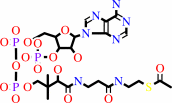 acetyl-CoA
|
=
|
N(6)-[(R)-S(8)- acetyldihydrolipoyl]-L-lysyl-[protein]
|
+
|
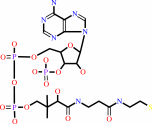 CoA
CoA
|
|
|
|
|
|
|
|
|
|
|
|
|
Molecule diagrams generated from .mol files obtained from the
KEGG ftp site
|
|
|
|
|
|
|
|
|
|
|
|
|
|
 |
|
|
|
|
|
|
| |
|
|
| |
|
DOI no:
|
FEBS J
272:259-268
(2005)
|
|
PubMed id:
|
|
|
|
|
|
| |
|
Interaction of the E2 and E3 components of the pyruvate dehydrogenase multienzyme complex of Bacillus stearothermophilus. Use of a truncated protein domain in NMR spectroscopy.
|
|
M.D.Allen,
R.W.Broadhurst,
R.G.Solomon,
R.N.Perham.
|
|
|
|
|
| |
ABSTRACT
|
|
|
|
| |
|
|
A (15)N-labelled peripheral-subunit binding domain (PSBD) of the dihydrolipoyl
acetyltransferase (E2p) and the dimer of a solubilized interface domain (E3int)
derived from the dihydrolipoyl dehydrogenase (E3) were used to investigate the
basis of the interaction of E2p with E3 in the assembly of the pyruvate
dehydrogenase multienzyme complex of Bacillus stearothermophilus. Thirteen of
the 55 amino acids in the PSBD show significant changes in either or both of the
(15)N and (1)H amide chemical shifts when the PSBD forms a 1 : 1 complex with
E3int. All of the 13 amino acids reside near the N-terminus of helix I of PSBD
or in the loop region between helix II and helix III. (15)N backbone dynamics
experiments on PSBD indicate that the structured region extends from Val129 to
Ala168, with limited structure present in residues Asn126 to Arg128. The
presence of structure in the region before helix I was confirmed by a refinement
of the NMR structure of uncomplexed PSBD. Comparison of the crystal structure of
the PSBD bound to E3 with the solution structure of uncomplexed PSBD described
here indicates that the PSBD undergoes almost no conformational change upon
binding to E3. These studies exemplify and validate the novel use of a
solubilized, truncated protein domain in overcoming the limitations of high
molecular mass on NMR spectroscopy.
|
|
|
|
|
|
| |
Selected figure(s)
|
|
|
|
| |
|
|

|
|

|
|
Figure 2.
Fig. 2. Backbone dynamics of PSBD. Plot of the backbone
steady state {^1H}-^15N NOE enhancement,  , for PSBD as
a function of residue number. , for PSBD as
a function of residue number.
|
|
Figure 3.
Fig. 3. Solution structure of PSBD from NMR spectroscopy.
Superposition of backbone traces of the 25 accepted structures
over residues 129–168, and a MOLSCRIPT[46] representation of
the PSBD structure in the same orientation. The residues
defining the secondary structural elements are labeled.
|
|
|
|
|
|
| |
The above figures are
reprinted
by permission from the Federation of European Biochemical Societies:
FEBS J
(2005,
272,
259-268)
copyright 2005.
|
|
| |
Figures were
selected
by an automated process.
|
|
|
|
|
|
|
|
|
|
|
|
|
|
|
|
 |
 |
 |
|
Literature references that cite this PDB file's key reference
|
|
|
| |
PubMed id
|
|
Reference
|
|
|
|
|
|
J.S.Lengyel,
K.M.Stott,
X.Wu,
B.R.Brooks,
A.Balbo,
P.Schuck,
R.N.Perham,
S.Subramaniam,
and
J.L.Milne
(2008).
Extended polypeptide linkers establish the spatial architecture of a pyruvate dehydrogenase multienzyme complex.
|
| |
Structure,
16,
93.
|
|
|
|
|
|
|
F.Huang,
S.Sato,
T.D.Sharpe,
L.Ying,
and
A.R.Fersht
(2007).
Distinguishing between cooperative and unimodal downhill protein folding.
|
| |
Proc Natl Acad Sci U S A,
104,
123-127.
|
|
|
|
|
|
|
C.A.Brautigam,
R.M.Wynn,
J.L.Chuang,
M.Machius,
D.R.Tomchick,
and
D.T.Chuang
(2006).
Structural insight into interactions between dihydrolipoamide dehydrogenase (E3) and E3 binding protein of human pyruvate dehydrogenase complex.
|
| |
Structure,
14,
611-621.
|
|
|
PDB codes:
|
|
|
|
|
|
|
|
E.M.Ciszak,
A.Makal,
Y.S.Hong,
A.K.Vettaikkorumakankauv,
L.G.Korotchkina,
and
M.S.Patel
(2006).
How dihydrolipoamide dehydrogenase-binding protein binds dihydrolipoamide dehydrogenase in the human pyruvate dehydrogenase complex.
|
| |
J Biol Chem,
281,
648-655.
|
|
|
PDB code:
|
|
|
|
|
|
|
|
J.L.Milne,
X.Wu,
M.J.Borgnia,
J.S.Lengyel,
B.R.Brooks,
D.Shi,
R.N.Perham,
and
S.Subramaniam
(2006).
Molecular structure of a 9-MDa icosahedral pyruvate dehydrogenase subcomplex containing the E2 and E3 enzymes using cryoelectron microscopy.
|
| |
J Biol Chem,
281,
4364-4370.
|
|
|
|
|
|
|
M.Knott,
and
H.S.Chan
(2006).
Criteria for downhill protein folding: calorimetry, chevron plot, kinetic relaxation, and single-molecule radius of gyration in chain models with subdued degrees of cooperativity.
|
| |
Proteins,
65,
373-391.
|
|
|
|
|
|
|
R.A.Frank,
J.V.Pratap,
X.Y.Pei,
R.N.Perham,
and
B.F.Luisi
(2005).
The molecular origins of specificity in the assembly of a multienzyme complex.
|
| |
Structure,
13,
1119-1130.
|
|
|
PDB code:
|
|
|
|
|
|
|
The most recent references are shown first.
Citation data come partly from CiteXplore and partly
from an automated harvesting procedure. Note that this is likely to be
only a partial list as not all journals are covered by
either method. However, we are continually building up the citation data
so more and more references will be included with time.
Where a reference describes a PDB structure, the PDB
codes are
shown on the right.
|
|


 Links
Links