|
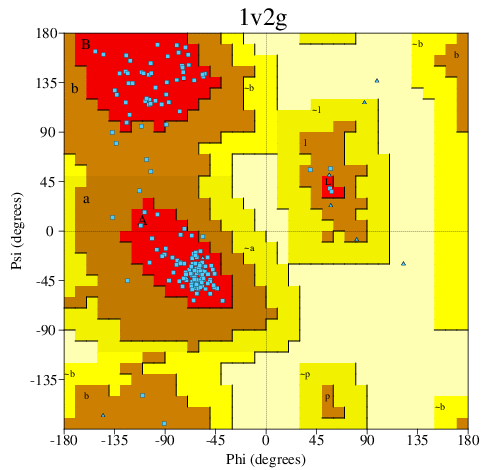
PDBsum entry 1v2g
|
|
|
|
References listed in PDB file
|
 |
|
Key reference
|
|
|
Title
|
|
Substrate specificities of escherichia coli thioesterase i/protease i/lysophospholipase l1 are governed by its switch loop movement.
|
|
|
Authors
|
|
Y.C.Lo,
S.C.Lin,
J.F.Shaw,
Y.C.Liaw.
|
|
|
Ref.
|
|
Biochemistry, 2005,
44,
1971-1979.
[DOI no: ]
|
|
|
PubMed id
|
|
|
|
|
|
Abstract
|
|
|
Escherichia coli thioesterase I/protease I/lysophospholipase L(1) (TAP) is a
multifunctional lysophospholipase and acyl-CoA thioesterase with a
SGNH-hydrolase fold. The relationship between TAP's structure and its versatile
substrate specificity, however, is unclear. Here, we present the crystal
structure of TAP in complex with octanoic acid (TAP-OCA; OCA, a free fatty acid
with eight carbon atoms, C(8)). A structural comparison of native TAP with
TAP-OCA reveals a remarkable conformational change in loop(75)(-)(80), called
"switch loop movement", upon OCA binding to the substrate-binding crevice of
TAP. OCA binding to the substrate-binding crevice results in a continuous
hydrophobic surface, which triggers switch loop movement. The switch loop
movement is acyl chain length dependent, with an effect of stabilizing the
Michaelis complex (MC) of TAP during catalysis, and is essential for TAP's
substrate preference. The finding of a sulfate ion binding site in the TAP
structures, together with previous enzyme kinetic analyses, leads us to
postulate that a putative CoA binding site is essential for efficient catalysis
of thioesters in TAP. We also present the crystal structure of L109P-OCA (TAP's
L109P mutant in complex with OCA), in which Leu109 mutated to Pro109 abolishes
switch loop movement. This result strengthens our hypothesis that the switch
loop movement is induced by hydrophobic interactions.
|
|
|
Secondary reference #1
|
|
|
Title
|
|
Crystal structure of escherichia coli thioesterase i/protease i/lysophospholipase l1: consensus sequence blocks constitute the catalytic center of sgnh-Hydrolases through a conserved hydrogen bond network.
|
|
|
Authors
|
|
Y.C.Lo,
S.C.Lin,
J.F.Shaw,
Y.C.Liaw.
|
|
|
Ref.
|
|
J Mol Biol, 2003,
330,
539-551.
[DOI no: ]
|
|
|
PubMed id
|
|
|
|
|
|
|
|
|
|

|
|

|
|
Figure 3.
Figure 3. Stereo diagrams of the oxyanion hole in the
TAP-DEP structure. The oxyanion hole residues Ser10, Gly44 and
Asn73, catalytic triad and DEP modified Ser10, are represented
as ball-and-sticks. The green broken-line indicates the hydrogen
bonds between the oxyanion oxygen atom and the hydrogen-donating
residues. The cyan broken-line indicates that the N  epsilon
2 of His157 is hydrogen bonded to the O2 of the leaving group of
DEP. The 2F[o] -F[c] electron density of DEP is countered at the
1s level. epsilon
2 of His157 is hydrogen bonded to the O2 of the leaving group of
DEP. The 2F[o] -F[c] electron density of DEP is countered at the
1s level.
|
|
Figure 7.
Figure 7. Superimposition of the conserved hydrogen bond
network in the SGNH-hydrolase family. (a) Stereo view of the
hydrogen bond network of consensus regions in the TAP structure.
The 2F[o] -F[c] electron density of water molecules is countered
at the 2.5s level. (b) Stereo view of superimposition of the
hydrogen bond network of TAP and PAF-AH(Ib)a1 structures. The
transparent and green sticks indicate TAP and PAF-AH(Ib)a1,
respectively. (c) The transparent and yellow sticks indicate TAP
and RGAH, respectively. (d) The transparent and red sticks
indicate TAP and SsEst, respectively.
|
|
|
|
|
|
The above figures are
reproduced from the cited reference
with permission from Elsevier
|
|
|
|
|
|
|