 |
PDBsum entry 1v0a

|
|
|
|
|
 |
Contents |
 |
|
|
|
|
|
|
|
|
|
|
|
|
|
|
* Residue conservation analysis
|
|
|
|
|
|
PDB id:
|
|
|
|
| Name: |
|
Hydrolase
|
|
|
Title:
|
|
Family 11 carbohydrate-binding module of cellulosomal cellulase lic26a-cel5e of clostridium thermocellum
|
|
Structure:
|
|
Endoglucanase h. Chain: a. Synonym: cellulose binding protein a, egh, endo-1,4-beta-glucanase, cellulase h. Engineered: yes
|
|
Source:
|
|
Clostridium thermocellum. Organism_taxid: 1515. Expressed in: escherichia coli. Expression_system_taxid: 562
|
|
Resolution:
|
|
|
1.98Å
|
R-factor:
|
0.195
|
R-free:
|
0.232
|
|
|
Authors:
|
|
A.L.Carvalho,M.J.Romao,A.Goyal,J.A.M.Prates,V.M.R.Pires, L.M.A.Ferreira,D.N.Bolam,H.J.Gilbert,C.M.G.A.Fontes
|
Key ref:

|
|
A.L.Carvalho
et al.
(2004).
The family 11 carbohydrate-binding module of Clostridium thermocellum Lic26A-Cel5E accommodates beta-1,4- and beta-1,3-1,4-mixed linked glucans at a single binding site.
J Biol Chem,
279,
34785-34793.
PubMed id:
DOI:

|
|
|
Date:
|
|
|
25-Mar-04
|
Release date:
|
12-Jan-05
|
|
|
|
|
|
|
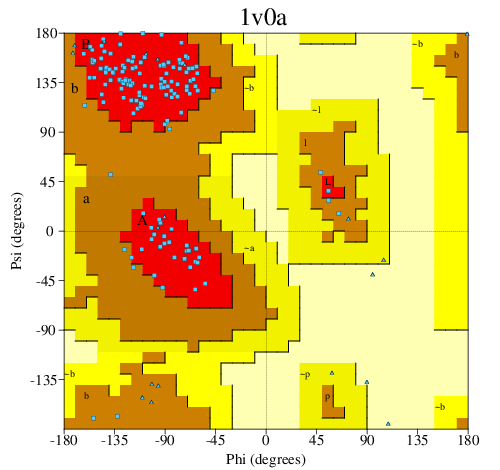
PROCHECK
|
|
|
|
|
|
Headers
|
|
|
|
References
|
|
|
|
|
|

|
|
P16218
(GUNH_CLOTH) -
Endoglucanase H from Acetivibrio thermocellus (strain ATCC 27405 / DSM 1237 / JCM 9322 / NBRC 103400 / NCIMB 10682 / NRRL B-4536 / VPI 7372)
|
|
|
|
Seq:
Struc:
|
|
|
|
900 a.a.
170 a.a.*
|
|

|

|

|
|
|
|
|
|
|
|
|
|
|
Key: |
 |
PfamA domain |
|
|
 |
Secondary structure |
|
 |
CATH domain |
|
|
*
PDB and UniProt seqs differ
at 6 residue positions (black
crosses)
|
|
|
|
|
|
|
|
|
|
|
|
|
Enzyme class:
|
|
E.C.3.2.1.4
- cellulase.
|
|
|
|
|
|
|
Reaction:
|
|
Endohydrolysis of 1,4-beta-D-glucosidic linkages in cellulose, lichenin and cereal beta-D-glucans.
|
|
|
|
|
|
|
|
|
|
|
|
|
|
|
|
|
|
 |
|
|
|
|
|
|
| |
|
DOI no:
|
J Biol Chem
279:34785-34793
(2004)
|
|
PubMed id:
|
|
|
|
|
|
| |
|
The family 11 carbohydrate-binding module of Clostridium thermocellum Lic26A-Cel5E accommodates beta-1,4- and beta-1,3-1,4-mixed linked glucans at a single binding site.
|
|
A.L.Carvalho,
A.Goyal,
J.A.Prates,
D.N.Bolam,
H.J.Gilbert,
V.M.Pires,
L.M.Ferreira,
A.Planas,
M.J.Romão,
C.M.Fontes.
|
|
|
|
|
| |
ABSTRACT
|
|
|
|
| |
|
|
Modular glycoside hydrolases that attack recalcitrant polymers generally contain
noncatalytic carbohydrate-binding modules (CBMs), which play a critical role in
the action of these enzymes by localizing the appended catalytic domains onto
the surface of insoluble polysaccharide substrates. Type B CBMs, which recognize
single polysaccharide chains, display ligand specificities that are consistent
with the substrates hydrolyzed by the associated catalytic domains. In enzymes
that contain multiple catalytic domains with distinct substrate specificities,
it is unclear how these different activities influence the evolution of the
ligand recognition profile of the appended CBM. To address this issue, we have
characterized the properties of a family 11 CBM (CtCBM11) in Clostridium
thermocellum Lic26A-Cel5E, an enzyme that contains GH5 and GH26 catalytic
domains that display beta-1,4- and beta-1,3-1,4-mixed linked endoglucanase
activity, respectively. Here we show that CtCBM11 binds to both beta-1,4- and
beta-1,3-1,4-mixed linked glucans, displaying K(a) values of 1.9 x 10(5), 4.4 x
10(4), and 2 x 10(3) m(-1) for Glc-beta1,4-Glc-beta1,4-Glc-beta1,3-Glc,
Glc-beta1,4-Glc-beta1,4-Glc-beta1,4-Glc, and
Glc-beta1,3-Glc-beta1,4-Glc-beta1,3-Glc, respectively, demonstrating that CBMs
can display a preference for mixed linked glucans. To determine whether these
ligands are accommodated in the same or diverse sites in CtCBM11, the crystal
structure of the protein was solved to a resolution of 1.98 A. The protein
displays a beta-sandwich with a concave side that forms a potential binding
cleft. Site-directed mutagenesis revealed that Tyr(22), Tyr(53), and Tyr(129),
located in the putative binding cleft, play a central role in the recognition of
all the ligands recognized by the protein. We propose, therefore, that CtCBM11
contains a single ligand-binding site that displays affinity for both beta-1,4-
and beta-1,3-1,4-mixed linked glucans.
|
|
|
|
|
|
| |
Selected figure(s)
|
|
|
|
| |
|
|

|
|

|
|
Figure 2.
FIG. 2. Ribbon representation of the three-dimensional
structure of CtCBM11. a, Stereo representation of the overall
structure of CtCBM11. The CtCBM11 structure consists of a
distorted  -jelly roll fold
composed of two six-stranded antiparallel -sheets, which form a
convex side ( -strands drawn in dark
blue) and a concave side ( -strands drawn in light
blue). The two calcium ions are indicated as green spheres. The
concave side of CtCBM11 forms a cleft. Residues inside the
putative binding cleft are shown as ball-and-stick models.
Tyrosine residues are represented in red, arginines are in
yellow, histidines are in pink, and aspartates are in orange.
The picture was drawn with the program MOLMOL (42). b, stereo
view of the CtCBM11 cleft, in the same orientation as in a,
occupied by the C terminus residues of a symmetry-related
molecule. The residues are labeled in red and represented in
ball-and-stick. The 2mF[o] - DF[c] electron density map around
the molecule is shown in dark blue and contoured at 1.1 -jelly roll fold
composed of two six-stranded antiparallel -sheets, which form a
convex side ( -strands drawn in dark
blue) and a concave side ( -strands drawn in light
blue). The two calcium ions are indicated as green spheres. The
concave side of CtCBM11 forms a cleft. Residues inside the
putative binding cleft are shown as ball-and-stick models.
Tyrosine residues are represented in red, arginines are in
yellow, histidines are in pink, and aspartates are in orange.
The picture was drawn with the program MOLMOL (42). b, stereo
view of the CtCBM11 cleft, in the same orientation as in a,
occupied by the C terminus residues of a symmetry-related
molecule. The residues are labeled in red and represented in
ball-and-stick. The 2mF[o] - DF[c] electron density map around
the molecule is shown in dark blue and contoured at 1.1  .
Residues inside the cleft (color code) are shown as
ball-and-stick models and labeled blue. The calcium-binding
site, Ca1, is represented as a green sphere. The picture was
produced with the program TURBO-FRODO (27). .
Residues inside the cleft (color code) are shown as
ball-and-stick models and labeled blue. The calcium-binding
site, Ca1, is represented as a green sphere. The picture was
produced with the program TURBO-FRODO (27).
|
|
Figure 3.
FIG. 3. The Ca^2+-binding sites of CtCBM11. Stereo view of
the Ca^2+ coordination in CtCBM11 superimposed in the 2mF[o] -
DF[c] electron density map, contoured at 1.3 . The residues involved
in calcium binding are represented as stick models and labeled
black. The polypeptide chain atoms are represented in color
code, and the Ca^2+ ions are shown as orange spheres. The
pictures were produced with the program TURBO-FRODO (27).
|
|
|
|
|
|
| |
The above figures are
reprinted
by permission from the ASBMB:
J Biol Chem
(2004,
279,
34785-34793)
copyright 2004.
|
|
| |
Figures were
selected
by an automated process.
|
|
|
|
|
|
|
|
|
|
|
|
|
|
|
|
 |
 |
 |
|
Literature references that cite this PDB file's key reference
|
|
|
| |
PubMed id
|
|
Reference
|
|
|
|
|
|
A.P.Yeh,
P.Abdubek,
T.Astakhova,
H.L.Axelrod,
C.Bakolitsa,
X.Cai,
D.Carlton,
C.Chen,
H.J.Chiu,
M.Chiu,
T.Clayton,
D.Das,
M.C.Deller,
L.Duan,
K.Ellrott,
C.L.Farr,
J.Feuerhelm,
J.C.Grant,
A.Grzechnik,
G.W.Han,
L.Jaroszewski,
K.K.Jin,
H.E.Klock,
M.W.Knuth,
P.Kozbial,
S.S.Krishna,
A.Kumar,
W.W.Lam,
D.Marciano,
D.McMullan,
M.D.Miller,
A.T.Morse,
E.Nigoghossian,
A.Nopakun,
L.Okach,
C.Puckett,
R.Reyes,
H.J.Tien,
C.B.Trame,
H.van den Bedem,
D.Weekes,
T.Wooten,
Q.Xu,
K.O.Hodgson,
J.Wooley,
M.A.Elsliger,
A.M.Deacon,
A.Godzik,
S.A.Lesley,
and
I.A.Wilson
(2010).
Structure of Bacteroides thetaiotaomicron BT2081 at 2.05 Å resolution: the first structural representative of a new protein family that may play a role in carbohydrate metabolism.
|
| |
Acta Crystallogr Sect F Struct Biol Cryst Commun,
66,
1287-1296.
|
|
|
PDB code:
|
|
|
|
|
|
|
|
C.M.Fontes,
and
H.J.Gilbert
(2010).
Cellulosomes: highly efficient nanomachines designed to deconstruct plant cell wall complex carbohydrates.
|
| |
Annu Rev Biochem,
79,
655-681.
|
|
|
|
|
|
|
T.Hattori,
M.Umetsu,
T.Nakanishi,
T.Togashi,
N.Yokoo,
H.Abe,
S.Ohara,
T.Adschiri,
and
I.Kumagai
(2010).
High affinity anti-inorganic material antibody generation by integrating graft and evolution technologies: potential of antibodies as biointerface molecules.
|
| |
J Biol Chem,
285,
7784-7793.
|
|
|
|
|
|
|
T.Schallus,
K.Fehér,
U.Sternberg,
V.Rybin,
and
C.Muhle-Goll
(2010).
Analysis of the specific interactions between the lectin domain of malectin and diglucosides.
|
| |
Glycobiology,
20,
1010-1020.
|
|
|
PDB code:
|
|
|
|
|
|
|
|
A.Peer,
S.P.Smith,
E.A.Bayer,
R.Lamed,
and
I.Borovok
(2009).
Noncellulosomal cohesin- and dockerin-like modules in the three domains of life.
|
| |
FEMS Microbiol Lett,
291,
1.
|
|
|
|
|
|
|
B.A.Pinheiro,
H.J.Gilbert,
K.Sakka,
K.Sakka,
V.O.Fernandes,
J.A.Prates,
V.D.Alves,
D.N.Bolam,
L.M.Ferreira,
and
C.M.Fontes
(2009).
Functional insights into the role of novel type I cohesin and dockerin domains from Clostridium thermocellum.
|
| |
Biochem J,
424,
375-384.
|
|
|
|
|
|
|
I.A.Dvortsov,
N.A.Lunina,
L.A.Chekanovskaya,
W.H.Schwarz,
V.V.Zverlov,
and
G.A.Velikodvorskaya
(2009).
Carbohydrate-binding properties of a separately folding protein module from {beta}-1,3-glucanase Lic16A of Clostridium thermocellum.
|
| |
Microbiology,
155,
2442-2449.
|
|
|
|
|
|
|
A.Viegas,
N.F.Brás,
N.M.Cerqueira,
P.A.Fernandes,
J.A.Prates,
C.M.Fontes,
M.Bruix,
M.J.Romão,
A.L.Carvalho,
M.J.Ramos,
A.L.Macedo,
and
E.J.Cabrita
(2008).
Molecular determinants of ligand specificity in family 11 carbohydrate binding modules: an NMR, X-ray crystallography and computational chemistry approach.
|
| |
FEBS J,
275,
2524-2535.
|
|
|
|
|
|
|
B.Nocek,
L.Bigelow,
J.Abdullah,
and
A.Joachimiak
(2008).
Structure of SO2946 orphan from Shewanella oneidensis shows "jelly-roll" fold with carbohydrate-binding module.
|
| |
J Struct Funct Genomics,
9,
1-6.
|
|
|
PDB code:
|
|
|
|
|
|
|
|
B.Wu,
L.Wang,
and
P.Gao
(2008).
Structural changes of cellobiohydrolase I (1,4-beta-D-glucan-cellobiohydrolase I, CBHI) and PNPC (p-nitrophenyl-beta-D-cellobioside) during the binding process.
|
| |
Sci China C Life Sci,
51,
459-469.
|
|
|
|
|
|
|
M.S.Centeno,
A.Goyal,
J.A.Prates,
L.M.Ferreira,
H.J.Gilbert,
and
C.M.Fontes
(2006).
Novel modular enzymes encoded by a cellulase gene cluster in Cellvibrio mixtus.
|
| |
FEMS Microbiol Lett,
265,
26-34.
|
|
|
|
|
|
|
M.S.Centeno,
C.I.Guerreiro,
F.M.Dias,
C.Morland,
L.E.Tailford,
A.Goyal,
J.A.Prates,
L.M.Ferreira,
R.M.Caldeira,
E.F.Mongodin,
K.E.Nelson,
H.J.Gilbert,
and
C.M.Fontes
(2006).
Galactomannan hydrolysis and mannose metabolism in Cellvibrio mixtus.
|
| |
FEMS Microbiol Lett,
261,
123-132.
|
|
|
|
|
|
The most recent references are shown first.
Citation data come partly from CiteXplore and partly
from an automated harvesting procedure. Note that this is likely to be
only a partial list as not all journals are covered by
either method. However, we are continually building up the citation data
so more and more references will be included with time.
Where a reference describes a PDB structure, the PDB
code is
shown on the right.
|
|


 Links
Links



