
|
|
|
|
|
 |
Contents |
 |
|
|
|
|
|
|
|
|
|
|
|
|
|
|
* Residue conservation analysis
|
|
|
|
|
|
PDB id:
|
|
|
|
| Name: |
|
Oxidoreductase
|
|
|
Title:
|
|
Three-dimensional structure of the carbon monoxide complex of [nife]hydrogenase from desulufovibrio vulgaris miyazaki f
|
|
Structure:
|
|
Periplasmic [nife] hydrogenase small subunit. Chain: s. Synonym: small subunit of [nife]hydrogenase. Periplasmic [nife] hydrogenase large subunit. Chain: l. Fragment: residues 19-552. Synonym: large subunit of [nife]hydrogenase. Ec: 1.12.2.1
|
|
Source:
|
|
Desulfovibrio vulgaris str. 'Miyazaki f'. Organism_taxid: 883. Strain: miyazaki f. Strain: miyazaki f
|
|
Biol. unit:
|
|
Dimer (from
)
|
|
Resolution:
|
|
|
1.35Å
|
R-factor:
|
0.131
|
R-free:
|
0.178
|
|
|
Authors:
|
|
H.Ogata,Y.Mizoguchi,N.Mizuno,K.Miki,S.Adachi,N.Yasuoka,T.Yagi, O.Yamauchi,S.Hirota,Y.Higuchi
|
|
Key ref:
|
|
H.Ogata
et al.
(2002).
Structural studies of the carbon monoxide complex of [NiFe]hydrogenase from Desulfovibrio vulgaris Miyazaki F: suggestion for the initial activation site for dihydrogen.
J Am Chem Soc,
124,
11628-11635.
PubMed id:
DOI:
|
|
|
Date:
|
|
|
04-Apr-03
|
Release date:
|
29-Apr-03
|
|
|
|
|
|
|
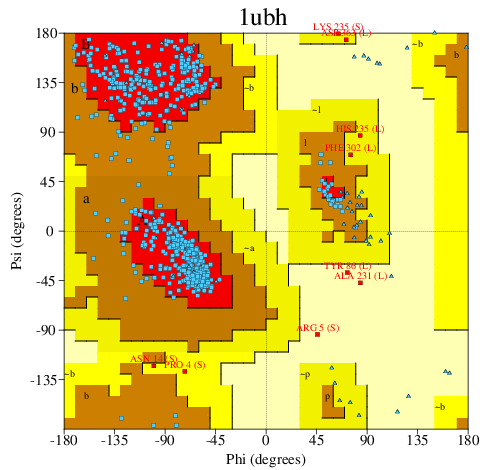
PROCHECK
|
|
|
|
|
|
Headers
|
|
|
|
References
|
|
|
|
|
|
|
|
|
|
|
|
Enzyme class:
|
|
Chains S, L:
E.C.1.12.2.1
- cytochrome-c3 hydrogenase.
|
|
|
|
|
|
|
Reaction:
|
|
2 Fe(III)-[cytochrome c3] + H2 = 2 Fe(II)-[cytochrome c3] + 2 H+
|
|
|
|
|
|
Cofactor:
|
|
Iron-sulfur; Ni(2+)
|
|
|
|
|
|
 Iron-sulfur
|
Ni(2+)
|
|
|
|
|
|
|
Molecule diagrams generated from .mol files obtained from the
KEGG ftp site
|
|
|
|
|
|
|
|
|
|
|
|
|
|
 |
|
|
|
|
|
|
| |
|
|
| |
|
DOI no:
|
J Am Chem Soc
124:11628-11635
(2002)
|
|
PubMed id:
|
|
|
|
|
|
| |
|
Structural studies of the carbon monoxide complex of [NiFe]hydrogenase from Desulfovibrio vulgaris Miyazaki F: suggestion for the initial activation site for dihydrogen.
|
|
H.Ogata,
Y.Mizoguchi,
N.Mizuno,
K.Miki,
S.Adachi,
N.Yasuoka,
T.Yagi,
O.Yamauchi,
S.Hirota,
Y.Higuchi.
|
|
|
|
|
| |
ABSTRACT
|
|
|
|
| |
|
|
The carbon monoxide complex of [NiFe]hydrogenase from Desulfovibrio vulgaris
Miyazaki F has been characterized by X-ray crystallography and absorption and
resonance Raman spectroscopy. Nine crystal structures of the [NiFe]hydrogenase
in the CO-bound and CO-liberated forms were determined at 1.2-1.4 A resolution.
The exogenously added CO was assigned to be bound to the Ni atom at the Ni-Fe
active site. The CO was not replaced with H(2) in the dark at 100 K, but was
liberated by illumination with a strong white light. The Ni-C distances and
Ni-C-O angles were about 1.77 A and 160 degrees, respectively, except for one
case (1.72 A and 135 degrees ), in which an additional electron density peak
between the CO and Sgamma(Cys546) was recognized. Distinct changes were observed
in the electron density distribution of the Ni and Sgamma(Cys546) atoms between
the CO-bound and CO-liberated structures for all the crystals tested. The novel
structural features found near the Ni and Sgamma(Cys546) atoms suggest that
these two atoms at the Ni-Fe active site play a role during the initial
H(2)-binding process. Anaerobic addition of CO to dithionite-reduced
[NiFe]hydrogenase led to a new absorption band at about 470 nm ( approximately
3000 M(-1)cm(-1)). Resonance Raman spectra (excitation at 476.5 nm) of the CO
complex revealed CO-isotope-sensitive bands at 375/393 and 430 cm(-1) (368 and
413 cm(-1) for (13)C(18)O). The frequencies and relative intensities of the
CO-related Raman bands indicated that the exogenous CO is bound to the Ni atom
with a bent Ni-C-O structure in solution, in agreement with the refined
structure determined by X-ray crystallography.
|
|
|
|
|
|
|
|
|
|
|
|
|
|
|
|
|
|
 |
 |
 |
|
Literature references that cite this PDB file's key reference
|
|
|
| |
PubMed id
|
|
Reference
|
|
|
|
|
|
B.E.Barton,
M.T.Olsen,
and
T.B.Rauchfuss
(2010).
Artificial hydrogenases.
|
| |
Curr Opin Biotechnol,
21,
292-297.
|
|
|
|
|
|
|
C.Gutiérrez-Sánchez,
O.Rüdiger,
V.M.Fernández,
A.L.De Lacey,
M.Marques,
and
I.A.Pereira
(2010).
Interaction of the active site of the Ni-Fe-Se hydrogenase from Desulfovibrio vulgaris Hildenborough with carbon monoxide and oxygen inhibitors.
|
| |
J Biol Inorg Chem,
15,
1285-1292.
|
|
|
|
|
|
|
M.E.Pandelia,
H.Ogata,
and
W.Lubitz
(2010).
Intermediates in the catalytic cycle of [NiFe] hydrogenase: functional spectroscopy of the active site.
|
| |
Chemphyschem,
11,
1127-1140.
|
|
|
|
|
|
|
Y.Ohki,
K.Yasumura,
M.Ando,
S.Shimokata,
and
K.Tatsumi
(2010).
A model for the CO-inhibited form of [NiFe] hydrogenase: synthesis of CO3Fe(micro-StBu)3Ni{SC6H3-2,6-(mesityl)2} and reversible CO addition at the Ni site.
|
| |
Proc Natl Acad Sci U S A,
107,
3994-3997.
|
|
|
|
|
|
|
A.Perra,
Q.Wang,
A.J.Blake,
E.S.Davies,
J.McMaster,
C.Wilson,
and
M.Schröder
(2009).
Unusual formation of a [NiSFe(2)(CO)(6)] cluster: a structural model for the inactive form of [NiFe] hydrogenase.
|
| |
Dalton Trans,
(),
925-931.
|
|
|
|
|
|
|
F.Germer,
I.Zebger,
M.Saggu,
F.Lendzian,
R.Schulz,
and
J.Appel
(2009).
Overexpression, isolation, and spectroscopic characterization of the bidirectional [NiFe] hydrogenase from Synechocystis sp. PCC 6803.
|
| |
J Biol Chem,
284,
36462-36472.
|
|
|
|
|
|
|
J.C.Fontecilla-Camps,
P.Amara,
C.Cavazza,
Y.Nicolet,
and
A.Volbeda
(2009).
Structure-function relationships of anaerobic gas-processing metalloenzymes.
|
| |
Nature,
460,
814-822.
|
|
|
|
|
|
|
M.E.Pandelia,
H.Ogata,
L.J.Currell,
M.Flores,
and
W.Lubitz
(2009).
Probing intermediates in the activation cycle of [NiFe] hydrogenase by infrared spectroscopy: the Ni-SIr state and its light sensitivity.
|
| |
J Biol Inorg Chem,
14,
1227-1241.
|
|
|
|
|
|
|
S.Shima,
O.Pilak,
S.Vogt,
M.Schick,
M.S.Stagni,
W.Meyer-Klaucke,
E.Warkentin,
R.K.Thauer,
and
U.Ermler
(2008).
The crystal structure of [Fe]-hydrogenase reveals the geometry of the active site.
|
| |
Science,
321,
572-575.
|
|
|
PDB codes:
|
|
|
|
|
|
|
|
Y.Ohki,
K.Yasumura,
K.Kuge,
S.Tanino,
M.Ando,
Z.Li,
and
K.Tatsumi
(2008).
Thiolate-bridged dinuclear iron(tris-carbonyl)-nickel complexes relevant to the active site of [NiFe] hydrogenase.
|
| |
Proc Natl Acad Sci U S A,
105,
7652-7657.
|
|
|
|
|
|
|
M.Long,
J.Liu,
Z.Chen,
B.Bleijlevens,
W.Roseboom,
and
S.P.Albracht
(2007).
Characterization of a HoxEFUYH type of [NiFe] hydrogenase from Allochromatium vinosum and some EPR and IR properties of the hydrogenase module.
|
| |
J Biol Inorg Chem,
12,
62-78.
|
|
|
|
|
|
|
A.Pardo,
A.L.De Lacey,
V.M.Fernández,
H.J.Fan,
Y.Fan,
and
M.B.Hall
(2006).
Density functional study of the catalytic cycle of nickel-iron [NiFe] hydrogenases and the involvement of high-spin nickel(II).
|
| |
J Biol Inorg Chem,
11,
286-306.
|
|
|
|
|
|
|
J.W.Tye,
M.Y.Darensbourg,
and
M.B.Hall
(2006).
Correlation between computed gas-phase and experimentally determined solution-phase infrared spectra: models of the iron-iron hydrogenase enzyme active site.
|
| |
J Comput Chem,
27,
1454-1462.
|
|
|
|
|
|
|
A.Volbeda,
and
J.C.Fontecilla-Camps
(2005).
Structural bases for the catalytic mechanism of Ni-containing carbon monoxide dehydrogenases.
|
| |
Dalton Trans,
(),
3443-3450.
|
|
|
|
|
|
|
H.Ogata,
S.Hirota,
A.Nakahara,
H.Komori,
N.Shibata,
T.Kato,
K.Kano,
and
Y.Higuchi
(2005).
Activation process of [NiFe] hydrogenase elucidated by high-resolution X-ray analyses: conversion of the ready to the unready state.
|
| |
Structure,
13,
1635-1642.
|
|
|
PDB codes:
|
|
|
|
|
|
|
|
J.Han,
and
D.Coucouvanis
(2005).
Synthesis and structure of the organometallic MFe2(mu3-S)2 clusters (M = Mo or Fe).
|
| |
Dalton Trans,
(),
1234-1240.
|
|
|
|
|
|
|
K.A.Vincent,
J.A.Cracknell,
O.Lenz,
I.Zebger,
B.Friedrich,
and
F.A.Armstrong
(2005).
Electrocatalytic hydrogen oxidation by an enzyme at high carbon monoxide or oxygen levels.
|
| |
Proc Natl Acad Sci U S A,
102,
16951-16954.
|
|
|
|
|
|
|
B.Bleijlevens,
T.Buhrke,
E.van der Linden,
B.Friedrich,
and
S.P.Albracht
(2004).
The auxiliary protein HypX provides oxygen tolerance to the soluble [NiFe]-hydrogenase of ralstonia eutropha H16 by way of a cyanide ligand to nickel.
|
| |
J Biol Chem,
279,
46686-46691.
|
|
|
|
|
|
|
E.J.Lyon,
S.Shima,
G.Buurman,
S.Chowdhuri,
A.Batschauer,
K.Steinbach,
and
R.K.Thauer
(2004).
UV-A/blue-light inactivation of the 'metal-free' hydrogenase (Hmd) from methanogenic archaea.
|
| |
Eur J Biochem,
271,
195-204.
|
|
|
|
|
|
|
F.A.Armstrong
(2004).
Hydrogenases: active site puzzles and progress.
|
| |
Curr Opin Chem Biol,
8,
133-140.
|
|
|
|
|
|
|
S.Dementin,
B.Burlat,
A.L.De Lacey,
A.Pardo,
G.Adryanczyk-Perrier,
B.Guigliarelli,
V.M.Fernandez,
and
M.Rousset
(2004).
A glutamate is the essential proton transfer gate during the catalytic cycle of the [NiFe] hydrogenase.
|
| |
J Biol Chem,
279,
10508-10513.
|
|
|
|
|
|
The most recent references are shown first.
Citation data come partly from CiteXplore and partly
from an automated harvesting procedure. Note that this is likely to be
only a partial list as not all journals are covered by
either method. However, we are continually building up the citation data
so more and more references will be included with time.
Where a reference describes a PDB structure, the PDB
codes are
shown on the right.
|
 |


 Links
Links


