|
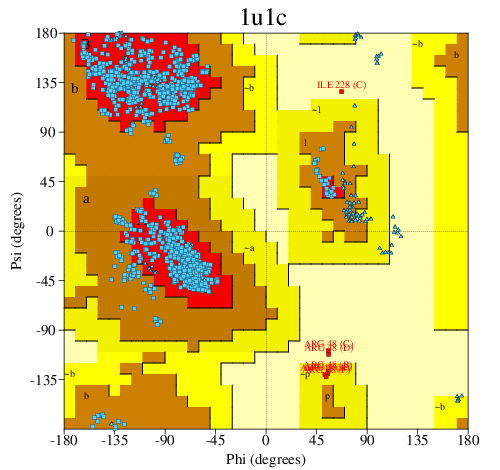
PDBsum entry 1u1c
|
|
|
|
References listed in PDB file
|
 |
|
Key reference
|
|
|
Title
|
|
Structural basis for inhibition of escherichia coli uridine phosphorylase by 5-Substituted acyclouridines.
|
|
|
Authors
|
|
W.Bu,
E.C.Settembre,
M.H.El kouni,
S.E.Ealick.
|
|
|
Ref.
|
|
Acta Crystallogr D Biol Crystallogr, 2005,
61,
863-872.
[DOI no: ]
|
|
|
PubMed id
|
|
|
|
|
|
Abstract
|
|
|
Uridine phosphorylase (UP) catalyzes the reversible phosphorolysis of uridine to
uracil and ribose 1-phosphate and is a key enzyme in the pyrimidine-salvage
pathway. Escherichia coli UP is structurally homologous to E. coli purine
nucleoside phosphorylase and other members of the type I family of nucleoside
phosphorylases. The structures of 5-benzylacyclouridine,
5-phenylthioacyclouridine, 5-phenylselenenylacyclouridine, 5-m-benzyloxybenzyl
acyclouridine and 5-m-benzyloxybenzyl barbituric acid acyclonucleoside bound to
the active site of E. coli UP have been determined, with resolutions ranging
from 1.95 to 2.3 A. For all five complexes the acyclo sugar moiety binds to the
active site in a conformation that mimics the ribose ring of the natural
substrates. Surprisingly, the terminal hydroxyl group occupies the position of
the nonessential 5'-hydroxyl substituent of the substrate rather than the
3'-hydroxyl group, which is normally required for catalytic activity. Until
recently, inhibitors of UP were designed with limited structural knowledge of
the active-site residues. These structures explain the basis of inhibition for
this series of acyclouridine analogs and suggest possible additional avenues for
future drug-design efforts. Furthermore, the studies can be extended to design
inhibitors of human UP, for which no X-ray structure is available.
|
|
|
|

|
|

|
|
Figure 2.
Figure 2
Structure of UP shown in ribbon representation. (a) UP monomer with [beta] -strands
in blue and [alpha] -helices in green. BAU and phosphate are shown in stick
representation bound at the active site. C atoms are colored green, N atoms blue, O atoms
red and P atoms pink. (b) UP hexamer shown in ribbon representation with BAU (orange) and
phosphate (red) shown bound at the active sites. Dimers with greater buried surface area
are shown in similar colors. This figure was prepared with MOLSCRIPT (Kraulis, 1991
[Kraulis, P. J. (1991). J. Appl. Cryst. 24, 946-950.]-[bluearr.gif] ) and RASTER3D
(Merritt & Bacon, 1997 [Merritt, E. A. & Bacon, D. J. (1997). Methods Enzymol. 277,
505-524.]-[bluearr.gif] ).
|
|
Figure 3.
Figure 3
Schematic representation of the UP active site with bound (a) 5-fluorouridine and
phosphate, (b) BAU and phosphate or (c) BBBA. Hydrogen bonds are shown in dashed lines.
The active-site hydrophobic pocket is indicated by a solid line flanked by the
participating residues.
|
|
|
|
|
|
The above figures are
reprinted
by permission from the IUCr:
Acta Crystallogr D Biol Crystallogr
(2005,
61,
863-872)
copyright 2005.
|
|
|
|
|
|
|