|
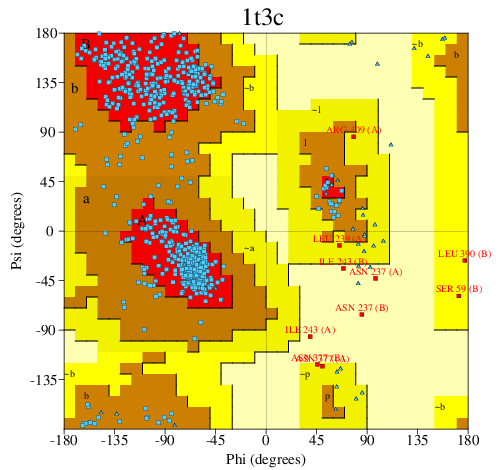
PDBsum entry 1t3c

|
|
|
|
|
|

|
|

|
|

|
|

|
|

|
|

|
|

|
|

|
|
|
 |

|

|
|
|
|
|
|
|
|
|
|
|
|
|
|
|
|
|
|
|
|
|
|
|
|
|
|
|
|
|
|
|
|
|
Hydrolase, toxin
|
PDB id
|
|
|
|
1t3c
|
|
|
|
|
|
|
|
|
|
|
|
|
|
|

|

|

|
|
|
|
|
|
|
|
 |
Contents |
 |
|
|
|
|
|
|
|
|
|
|
|
|
* Residue conservation analysis
|
|
|
|
|
References listed in PDB file
|
|
|
Key reference
|
|
|
Title
|
|
Structural analysis of botulinum neurotoxin type e catalytic domain and its mutant glu212--≫gln reveals the pivotal role of the glu212 carboxylate in the catalytic pathway.
|
|
|
Authors
|
|
R.Agarwal,
S.Eswaramoorthy,
D.Kumaran,
T.Binz,
S.Swaminathan.
|
|
|
Ref.
|
|
Biochemistry, 2004,
43,
6637-6644.
[DOI no: ]
|
|
|
PubMed id
|
|
|
|
|
|
Abstract
|
|
|
The seven serotypes of botulinum neurotoxins (A-G) produced by Clostridium
botulinum share significant sequence homology and structural similarity. The
functions of their individual domains and the modes of action are also similar.
However, the substrate specificity and the peptide bond cleavage selectivity of
their catalytic domains are different. The reason for this unique specificity of
botulinum neurotoxins is still baffling. If an inhibitor leading to a
therapeutic drug common to all serotypes is to be developed, it is essential to
understand the differences in their three-dimensional structures that empower
them with this unique characteristic. Accordingly, high-resolution structures of
all serotypes are required, and toward achieving this goal the crystal structure
of the catalytic domain of C. botulinum neurotoxin type E has been determined to
2.1 A resolution. The crystal structure of the inactive mutant Glu212-->Gln
of this protein has also been determined. While the overall conformation is
unaltered in the active site, the position of the nucleophilic water changes in
the mutant, thereby causing it to lose its ability to activate the catalytic
reaction. The structure explains the importance of the nucleophilic water and
the charge on Glu212. The structural differences responsible for the loss of
activity of the mutant provide a common model for the catalytic pathway of
Clostridium neurotoxins since Glu212 is conserved and has a similar role in all
serotypes. This or a more nonconservative mutant (e.g., Glu212-->Ala) could
provide a novel, genetically modified protein vaccine for botulinum.
|
|
|
|
|
|
|