|
PDBsum entry 1rn4

|
|
|
|
|
|

|
|

|
|

|
|

|
|

|
|
|
 |

|

|
|
|
|
|
|
|
|
|
|
|
|
|
|
|
|
|
|
|
|
|
|
|
|
|
|
|
|
|
|
Hydrolase(endoribonuclease)
|
PDB id
|
|
|
|
1rn4
|
|
|
|
|
|
|
|
|
|
|
|
|
|
|

|

|

|
|
|
|
|
|
References listed in PDB file
|
|
|
Key reference
|
|
|
Title
|
|
His92ala mutation in ribonuclease t1 induces segmental flexibility. An x-Ray study.
|
|
|
Authors
|
|
G.Koellner,
H.W.Choe,
U.Heinemann,
H.P.Grunert,
A.Zouni,
U.Hahn,
W.Saenger.
|
|
|
Ref.
|
|
J Mol Biol, 1992,
224,
701-713.
[DOI no: ]
|
|
|
PubMed id
|
|
|
|
|
|
Abstract
|
|
|
In the genetically mutated ribonuclease T1 His92Ala (RNase T1 His92Ala),
deletion of the active site His92 imidazole leads to an inactive enzyme.
Attempts to crystallize RNase T1 His92Ala under conditions used for wild-type
enzyme failed, and a modified protocol produced two crystal forms, one obtained
with polyethylene glycol (PEG), and the other with phosphate as precipitants.
Space groups are identical to wild-type RNase T1, P2(1)2(1)2(1), but unit cell
dimensions differ significantly, associated with different molecular packings in
the crystals; they are a = 31.04 A, b = 62.31 A, c = 43.70 A for PEG-derived
crystals and a = 32.76 A, b = 55.13 A, c = 43.29 A for phosphate-derived
crystals, compared to a = 48.73 A, b = 46.39 A, c = 41.10 A for uncomplexed
wild-type RNase T1. The crystal structures were solved by molecular replacement
and refined by stereochemically restrained least-squares methods based on Fo
greater than or equal to sigma (Fo) of 3712 reflections in the resolution range
10 to 2.2 A (R = 15.8%) for the PEG-derived crystal and based on Fo greater than
or equal to sigma (Fo) of 6258 reflections in the resolution range 10 to 1.8 A
(R = 14.8%) for the phosphate-derived crystal. The His92Ala mutation deletes the
hydrogen bond His92N epsilon H ... O Asn99 of wild-type RNase T1, thereby
inducing structural flexibility and conformational changes in the loop 91 to 101
which is located at the periphery of the globular enzyme. This loop is
stabilized in the wild-type protein by two beta-turns of which only one is
retained in the crystals obtained with PEG. In the crystals grown with phosphate
as precipitant, both beta-turns are deleted and the segment
Gly94-Ala95-Ser96-Gly97 is so disordered that it is not seen at all. In
addition, the geometry of the guanine binding site in both mutant studies is
different from "empty" wild-type RNase T1 but similar to that found in
complexes with guanosine derivatives: the Glu46 side-chain carboxylate hydrogen
bonds to Tyr42 O eta; water molecules that are present in the guanine binding
site of "empty" wild-type RNase T1 are displaced; the Asn43-Asn44
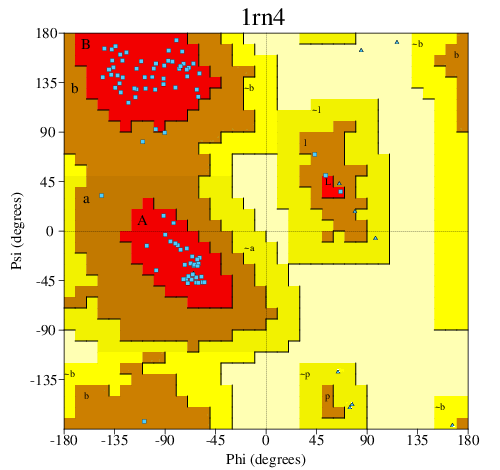
peptide is flipped such that phi/psi-angles of Asn44 are in alpha L-conformation
(that is observed in wild-type enzyme when guanine is bound).(ABSTRACT TRUNCATED
AT 400 WORDS)
|
|
|
|

|
|

|
|
Figure 1.
Figure 1. Stereo drawings of the orientation of the RNase T, molecules in the unit cel (drawn with SCHAKAL:
Keller, 1988). For clarity, only C'' atoms are shown; the loop 91 to 101 s drawn in thick lines. (a) RNase T, wild-type.
Xote that the terminus Ala1 NH; of each molecule contacts the loop 91 to 101 of a symmetry-related molecule.
(b) RNase T, H92A-PEG. With respect to the wild-type structure, the u-axis is shortened ad the h-axis is lengthened.
Loop 91 to 101 contacts the a-helix of a symmetry-related molecule. (c) Rru'ase T, HOBA-phosphate. With respect to (b),
the b-axis is shortened. Segment 94 to 97 o loop 91 to 101 was located due to disorder and is therefore not drawn.
|
|
Figure 4.
Figure 4. Electron density map (2F,- F,) of the dis-
ordered disulfide bridge Cys2Sy-CyslOSy in RNase T,
H92A-phosphate.
|
|
|
|
|
|
The above figures are
reprinted
by permission from Elsevier:
J Mol Biol
(1992,
224,
701-713)
copyright 1992.
|
|
|
|
|
|
|