|
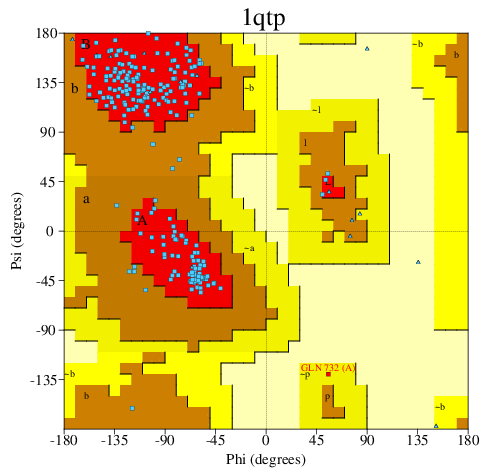
PDBsum entry 1qtp

|
|
|
|
|
|

|
|

|
|

|
|

|
|
|
 |

|

|
|
|
|
|
|
|
|
|
|
|
|
|
|
|
|
|
|
|
|
|
|
|
|
|
|
|
|
|
Membrane protein
|
PDB id
|
|
|
|
1qtp
|
|
|
|
|
|
|
|
|
|
|
|
|
|
|

|

|

|
|
|
|
|
|
|
|
 |
Contents |
 |
|
|
|
|
|
|
|
|
|
|
* Residue conservation analysis
|
|
|
|
|
References listed in PDB file
|
|
|
Key reference
|
|
|
Title
|
|
Crystal structure of the alpha appendage of ap-2 reveals a recruitment platform for clathrin-Coat assembly.
|
|
|
Authors
|
|
L.M.Traub,
M.A.Downs,
J.L.Westrich,
D.H.Fremont.
|
|
|
Ref.
|
|
Proc Natl Acad Sci U S A, 1999,
96,
8907-8912.
[DOI no: ]
|
|
|
PubMed id
|
|
|
|
|
|
Abstract
|
|
|
AP-2 adaptors regulate clathrin-bud formation at the cell surface by recruiting
clathrin trimers to the plasma membrane and by selecting certain membrane
proteins for inclusion within the developing clathrin-coat structure. These
functions are performed by discrete subunits of the adaptor heterotetramer. The
carboxyl-terminal appendage of the AP-2 alpha subunit appears to regulate the
translocation of several endocytic accessory proteins to the bud site. We have
determined the crystal structure of the alpha appendage at 1.4-A resolution by
multiwavelength anomalous diffraction phasing. It is composed of two distinct
structural modules, a beta-sandwich domain and a mixed alpha-beta platform
domain. Structure-based mutagenesis shows that alterations to the molecular
surface of a highly conserved region on the platform domain differentially
affect associations of the appendage with amphiphysin, eps15, epsin, and AP180,
revealing a common protein-binding interface.
|
|
|
|

|
|

|
|
Figure 1.
Fig. 1. (A) Schematic illustration of the subunit
organization of the AP-2 adaptor heterotetramer. Regions of the
complex with known protein-binding functions are indicated. For
tyrosine-based internalization signals, X is any amino acid and
Ø represents a bulky hydrophobic residue (1, 3). (B)
Functional protein associations with the GST-  [C]-appendage
fusion protein. Purified GST- [C]
appendage (0-100 µg) or GST (100 µg), immobilized on
25 µl packed glutathione Sepharose, were incubated in [C]-appendage
fusion protein. Purified GST- [C]
appendage (0-100 µg) or GST (100 µg), immobilized on
25 µl packed glutathione Sepharose, were incubated in  7.5 mg/ml rat
brain cytosol for 60 min at 4°C. The Sepharose beads were
then recovered by centrifugation, and aliquots corresponding to
1/150 of the
supernatant (S) and 1/10 of each pellet (P) were resolved by
SDS/PAGE and either stained with Coomassie blue (Left) or
transferred to nitrocellulose (Right). Portions of the blots
were probed with anti-epsin, anti-eps15, anti-amphiphysin,
anti-AP180, or anti-dynamin antibodies. The position of the
markers (kDa) is indicated on the left and only the relevant
portion of each blot is shown. 7.5 mg/ml rat
brain cytosol for 60 min at 4°C. The Sepharose beads were
then recovered by centrifugation, and aliquots corresponding to
1/150 of the
supernatant (S) and 1/10 of each pellet (P) were resolved by
SDS/PAGE and either stained with Coomassie blue (Left) or
transferred to nitrocellulose (Right). Portions of the blots
were probed with anti-epsin, anti-eps15, anti-amphiphysin,
anti-AP180, or anti-dynamin antibodies. The position of the
markers (kDa) is indicated on the left and only the relevant
portion of each blot is shown.
|
|
Figure 4.
Fig. 4. [C]
appendage-partner recognition surface. (A) Glutathione Sepharose
(25 µl packed beads) containing either wild-type GST- [C]
appendage ( [C]) or
GST- [C]
appendage F837A, R905A, R905A-F837A, R916A, or R916A-F837A
mutants were incubated with rat brain cytosol for 60 min at
4°C. The Sepharose beads were then recovered by
centrifugation, and aliquots corresponding to 1/150 of the
supernatant (S) and 1/10 of each washed pellet (P) were resolved
by SDS/PAGE and either stained with Coomassie blue (Left) or
transferred to nitrocellulose (Right). Portions of the blots
were probed with anti-epsin, anti-eps15, anti-amphiphysin,
anti-AP180, or anti-dynamin antibodies. Immunoblots from assays
performed at low ( 25 µg,
L) or high ( 100 µg,
H) GST- [C] density
are indicated on the left. In the experiment performed at high
density shown, the GST- [C] F837A
mutant was not tested, and 1/40 of each supernatant was
analyzed. The position of the markers (kDa) is indicated on the
left, and only the relevant portion of each blot is shown. (B)
Ribbon diagram (32) of the platform domain viewed from the top.
Conserved residues that make up the upper surface of the
platform are colored with invariant residues shaded magenta and
conserved residues, yellow. The extended hydrogen-bonding
network is shown as small gray balls with oxygen atoms in red,
nitrogen in blue. The three highly exposed residues that have
major consequences on partner binding when mutated to Ala are
highlighted (F837, R905, R916).
|
|
|
|
|
|
|
|
|
|