|
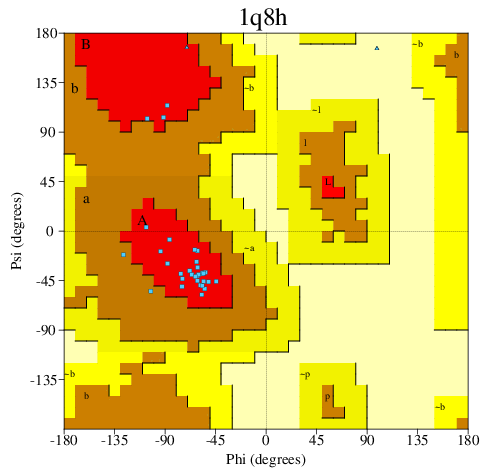
PDBsum entry 1q8h

|
|
|
|
|
|

|
|

|
|

|
|

|
|

|
|
|
 |

|

|
|
|
|
|
|
|
|
|
|
|
|
|
|
|
|
|
|
|
|
|
|
|
|
|
|
|
|
|
|
Metal binding protein
|
PDB id
|
|
|
|
1q8h
|
|
|
|
|
|
|
|
|
|
|
|
|
|
|

|

|

|
|
|
|
|
|
|
|
 |
Contents |
 |
|
|
|
|
|
|
|
|
|
|
|
|
* Residue conservation analysis
|
|
|
|
|
References listed in PDB file
|
|
|
Key reference
|
|
|
Title
|
|
Bone recognition mechanism of porcine osteocalcin from crystal structure.
|
|
|
Authors
|
|
Q.Q.Hoang,
F.Sicheri,
A.J.Howard,
D.S.Yang.
|
|
|
Ref.
|
|
Nature, 2003,
425,
977-980.
[DOI no: ]
|
|
|
PubMed id
|
|
|
|
|
|
Abstract
|
|
|
Osteocalcin is the most abundant noncollagenous protein in bone, and its
concentration in serum is closely linked to bone metabolism and serves as a
biological marker for the clinical assessment of bone disease. Although its
precise mechanism of action is unclear, osteocalcin influences bone
mineralization, in part through its ability to bind with high affinity to the
mineral component of bone, hydroxyapatite. In addition to binding to
hydroxyapatite, osteocalcin functions in cell signalling and the recruitment of
osteoclasts and osteoblasts, which have active roles in bone resorption and
deposition, respectively. Here we present the X-ray crystal structure of porcine
osteocalcin at 2.0 A resolution, which reveals a negatively charged protein
surface that coordinates five calcium ions in a spatial orientation that is
complementary to calcium ions in a hydroxyapatite crystal lattice. On the basis
of our findings, we propose a model of osteocalcin binding to hydroxyapatite and
draw parallels with other proteins that engage crystal lattices.
|
|
|
|

|
|

|
|
Figure 1.
Figure 1: Structure of pOC. a, Protein sequence with the
secondary structure elements indicated and the conserved
residues highlighted (green, red, blue, yellow, orange and grey
indicate conserved, acidic, basic, cysteine, asparagine and
glycine residues, respectively). Positions are identified as
conserved if more than 85% of the residues are identical, or
similar if hydrophobic in nature (see Supplementary Information
for the full sequence alignment). '  '
indicates a Gla residue, open triangles and circles indicate
hydrophobic core and Ca^2+-coordinating surface, respectively.
b, Ribbon representation of the crystal structure. The N and C
termini are labelled. Side chains of the Ca^2+-coordinating
residues and those involved in tertiary structure stabilization
are shown in stick representation. Broken grey line indicates a
hydrogen bond. c, d, Molecular surface representations of pOC
with the surface hydrophobic patch (green) and the
Ca^2+-coordinating surface (red) highlighted. Views in b and c
are perpendicular to that in d. e, Crystallographic dimer
interface. Orange and blue distinguish the two molecules. Purple
spheres and the yellow broken lines represent Ca^2+ ions and
ionic bonds, respectively. '
indicates a Gla residue, open triangles and circles indicate
hydrophobic core and Ca^2+-coordinating surface, respectively.
b, Ribbon representation of the crystal structure. The N and C
termini are labelled. Side chains of the Ca^2+-coordinating
residues and those involved in tertiary structure stabilization
are shown in stick representation. Broken grey line indicates a
hydrogen bond. c, d, Molecular surface representations of pOC
with the surface hydrophobic patch (green) and the
Ca^2+-coordinating surface (red) highlighted. Views in b and c
are perpendicular to that in d. e, Crystallographic dimer
interface. Orange and blue distinguish the two molecules. Purple
spheres and the yellow broken lines represent Ca^2+ ions and
ionic bonds, respectively.
|
|
Figure 2.
Figure 2: Model of pOC engaging an HA crystal based on a Ca^2+
ion lattice match. Only the best search solution is shown
(see Supplementary Information for a comparison of the four best
solutions). a, Alignment of pOC-bound (purple) and HA (green)
Ca^2+ ions. b, c, Orientation of pOC-bound Ca^2+ ions in a
sphere of HA -Ca lattice (b) and on the HA surface (c). In b,
the parallelogram indicates a unit cell; the box approximates
the boundary of the slab shown in c and d. d, Docking of pOC
(orange backbone with grey semitransparent surface) on HA. e,
Detailed view of d showing the Ca -O coordination network at the
pOC -HA interface. Yellow broken lines denote ionic bonds.
Isolated red spheres and the tetrahedral clusters of magenta and
red spheres represent OH- and PO[4]^3- ions, respectively.
|
|
|
|
|
|
The above figures are
reprinted
by permission from Macmillan Publishers Ltd:
Nature
(2003,
425,
977-980)
copyright 2003.
|
|
|
|
|
|
|