|
PDBsum entry 1psr

|
|
|
|
|
|

|
|

|
|

|
|

|
|

|
|

|
|
|
 |

|

|
|
|
|
|
|
|
|
|
|
|
|
|
|
|
|
|
|
|
|
|
|
|
|
|
|
|
|
|
|
|
Ef-hand protein
|
PDB id
|
|
|
|
1psr
|
|
|
|
|
|
|
|
|
|
|
|
|
|
|

|

|

|
|
|
|
|
|
|
|
 |
Contents |
 |
|
|
|
|
|
|
|
|
|
|
|
|
* Residue conservation analysis
|
|
|
|
|
References listed in PDB file
|
|
|
Key reference
|
|
|
Title
|
|
Ef-Hands at atomic resolution: the structure of human psoriasin (s100a7) solved by mad phasing.
|
|
|
Authors
|
|
D.E.Brodersen,
M.Etzerodt,
P.Madsen,
J.E.Celis,
H.C.Thøgersen,
J.Nyborg,
M.Kjeldgaard.
|
|
|
Ref.
|
|
Structure, 1998,
6,
477-489.
[DOI no: ]
|
|
|
PubMed id
|
|
|
|
|
|
Abstract
|
|
|
BACKGROUND: The S100 family consists of small acidic proteins, belonging to the
EF-hand class of calcium-binding proteins. They are primarily regulatory
proteins, involved in cell growth, cell structure regulation and signal
transduction. Psoriasin (S100A7) is an 11.7 kDa protein that is highly
upregulated in the epidermis of patients suffering from the chronic skin disease
psoriasis. Although its exact function is not known, psoriasin is believed to
participate in the biochemical response which follows transient changes in the
cellular Ca2+ concentration. RESULTS: The three-dimensional structure of
holmium-substituted psoriasin has been determined by multiple anomalous
wavelength dispersion (MAD) phasing and refined to atomic resolution (1.05 A).
The structure represents the most accurately determined structure of a
calcium-binding protein. Although the overall structure of psoriasin is similar
to those of other S100 proteins, several important differences exist, mainly in
the N-terminal EF-hand motif that contains a distorted loop and lacks a crucial
calcium-binding residue. It is these minor differences that may account for the
different specificities among members of this family. CONCLUSIONS: The structure
of human psoriasin reveals that this protein, in contrast to other S100 proteins
with known structure, is not likely to strongly bind more than one calcium ion
per monomer. The present study contradicts the idea that calcium binding induces
large changes in conformation, as suggested by previously determined structures
of apo forms of S100 proteins. The substitution of Ca2+ ions in EF-hands by
lanthanide ions may provide a general vehicle for structure determination of
S100 proteins by means of MAD phasing.
|
|
|
|

|
|
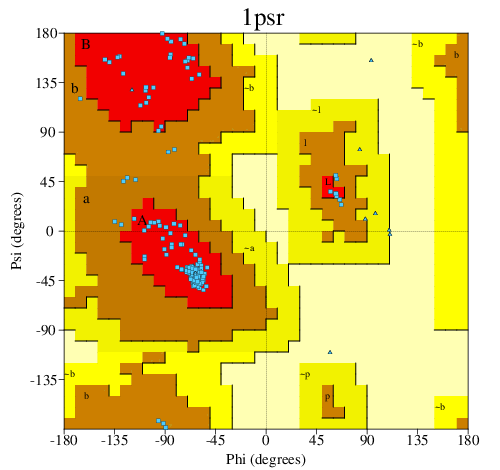
Figure 7.
Figure 7. The Ramachandran plot for the final model.
Non-glycine and non-proline residues are indicated by solid
circles (asparagine residues as solid diamonds) and glycine
residues as open squares. The shaded area corresponds to the 98%
core regions as defined by Kleywegt and Jones [38]. Plot was
created with rama (MK, unpublished program).
|
|
|
|
|
|
The above figure is
reprinted
by permission from Cell Press:
Structure
(1998,
6,
477-489)
copyright 1998.
|
|
|
Secondary reference #1
|
|
|
Title
|
|
Crystallization and preliminary X-Ray diffraction studies of psoriasin.
|
|
|
Authors
|
|
S.Nolsøe,
S.Thirup,
M.Etzerodt,
H.C.Thøgersen,
J.Nyborg.
|
|
|
Ref.
|
|
Acta Crystallogr D Biol Crystallogr, 1997,
53,
119-121.
[DOI no: ]
|
|
|
PubMed id
|
|
|
|
|
|
|
|
|
|

|
|
Figure 1.
Fig. 1. (a) Crystal form I. Crystals of psoriasin, crystallized in the
presence of Ca2+with dimensions 500 x 50 × 50 ~tm. (b) Crystal
form II. Crystals of psoriasin, crystallized in the presence of Zn
2+
with dimensions 100 x 100 x 200 lam.
|
|
|
|
|
|
The above figure is
reproduced from the cited reference
with permission from the IUCr
|
|
|
Secondary reference #2
|
|
|
Title
|
|
Molecular cloning, Occurrence, And expression of a novel partially secreted protein "psoriasin" that is highly up-Regulated in psoriatic skin.
|
|
|
Authors
|
|
P.Madsen,
H.H.Rasmussen,
H.Leffers,
B.Honoré,
K.Dejgaard,
E.Olsen,
J.Kiil,
E.Walbum,
A.H.Andersen,
B.Basse.
|
|
|
Ref.
|
|
J Invest Dermatol, 1991,
97,
701-712.
|
|
|
PubMed id
|
|
|
|
|
|
|
|
|
|
|
|
|