Efficient type-III secretion depends on cytosolic molecular chaperones, which
bind specifically to the translocators and effectors. In the past there has been
a tendency to shoe-horn all type-III-secretion chaperones into a single
structural and functional class. However, we have shown that the LcrH/SycD-like
chaperones consist of three central tetratricopeptide-like repeats that are
predicted to fold into an all-alpha-helical array that is quite distinct from
the known structure of the SycE class of chaperones. Furthermore, we predict
that this array creates a peptide-binding groove that is utterly different from
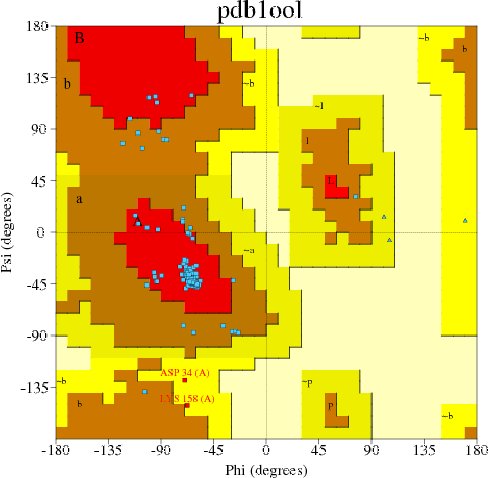
the helix-binding groove in SycE. We present a homology model of LcrH/SycD that
is consistent with existing mutagenesis data. We also report the existence of
tetratricopeptide-like repeats in regulators of type-III secretion, such as HilA
from Salmonella enterica and HrpB from Ralstonia solanacearum. The discovery of
tetratricopeptide-like repeats in type-III-secretion regulators and chaperones
provides a new conceptual framework for structural and mutagenesis studies and
signals a potential unification of prokaryotic and eukaryotic chaperone biology.