|
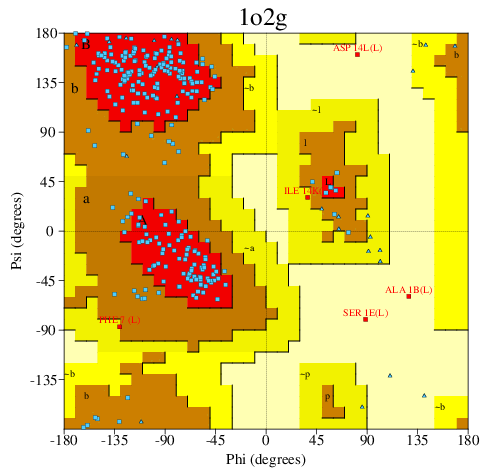
PDBsum entry 1o2g

|
|
|
|
|
|

|
|

|
|

|
|

|
|

|
|

|
|

|
|

|
|
|
 |

|

|
|
|
|
|
|
|
|
|
|
|
|
|
|
|
|
|
|
|
|
|
|
|
|
|
|
|
|
|
|
|
|
|
Blood clotting,hydrolase/inhibitor
|
PDB id
|
|
|
|
1o2g
|
|
|
|
|
|
|
|
|
|
|
|
|
|
|

|

|

|
|
|
|
|
|
|
|
 |
Contents |
 |
|
|
|
|
|
|
|
|
|
|
|
|
|
|
* Residue conservation analysis
|
|
|
|
|
References listed in PDB file
|
|
|
Key reference
|
|
|
Title
|
|
Elaborate manifold of short hydrogen bond arrays mediating binding of active site-Directed serine protease inhibitors.
|
|
|
Authors
|
|
B.A.Katz,
K.Elrod,
E.Verner,
R.L.Mackman,
C.Luong,
W.D.Shrader,
M.Sendzik,
J.R.Spencer,
P.A.Sprengeler,
A.Kolesnikov,
V.W.Tai,
H.C.Hui,
J.G.Breitenbucher,
D.Allen,
J.W.Janc.
|
|
|
Ref.
|
|
J Mol Biol, 2003,
329,
93.
[DOI no: ]
|
|
|
PubMed id
|
|
|
|
|
|
Abstract
|
|
|
An extensive structural manifold of short hydrogen bond-mediated, active
site-directed, serine protease inhibition motifs is revealed in a set of over
300 crystal structures involving a large suite of small molecule inhibitors
(2-(2-phenol)-indoles and 2-(2-phenol)-benzimidazoles) determined over a wide
range of pH (3.5-11.4). The active site hydrogen-bonding mode was found to vary
markedly with pH, with the steric and electronic properties of the inhibitor,
and with the type of protease (trypsin, thrombin or urokinase type plasminogen
activator (uPA)). The pH dependence of the active site hydrogen-bonding motif is
often intricate, constituting a distinct fingerprint of each complex. Isosteric
replacements or minor substitutions within the inhibitor that modulate the pK(a)
of the phenol hydroxyl involved in short hydrogen bonding, or that affect steric
interactions distal to the active site, can significantly shift the pH-dependent
structural profile characteristic of the parent scaffold, or produce active
site-binding motifs unique to the bound analog.Ionization equilibria at the
active site associated with inhibitor binding are probed in a series of the
protease-inhibitor complexes through analysis of the pH dependence of the
structure and environment of the active site-binding groups involved in short
hydrogen bond arrays. Structures determined at high pH (>11), suggest that the
pK(a) of His57 is dramatically elevated, to a value as high as approximately 11
in certain complexes. K(i) values involving uPA and trypsin determined as a
function of pH for a set of inhibitors show pronounced parabolic pH dependence,
the pH for optimal inhibition governed by the pK(a) of the inhibitor phenol
involved in short hydrogen bonds. Comparison of structures of trypsin, thrombin
and uPA, each bound by the same inhibitor, highlights important structural
variations in the S1 and active sites accessible for engineering notable
selectivity into remarkably small molecules with low nanomolar K(i) values.
|
|
|
|

|
|

|
|
Figure 4.
Figure 4. (a) Resonance forms (A,
B) for the lowest energy (non-bind-
ing) conformation of the benzi-
midazole scaffold. Structure C
represents the conformer and tauto-
mer for bound benzimidazoles. (b1)
Resonance forms for the lowest
energy (non-binding) conformation
of the 6-chlorobenzimidazole
scaffold (D, E). Structure F rep-
resents the conformer and tautomer
for bound 6-chlorobenzimidazoles.
(b2) Resonance forms for bound
6-chlorobenzimidazoles.
|
|
Figure 10.
Figure 10. (a) Structure and
(2lF
ol 2 lFc l); ac map for trypsin-CRA-18306, pH 7.2, 1.56 A
š
resolution. The OSer195
g
--
Ophenol hydrogen bond is short (2.35 ^ 05 A
š
) at pH , 7.7 and longer at pH . 7.8 (2.59 ^ 09 A
š
, Table S1). (b) Structure
and
(2lF
o l 2 lFcl); ac map for trypsin-CRA-18607, pH 7.9, 1.55 A
š
resolution. Hydrogen bonds (short and ordinary) cor-
responding to the (Ooxy, OSer195 (conformation 1)
g
, Ophenol) array are cyan, while those for the (OS2, OSer195 (conformation 2)
g
, Ophenol)
array are yellow, (or olive green for NHis57
12
-- OS2).
|
|
|
|
|
|
The above figures are
reprinted
by permission from Elsevier:
J Mol Biol
(2003,
329,
93-0)
copyright 2003.
|
|
|
|
|
|
|