 |
PDBsum entry 1mwc

|
|
|
|
|
|

|

|

|

|
|

|
|

|
|

|
|

|
|
|
 |

|

|
|
|
|
|
|
|
|
|
|
|
|
|
|
|
|
|
|
|
|
|
|
|
|
|
|
|
|
|
|
|
|
|
Oxygen storage/transport
|
PDB id
|
|
|
|
1mwc
|
|
|
|
|
|
|
|
|
|
|
|
|
|
|

|

|

|
|
|
|
|
|
|
|
 |
Contents |
 |
|
|
|
|
|
|
|
|
|
|
|
|
* Residue conservation analysis
|
|
|
|
|
|
PDB id:
|
|
|
|
| Name: |
|
Oxygen storage/transport
|
|
|
Title:
|
|
Wild type myoglobin with co
|
|
Structure:
|
|
Protein (myoglobin). Chain: a, b. Engineered: yes
|
|
Source:
|
|
Sus scrofa. Pig. Organism_taxid: 9823. Expressed in: escherichia coli. Expression_system_taxid: 562.
|
|
Resolution:
|
|
|
1.70Å
|
R-factor:
|
0.189
|
R-free:
|
0.237
|
|
|
Authors:
|
|
G.N.Murshudov,S.Krzywda,A.M.Brzozowski,M.Jaskolski,E.E.Scott, S.A.Klizas,Q.H.Gibson,J.S.Olson,A.J.Wilkinson
|
Key ref:

|
|
S.Krzywda
et al.
(1998).
Stabilizing bound O2 in myoglobin by valine68 (E11) to asparagine substitution.
Biochemistry,
37,
15896-15907.
PubMed id:
DOI:
|
|
|
Date:
|
|
|
12-Aug-98
|
Release date:
|
19-Aug-98
|
|
|
|
|
|
|
PROCHECK
|

|
|
|
|
|
Headers
|
|
|
|
References
|
|
|
|
|
|

|
|
P02189
(MYG_PIG) -
Myoglobin from Sus scrofa
|
|
|
|
Seq:
Struc:
|
|
|
|
154 a.a.
153 a.a.
|
|

|
|
|
|
|
|
|
|
|
|
|
|
|
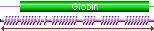
Key: |
 |
PfamA domain |
|
|
 |
Secondary structure |
|
 |
CATH domain |
|
|
|
|
|
|
|
|
|
|
|
|
|
|
|
|
|
 |
|
|
|
|
|
|
| |
|
DOI no:
|
Biochemistry
37:15896-15907
(1998)
|
|
PubMed id:
|
|
|
|
|
|
| |
|
Stabilizing bound O2 in myoglobin by valine68 (E11) to asparagine substitution.
|
|
S.Krzywda,
G.N.Murshudov,
A.M.Brzozowski,
M.Jaskolski,
E.E.Scott,
S.A.Klizas,
Q.H.Gibson,
J.S.Olson,
A.J.Wilkinson.
|
|
|
|
|
| |
ABSTRACT
|
|
|
|
| |
|
|
The isopropyl side chain of valine68 in myoglobin has been replaced by the
acetamide side chain of asparagine in an attempt to engineer higher oxygen
affinity. The asparagine replacement introduces a second hydrogen bond donor
group into the distal heme pocket which could further stabilize bound oxygen.
The Val68 to Asn substitution leads to approximately 3-fold increases in oxygen
affinity and 4-6-fold decreases in CO affinity. As a result, the M-value
(KCO/KO2) is lowered 15-20-fold to a value close to unity. An even larger
enhancement of O2 affinity is seen when asparagine68 is inserted into H64L sperm
whale myoglobin which lacks a distal histidine. The overall rate constants for
oxygen and carbon monoxide binding to the single V68N myoglobin mutants are
uniformly lower than those for the wild-type protein. In contrast, the overall
rate constant for NO association is unchanged. Analyses of time courses
monitoring the geminate recombination of ligands following nanosecond and
picosecond flash photolysis of MbNO and MbO2 indicate that the barrier to ligand
binding from within the heme pocket has been raised with little effect on the
barrier to diffusion of the ligand into the pocket from the solvent. The crystal
structures of the aquomet, deoxy, oxy, and carbon monoxy forms of the V68N
mutant have been determined to resolutions ranging from 1.75 to 2.2 A at 150 K.
The overall structures are very similar to those of the wild-type protein with
the principal alterations taking place within and around the distal heme pocket.
In all four structures the asparagine68 side chain lies almost parallel to the
plane of the heme with its amide group directed toward the back of the distal
heme pocket. The coordinated water molecule in the aquomet form and the bound
oxygen in the oxy form can form hydrogen-bonding interactions with both the
Asn68 amide group and the imidazole side chain of His64. Surprisingly, in the
carbon monoxy form of the V68N mutant, the histidine64 side chain has swung
completely out the distal pocket, its place being taken by two ordered water
molecules. Overall, these functional and structural results show that the
asparagine68 side chain (i) forms a strong hydrogen bond with bound oxygen
through its -NH2 group but (ii) sterically hinders the approach of ligands to
the iron from within the distal heme pocket.
|
|
|
|
|
|
|
|
|
|
|
|
|
|
|
|
|
|
 |
 |
 |
|
Literature references that cite this PDB file's key reference
|
|
|
| |
PubMed id
|
|
Reference
|
|
|
|
|
|
J.J.Stewart
(2009).
Application of the PM6 method to modeling proteins.
|
| |
J Mol Model,
15,
765-805.
|
|
|
|
|
|
|
R.A.Goldbeck,
M.L.Pillsbury,
R.A.Jensen,
J.L.Mendoza,
R.L.Nguyen,
J.S.Olson,
J.Soman,
D.S.Kliger,
and
R.M.Esquerra
(2009).
Optical detection of disordered water within a protein cavity.
|
| |
J Am Chem Soc,
131,
12265-12272.
|
|
|
PDB codes:
|
|
|
|
|
|
|
|
Z.N.Zahran,
L.Chooback,
D.M.Copeland,
A.H.West,
and
G.B.Richter-Addo
(2008).
Crystal structures of manganese- and cobalt-substituted myoglobin in complex with NO and nitrite reveal unusual ligand conformations.
|
| |
J Inorg Biochem,
102,
216-233.
|
|
|
PDB codes:
|
|
|
|
|
|
|
|
J.Friedman,
Y.T.Meharenna,
A.Wilks,
and
T.L.Poulos
(2007).
Diatomic ligand discrimination by the heme oxygenases from Neisseria meningitidis and Pseudomonas aeruginosa.
|
| |
J Biol Chem,
282,
1066-1071.
|
|
|
|
|
|
|
D.Dantsker,
C.Roche,
U.Samuni,
G.Blouin,
J.S.Olson,
and
J.M.Friedman
(2005).
The position 68(E11) side chain in myoglobin regulates ligand capture, bond formation with heme iron, and internal movement into the xenon cavities.
|
| |
J Biol Chem,
280,
38740-38755.
|
|
|
|
|
|
|
F.Rodier,
R.P.Bahadur,
P.Chakrabarti,
and
J.Janin
(2005).
Hydration of protein-protein interfaces.
|
| |
Proteins,
60,
36-45.
|
|
|
|
|
|
|
D.Dantsker,
U.Samuni,
Y.Ouellet,
B.A.Wittenberg,
J.B.Wittenberg,
M.Milani,
M.Bolognesi,
M.Guertin,
and
J.M.Friedman
(2004).
Viscosity-dependent relaxation significantly modulates the kinetics of CO recombination in the truncated hemoglobin TrHbN from Mycobacterium tuberculosis.
|
| |
J Biol Chem,
279,
38844-38853.
|
|
|
|
|
|
|
M.Unno,
T.Matsui,
G.C.Chu,
M.Couture,
T.Yoshida,
D.L.Rousseau,
J.S.Olson,
and
M.Ikeda-Saito
(2004).
Crystal structure of the dioxygen-bound heme oxygenase from Corynebacterium diphtheriae: implications for heme oxygenase function.
|
| |
J Biol Chem,
279,
21055-21061.
|
|
|
PDB code:
|
|
|
|
|
|
|
|
Y.Wang,
J.S.Baskin,
T.Xia,
and
A.H.Zewail
(2004).
Human myoglobin recognition of oxygen: dynamics of the energy landscape.
|
| |
Proc Natl Acad Sci U S A,
101,
18000-18005.
|
|
|
|
|
|
|
S.Kundu,
and
M.S.Hargrove
(2003).
Distal heme pocket regulation of ligand binding and stability in soybean leghemoglobin.
|
| |
Proteins,
50,
239-248.
|
|
|
|
|
|
|
H.Ishikawa,
T.Uchida,
S.Takahashi,
K.Ishimori,
and
I.Morishima
(2001).
Ligand migration in human myoglobin: steric effects of isoleucine 107(G8) on O(2) and CO binding.
|
| |
Biophys J,
80,
1507-1517.
|
|
|
|
|
|
|
S.Ozaki,
I.Hara,
T.Matsui,
and
Y.Watanabe
(2001).
Molecular engineering of myoglobin: the improvement of oxidation activity by replacing Phe-43 with tryptophan.
|
| |
Biochemistry,
40,
1044-1052.
|
|
|
|
|
|
|
B.D.Nguyen,
Z.Xia,
F.Cutruzzolá,
C.T.Allocatelli,
M.Brunori,
and
G.N.La Mar
(2000).
Solution (1)H NMR study of the influence of distal hydrogen bonding and N terminus acetylation on the active site electronic and molecular structure of Aplysia limacina cyanomet myoglobin.
|
| |
J Biol Chem,
275,
742-751.
|
|
|
|
|
|
The most recent references are shown first.
Citation data come partly from CiteXplore and partly
from an automated harvesting procedure. Note that this is likely to be
only a partial list as not all journals are covered by
either method. However, we are continually building up the citation data
so more and more references will be included with time.
Where a reference describes a PDB structure, the PDB
codes are
shown on the right.
|
|


 Links
Links


