 |
PDBsum entry 1m8f

|
|
|
|
|
 |
Contents |
 |
|
|
|
|
|
|
|
|
|
|
|
|
* Residue conservation analysis
|
|
|
|
|
|
|
|
|
|
|
Enzyme class:
|
|
E.C.2.7.7.1
- nicotinamide-nucleotide adenylyltransferase.
|
|
|
|
|
|
|
Reaction:
|
|
beta-nicotinamide D-ribonucleotide + ATP + H+ = diphosphate + NAD+
|
|
|
|
|
|
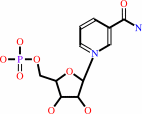 beta-nicotinamide D-ribonucleotide
|
+
|
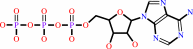 ATP
ATP
|
+
|
H(+)
|
=
|
 diphosphate
|
+
|
NAD(+)
Bound ligand (Het Group name = )
corresponds exactly
|
|
|
|
|
|
|
|
|
|
|
|
|
Molecule diagrams generated from .mol files obtained from the
KEGG ftp site
|
|
|
|
|
|
|
|
|
|
|
|
|
|
 |
|
|
|
|
|
|
| |
|
|
| |
|
DOI no:
|
J Biol Chem
278:34356-34363
(2003)
|
|
PubMed id:
|
|
|
|
|
|
| |
|
Mutational, structural, and kinetic studies of the ATP-binding site of Methanobacterium thermoautotrophicum nicotinamide mononucleotide adenylyltransferase.
|
|
V.Saridakis,
E.F.Pai.
|
|
|
|
|
| |
ABSTRACT
|
|
|
|
| |
|
|
Several residues lining the ATP-binding site of Methanobacterium
thermoautotrophicum nicotinamide mononucleotide adenylyltransferase (NMNATase)
were mutated in an effort to better characterize their roles in substrate
binding and catalysis. Residues selected were Arg-11 and Arg-136, both of which
had previously been implicated as substrate binding residues, as well as His-16
and His-19, part of the HXGH active site motif and postulated to be of
importance in catalysis. Kinetic studies revealed that both Arg-11 and Arg-136
contributed to the binding of the substrate, ATP. When these amino acids were
replaced by lysines, the apparent Km values of the respective mutants for ATP
decreased by factors of 1.3 and 2.9 and by factors of 1.9 and 8.8 when the same
residues were changed to alanines. All four Arg mutants displayed unaltered Km
values for NMN. The apparent kcat values of the R11K and R136K mutants were the
same as those of WT NMNATase but the apparent kcat values of the alanine mutants
had decreased. Crystal structures of the Arg mutants revealed NAD+ and SO42-
molecules trapped at their active sites. The binding interactions of NAD+ were
unchanged but the binding of SO42- was altered in these mutants compared with
wild type. The alanine mutants at positions His-16 and His-19 retained
approximately 6 and 1.3%, respectively, of WT NMNATase activity indicating that
His-19 is a key catalytic group. Surprisingly, this H19A mutant displayed a
novel and distinct mode of NAD+ binding when co-crystallized in the presence of
NAD+ and SO42-.
|
|
|
|
|
|
| |
Selected figure(s)
|
|
|
|
| |
|
|

|
|

|
|
Figure 2.
FIG. 2. A, the crystallographic contacts formed between
adjacent WT hexamers complexed with NAD^+ are shown (yellow and
red). B, the principle interactions between the hexamers are
shown in greater detail with the residues forming these
interactions in ball and stick form.
|
|
Figure 3.
FIG. 3. A, the crystallographic contacts formed between
adjacent H19A hexamers complexed with NAD^+ are shown (blue and
green). B, the principle interactions between the hexamers are
shown in greater detail with the residues forming these
interactions in ball and stick form.
|
|
|
|
|
|
| |
The above figures are
reprinted
by permission from the ASBMB:
J Biol Chem
(2003,
278,
34356-34363)
copyright 2003.
|
|
| |
Figures were
selected
by an automated process.
|
|
|
|
|
|
|
|
|
|
|
|
|
|
|
|
 |
 |
 |
|
Literature references that cite this PDB file's key reference
|
|
|
| |
PubMed id
|
|
Reference
|
|
|
|
|
|
R.G.Zhai,
M.Rizzi,
and
S.Garavaglia
(2009).
Nicotinamide/nicotinic acid mononucleotide adenylyltransferase, new insights into an ancient enzyme.
|
| |
Cell Mol Life Sci,
66,
2805-2818.
|
|
|
|
|
|
|
S.Frago,
A.Velázquez-Campoy,
and
M.Medina
(2009).
The puzzle of ligand binding to Corynebacterium ammoniagenes FAD synthetase.
|
| |
J Biol Chem,
284,
6610-6619.
|
|
|
|
|
|
|
N.Huang,
L.Sorci,
X.Zhang,
C.A.Brautigam,
X.Li,
N.Raffaelli,
G.Magni,
N.V.Grishin,
A.L.Osterman,
and
H.Zhang
(2008).
Bifunctional NMN adenylyltransferase/ADP-ribose pyrophosphatase: structure and function in bacterial NAD metabolism.
|
| |
Structure,
16,
196-209.
|
|
|
PDB codes:
|
|
|
|
|
|
|
|
M.Stancek,
R.Schnell,
and
M.Rydén-Aulin
(2005).
Analysis of Escherichia coli nicotinate mononucleotide adenylyltransferase mutants in vivo and in vitro.
|
| |
BMC Biochem,
6,
16.
|
|
|
|
|
|
|
S.Mahato,
D.De,
D.Dutta,
M.Kundu,
S.Bhattacharya,
M.T.Schiavone,
and
S.K.Bhattacharya
(2004).
Potential use of sugar binding proteins in reactors for regeneration of CO2 fixation acceptor D-Ribulose-1,5-bisphosphate.
|
| |
Microb Cell Fact,
3,
7.
|
|
|
|
|
|
The most recent references are shown first.
Citation data come partly from CiteXplore and partly
from an automated harvesting procedure. Note that this is likely to be
only a partial list as not all journals are covered by
either method. However, we are continually building up the citation data
so more and more references will be included with time.
Where a reference describes a PDB structure, the PDB
codes are
shown on the right.
|
|


 Links
Links


