 |
PDBsum entry 1llw

|
|
|
|
|
|

|

|

|

|
|

|
|

|
|

|
|

|
|
|
 |

|

|
|
|
|
|
|
|
|
|
|
|
|
|
|
|
|
|
|
|
|
|
|
|
|
|
|
|
|
|
|
|
|
|
Oxidoreductase
|
PDB id
|
|
|
|
1llw
|
|
|
|
|
|
|
|
|
|
|
|
|
|
|

|

|

|
|
|
|
|
|
|
|
 |
Contents |
 |
|
|
|
|
|
|
|
|
|
|
|
|
* Residue conservation analysis
|
|
|
|
|
|
|
|
|
|
|
Enzyme class:
|
|
E.C.1.4.7.1
- glutamate synthase (ferredoxin).
|
|
|
|
|
|
|
Reaction:
|
|
2 oxidized [2Fe-2S]-[ferredoxin] + 2 L-glutamate = L-glutamine + 2 reduced [2Fe-2S]-[ferredoxin] + 2-oxoglutarate + 2 H+
|
|
|
|
|
|
2
×
oxidized [2Fe-2S]-[ferredoxin]
|
+
|
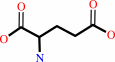 2
×
L-glutamate
2
×
L-glutamate
|
=
|
L-glutamine
Bound ligand (Het Group name = )
corresponds exactly
|
+
|
2
×
reduced [2Fe-2S]-[ferredoxin]
|
+
|
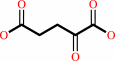 2-oxoglutarate
|
+
|
2
×
H(+)
|
|
|
|
|
|
|
|
|
|
Cofactor:
|
|
FAD; FMN; Iron-sulfur
|
|
|
|
|
|
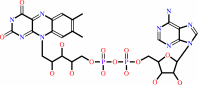 FAD
FAD
|
FMN
Bound ligand (Het Group name =
FMN)
corresponds exactly
|
 Iron-sulfur
|
|
|
|
|
|
|
Molecule diagrams generated from .mol files obtained from the
KEGG ftp site
|
|
|
|
|
|
|
|
|
|
|
|
|
|
 |
|
|
|
|
|
|
| |
|
|
| |
|
DOI no:
|
J Biol Chem
277:24579-24583
(2002)
|
|
PubMed id:
|
|
|
|
|
|
| |
|
Structural studies on the synchronization of catalytic centers in glutamate synthase.
|
|
R.H.van den Heuvel,
D.Ferrari,
R.T.Bossi,
S.Ravasio,
B.Curti,
M.A.Vanoni,
F.J.Florencio,
A.Mattevi.
|
|
|
|
|
| |
ABSTRACT
|
|
|
|
| |
|
|
The complex iron-sulfur flavoprotein glutamate synthase (GltS) plays a prominent
role in ammonia assimilation in bacteria, yeasts, and plants. GltS catalyzes the
formation of two molecules of l-glutamate from 2-oxoglutarate and l-glutamine
via intramolecular channeling of ammonia. GltS has the impressive ability of
synchronizing its distinct catalytic centers to avoid wasteful consumption of
l-glutamine. We have determined the crystal structure of the
ferredoxin-dependent GltS in several ligation and redox states. The structures
reveal the crucial elements in the synchronization between the glutaminase site
and the 2-iminoglutarate reduction site. The structural data combined with the
catalytic properties of GltS indicate that binding of ferredoxin and
2-oxoglutarate to the FMN-binding domain of GltS induce a conformational change
in the loop connecting the two catalytic centers. The rearrangement induces a
shift in the catalytic elements of the amidotransferase domain, such that it
becomes activated. This machinery, over a distance of more than 30 A, controls
the ability of the enzyme to bind and hydrolyze the ammonia-donating substrate
l-glutamine.
|
|
|
|
|
|
| |
Selected figure(s)
|
|
|
|
| |
|
|

|
|

|
|
Figure 1.
Fig. 1. The overall structure of Fd-GltS with the
N-terminal amidotransferase domain depicted in cornflower blue,
the FMN-binding domain in yellow, the central domain in magenta,
and the C-terminal domain in green. The FMN cofactor and the
3Fe-4S cluster are shown in black ball-and-stick, and the
ammonia channel is outlined by red spheres. Dashed lines connect
the borders of disordered loops.
|
|
Figure 3.
Fig. 3. Interdomain communication in Fd-GltS. The
transparent coloring of the Fd-GltS monomer is identical to the
coloring in Fig. 1 as is the orientation. Highlighted are the
proposed elements involved in interdomain channeling and
synchronization; Fd loop (residues 907-933), loop 4 (residues
968-1013), and loop 31-39. The FMN cofactor, 3Fe-4S cluster, and
residues Cys-1 and Glu-1013 are shown as black ball-and-stick.
The ammonia channel is outlined by red spheres.
|
|
|
|
|
|
| |
The above figures are
reprinted
by permission from the ASBMB:
J Biol Chem
(2002,
277,
24579-24583)
copyright 2002.
|
|
| |
Figures were
selected
by an automated process.
|
|
|
|
|
|
|
|
|
|
|
|
|
|
|
|
 |
 |
 |
|
Literature references that cite this PDB file's key reference
|
|
|
| |
PubMed id
|
|
Reference
|
|
|
|
|
|
H.B.Dincturk,
R.Cunin,
and
H.Akce
(2011).
Expression and functional analysis of glutamate synthase small subunit-like proteins from archaeon Pyrococcus horikoshii.
|
| |
Microbiol Res,
166,
294-303.
|
|
|
|
|
|
|
L.Lund,
Y.Fan,
Q.Shao,
Y.Q.Gao,
and
F.M.Raushel
(2010).
Carbamate transport in carbamoyl phosphate synthetase: a theoretical and experimental investigation.
|
| |
J Am Chem Soc,
132,
3870-3878.
|
|
|
|
|
|
|
J.B.Glass,
F.Wolfe-Simon,
and
A.D.Anbar
(2009).
Coevolution of metal availability and nitrogen assimilation in cyanobacteria and algae.
|
| |
Geobiology,
7,
100-123.
|
|
|
|
|
|
|
Y.Fan,
L.Lund,
Q.Shao,
Y.Q.Gao,
and
F.M.Raushel
(2009).
A combined theoretical and experimental study of the ammonia tunnel in carbamoyl phosphate synthetase.
|
| |
J Am Chem Soc,
131,
10211-10219.
|
|
|
|
|
|
|
M.A.Vanoni,
and
B.Curti
(2008).
Structure-function studies of glutamate synthases: a class of self-regulated iron-sulfur flavoenzymes essential for nitrogen assimilation.
|
| |
IUBMB Life,
60,
287-300.
|
|
|
|
|
|
|
M.Kameya,
T.Ikeda,
M.Nakamura,
H.Arai,
M.Ishii,
and
Y.Igarashi
(2007).
A novel ferredoxin-dependent glutamate synthase from the hydrogen-oxidizing chemoautotrophic bacterium Hydrogenobacter thermophilus TK-6.
|
| |
J Bacteriol,
189,
2805-2812.
|
|
|
|
|
|
|
S.Mouilleron,
and
B.Golinelli-Pimpaneau
(2007).
Conformational changes in ammonia-channeling glutamine amidotransferases.
|
| |
Curr Opin Struct Biol,
17,
653-664.
|
|
|
|
|
|
|
A.Cámara-Artigas,
M.Hirasawa,
D.B.Knaff,
M.Wang,
and
J.P.Allen
(2006).
Crystallization and structural analysis of GADPH from Spinacia oleracea in a new form.
|
| |
Acta Crystallogr Sect F Struct Biol Cryst Commun,
62,
1087-1092.
|
|
|
PDB code:
|
|
|
|
|
|
|
|
M.Miethke,
H.Westers,
E.J.Blom,
O.P.Kuipers,
and
M.A.Marahiel
(2006).
Iron starvation triggers the stringent response and induces amino acid biosynthesis for bacillibactin production in Bacillus subtilis.
|
| |
J Bacteriol,
188,
8655-8657.
|
|
|
|
|
|
|
N.G.Richards,
and
M.S.Kilberg
(2006).
Asparagine synthetase chemotherapy.
|
| |
Annu Rev Biochem,
75,
629-654.
|
|
|
|
|
|
|
V.Demir,
and
H.B.Dincturk
(2006).
Semi-anaerobic growth conditions are favoured by some Escherichia coli strains during heterologous expression of some archaeal proteins.
|
| |
Mol Biol Rep,
33,
59-63.
|
|
|
|
|
|
|
A.Suzuki,
and
D.B.Knaff
(2005).
Glutamate synthase: structural, mechanistic and regulatory properties, and role in the amino acid metabolism.
|
| |
Photosynth Res,
83,
191-217.
|
|
|
|
|
|
|
M.A.Vanoni,
L.Dossena,
R.H.van den Heuvel,
and
B.Curti
(2005).
Structure-function studies on the complex iron-sulfur flavoprotein glutamate synthase: the key enzyme of ammonia assimilation.
|
| |
Photosynth Res,
83,
219-238.
|
|
|
|
|
|
|
M.I.Muro-Pastor,
J.C.Reyes,
and
F.J.Florencio
(2005).
Ammonium assimilation in cyanobacteria.
|
| |
Photosynth Res,
83,
135-150.
|
|
|
|
|
|
|
A.J.Heck,
and
R.H.Van Den Heuvel
(2004).
Investigation of intact protein complexes by mass spectrometry.
|
| |
Mass Spectrom Rev,
23,
368-389.
|
|
|
|
|
|
|
V.M.Coiro,
A.Di Nola,
M.A.Vanoni,
M.Aschi,
A.Coda,
B.Curti,
and
D.Roccatano
(2004).
Molecular dynamics simulation of the interaction between the complex iron-sulfur flavoprotein glutamate synthase and its substrates.
|
| |
Protein Sci,
13,
2979-2991.
|
|
|
|
|
|
|
M.H.Hefti,
J.Vervoort,
and
W.J.van Berkel
(2003).
Deflavination and reconstitution of flavoproteins.
|
| |
Eur J Biochem,
270,
4227-4242.
|
|
|
|
|
|
The most recent references are shown first.
Citation data come partly from CiteXplore and partly
from an automated harvesting procedure. Note that this is likely to be
only a partial list as not all journals are covered by
either method. However, we are continually building up the citation data
so more and more references will be included with time.
Where a reference describes a PDB structure, the PDB
code is
shown on the right.
|
|


 Links
Links


