 |
PDBsum entry 1k69
|
|
 |
|
|
|
|
|
|
Enzyme class:
|
|
Chain A:
E.C.6.3.4.14
- biotin carboxylase.
|
|
|
|
|
|
|
Reaction:
|
|
N6-biotinyl-L-lysyl-[protein] + hydrogencarbonate + ATP = N6- carboxybiotinyl-L-lysyl-[protein] + ADP + phosphate + H+
|
|
|
|
|
|
N(6)-biotinyl-L-lysyl-[protein]
|
+
|
 hydrogencarbonate
|
+
|
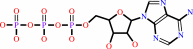 ATP
ATP
|
=
|
N(6)- carboxybiotinyl-L-lysyl-[protein]
Bound ligand (Het Group name = )
matches with 8710.00% similarity
corresponds exactly
|
+
|
 ADP
ADP
|
+
|
 phosphate
|
+
|
H(+)
|
|
|
|
|
|
|
|
|
|
|
|
|
Molecule diagrams generated from .mol files obtained from the
KEGG ftp site
|
|
|
|
|
|
|
|
|
|
|
|
|
|
 |
|
|
|
|
|
|
| |
|
|
| |
|
|
Protein Sci
10:2618-2622
(2001)
|
|
PubMed id:
|
|
|
|
|
|
| |
|
Competing protein:protein interactions are proposed to control the biological switch of the E coli biotin repressor.
|
|
L.H.Weaver,
K.Kwon,
D.Beckett,
B.W.Matthews.
|
|
|
|
|
| |
ABSTRACT
|
|
|
|
| |
|
|
A model is suggested for the complex between the biotin repressor of Escherichia
coli, BirA, and BCCP, the biotin carboxyl carrier protein to which BirA
transfers biotin. The model is consistent with prior physical and biochemical
studies. Measurement of transfer rates for variants of BirA with single-site
mutations in the proposed BirA:BCCP interface region also provides support. The
unique feature of the proposed interaction between BirA and BCCP is that it uses
the same beta-sheet region on the surface of BirA that the protein uses for
homodimerization into a form competent to bind DNA. The resulting mutually
exclusive protein:protein interfaces explain the novel feature of the BirA
regulatory system, namely, that transcription of the genes involved in biotin
synthesis is not determined by the level of biotin, per se, but by the level of
unmodified BCCP. The model also provides a role for the C-terminal domain of
BirA that is structurally similar to an SH3 domain.
|
|
|
|
|
|
|
|
|
|
|
|
|
|
|
|
|
|
 |
 |
 |
|
Literature references that cite this PDB file's key reference
|
|
|
| |
PubMed id
|
|
Reference
|
|
|
|
|
|
P.Handke,
S.A.Lynch,
and
R.T.Gill
(2011).
Application and engineering of fatty acid biosynthesis in Escherichia coli for advanced fuels and chemicals.
|
| |
Metab Eng,
13,
28-37.
|
|
|
|
|
|
|
J.Solbiati,
and
J.E.Cronan
(2010).
The switch regulating transcription of the Escherichia coli biotin operon does not require extensive protein-protein interactions.
|
| |
Chem Biol,
17,
11-17.
|
|
|
|
|
|
|
D.Beckett
(2009).
Biotin sensing at the molecular level.
|
| |
J Nutr,
139,
167-170.
|
|
|
|
|
|
|
H.Zhao,
S.Naganathan,
and
D.Beckett
(2009).
Thermodynamic and structural investigation of bispecificity in protein-protein interactions.
|
| |
J Mol Biol,
389,
336-348.
|
|
|
|
|
|
|
Y.I.Hassan,
H.Moriyama,
L.J.Olsen,
X.Bi,
and
J.Zempleni
(2009).
N- and C-terminal domains in human holocarboxylase synthetase participate in substrate recognition.
|
| |
Mol Genet Metab,
96,
183-188.
|
|
|
|
|
|
|
H.Zhao,
and
D.Beckett
(2008).
Kinetic partitioning between alternative protein-protein interactions controls a transcriptional switch.
|
| |
J Mol Biol,
380,
223-236.
|
|
|
|
|
|
|
J.R.Bernstein,
T.Bulter,
and
J.C.Liao
(2008).
Transfer of the high-GC cyclohexane carboxylate degradation pathway from Rhodopseudomonas palustris to Escherichia coli for production of biotin.
|
| |
Metab Eng,
10,
131-140.
|
|
|
|
|
|
|
A.M.Abdel-Hamid,
and
J.E.Cronan
(2007).
Coordinate expression of the acetyl coenzyme A carboxylase genes, accB and accC, is necessary for normal regulation of biotin synthesis in Escherichia coli.
|
| |
J Bacteriol,
189,
369-376.
|
|
|
|
|
|
|
B.Bagautdinov,
Y.Matsuura,
S.Bagautdinova,
and
N.Kunishima
(2007).
Crystallization and preliminary X-ray crystallographic studies of the biotin carboxyl carrier protein and biotin protein ligase complex from Pyrococcus horikoshii OT3.
|
| |
Acta Crystallogr Sect F Struct Biol Cryst Commun,
63,
334-337.
|
|
|
|
|
|
|
E.Leonard,
K.H.Lim,
P.N.Saw,
and
M.A.Koffas
(2007).
Engineering central metabolic pathways for high-level flavonoid production in Escherichia coli.
|
| |
Appl Environ Microbiol,
73,
3877-3886.
|
|
|
|
|
|
|
E.D.Streaker,
and
D.Beckett
(2006).
Nonenzymatic biotinylation of a biotin carboxyl carrier protein: unusual reactivity of the physiological target lysine.
|
| |
Protein Sci,
15,
1928-1935.
|
|
|
|
|
|
|
D.Beckett
(2005).
Multilevel regulation of protein-protein interactions in biological circuitry.
|
| |
Phys Biol,
2,
S67-S73.
|
|
|
|
|
|
|
D.Beckett
(2005).
The Escherichia coli biotin regulatory system: a transcriptional switch.
|
| |
J Nutr Biochem,
16,
411-415.
|
|
|
|
|
|
|
E.Choi-Rhee,
H.Schulman,
and
J.E.Cronan
(2004).
Promiscuous protein biotinylation by Escherichia coli biotin protein ligase.
|
| |
Protein Sci,
13,
3043-3050.
|
|
|
|
|
|
|
D.J.Clarke,
J.Coulson,
R.Baillie,
and
D.J.Campopiano
(2003).
Biotinylation in the hyperthermophile Aquifex aeolicus.
|
| |
Eur J Biochem,
270,
1277-1287.
|
|
|
|
|
|
|
K.Kwon,
E.D.Streaker,
and
D.Beckett
(2002).
Binding specificity and the ligand dissociation process in the E. coli biotin holoenzyme synthetase.
|
| |
Protein Sci,
11,
558-570.
|
|
|
|
|
|
The most recent references are shown first.
Citation data come partly from CiteXplore and partly
from an automated harvesting procedure. Note that this is likely to be
only a partial list as not all journals are covered by
either method. However, we are continually building up the citation data
so more and more references will be included with time.
|
|
|


 Links
Links


