|
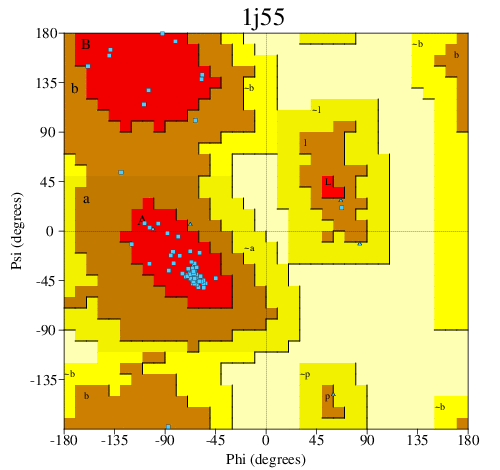
PDBsum entry 1j55

|
|
|
|
|
|

|
|

|
|

|
|

|
|

|
|

|
|
|
 |

|

|
|
|
|
|
|
|
|
|
|
|
|
|
|
|
|
|
|
|
|
|
|
|
|
|
|
|
|
|
|
|
Metal binding protein
|
PDB id
|
|
|
|
1j55
|
|
|
|
|
|
|
|
|
|
|
|
|
|
|

|

|

|
|
|
|
|
|
|
|
 |
Contents |
 |
|
|
|
|
|
|
|
|
|
|
|
|
* Residue conservation analysis
|
|
|
|
|
References listed in PDB file
|
|
|
Key reference
|
|
|
Title
|
|
The crystal structure at 2a resolution of the ca2+ -Binding protein s100p.
|
|
|
Authors
|
|
H.Zhang,
G.Wang,
Y.Ding,
Z.Wang,
R.Barraclough,
P.S.Rudland,
D.G.Fernig,
Z.Rao.
|
|
|
Ref.
|
|
J Mol Biol, 2003,
325,
785-794.
[DOI no: ]
|
|
|
PubMed id
|
|
|
|
|
|
Abstract
|
|
|
S100P is a small calcium-binding protein of the S100 EF-hand-containing family
of proteins. Elevated levels of its mRNA are reported to be associated with the
progression to hormone independence and metastasis of prostate cancer and to be
associated with loss of senescence in human breast epithelial cells in vitro.
The first structure of human recombinant S100P in calcium-bound form is now
reported at 2.0A resolution by X-ray diffraction. A flexible linker connects the
two EF-hand motifs. The protein exists as a homodimer formed by non-covalent
interactions between large hydrophobic areas on monomeric S100P. Experiments
with an optical biosensor to study binding parameters of the S100P monomer
interaction showed that the association rate constant was faster in the presence
of calcium than in their absence, whereas the dissociation rate constant was
independent of calcium. The K(d) values were 64(+/-24)nM and 2.5(+/-0.8) microM
in the presence and in the absence of calcium ions, respectively. Dimerization
of S100P is demonstrated in vivo using the yeast two-hybrid system. The effect
of mutation of specific amino acids suggests that dimerization in vivo can be
affected by amino acids on the dimer interface and in the hydrophobic core.
|
|
|
|

|
|

|
|
Figure 3.
Figure 3. The hydrophobic region
of the S100P monomer. (a) A ball-
and-stick representation of the
hydrophobic core formed by F71,
F74, and F15, hydrogen bonds
between two b-strands by L28 and
V69 are coloured in blue. Phenyl-
alanine residues are shown in
yellow, and other hydrophobic
residues labelled are shown in the
same colour as their helices (see
Figure 2). The monomer is coloured
as in Figure 2. (b) Ribbon and atom
sphere surface representations of
the hydrophobic globe. The hydro-
phobic core is further enlarged to a
globe by many hydrophobic
residues in khaki. The monomer is
coloured in slate-blue, and calcium
ions are shown in blue. The atom
sphere surface was drawn by the
program GRASP.
43
|
|
Figure 4.
Figure 4. Ribbon model of the S100P dimer. Two
monomers are shown in red and royal blue respectively.
Calcium ions are in blue. Amino acid residues 46 --51
are invisible, and are indicated by the broken-line.
Regions of contact between the subunits are marked in
yellow.
|
|
|
|
|
|
The above figures are
reprinted
by permission from Elsevier:
J Mol Biol
(2003,
325,
785-794)
copyright 2003.
|
|
|
|
|
|
|