|
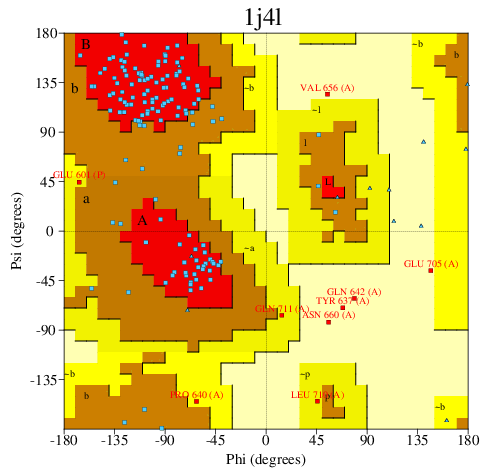
PDBsum entry 1j4l
|
|
|
|
References listed in PDB file
|
 |
|
Key reference
|
|
|
Title
|
|
Solution structure of the yeast rad53 fha2 complexed with a phosphothreonine peptide ptxxl: comparison with the structures of fha2-Pyxl and fha1-Ptxxd complexes.
|
|
|
Authors
|
|
I.J.Byeon,
S.Yongkiettrakul,
M.D.Tsai.
|
|
|
Ref.
|
|
J Mol Biol, 2001,
314,
577-588.
[DOI no: ]
|
|
|
PubMed id
|
|
|
|
|
|
Abstract
|
|
|
It was proposed previously that the FHA2 domain of the yeast protein kinase
Rad53 has dual specificity toward pY and pT peptides. The consensus sequences of
pY peptides for binding to FHA2, as well as the solution structures of free FHA2
and FHA2 complex with a pY peptide derived from Rad9, have been obtained
previously. We now report the use of a pT library to screen for binding of pT
peptides with the FHA2 domain. The results show that FHA2 binds favorably to pT
peptides with Ile at the +3 position. We then searched the Rad9 sequences with a
pTXXI/L motif, and tested the binding affinity of FHA2 toward ten pT peptides
derived from Rad9. One of the peptides, (599)EVEL(pT)QELP(607), displayed the
best binding affinity (K(d)=12.9 microM) and the greatest chemical shift
changes. The structure of the FHA2 complex with this peptide was then determined
by solution NMR and the structure of the complex between FHA2 and the pY peptide
(826)EDI(pY)YLD(832) was further refined. Structural comparison of these two
complexes indicates that the Leu residue at the +3 position in the pT peptide
and that at the +2 position in the pY peptide occupy a very similar position
relative to the binding site residues from FHA2. This can explain why FHA2 is
able to bind both pT and pY peptides. This position change from +3 to +2 could
be the consequence of the size difference between Thr and Tyr. Further insight
into the structural basis of ligand specificity of FHA domains was obtained by
comparing the structures of the FHA2-pTXXL complex obtained in this work and the
FHA1-pTXXD complex reported in the accompanying paper.
|
|
|
|

|
|

|
|
Figure 5.
Figure 5. Structures of (a) the FHA2-pT peptide complex and
(b) the FHA2-pY peptide complex. FHA2 is shown in ribbons and
the peptides are shown as sticks. The side-chains of (a) pT and
(b) pY are colored magenta, and those of Leu at (a) +3 and at
(b) +2 are colored green. The minimized mean structures are used.
|
|
Figure 7.
Figure 7. Diagrams showing detailed interactions between
the phosphopeptide and the protein in (a) the FHA2-pT peptide
complex and (b) the FHA2-pY peptide complex. Possible hydrogen
bonds are defined as for Figure 6 and shown as dotted lines.
Intermolecular NOEs are shown as double-pointed arrows, where
thick and thin lines indicate strong and medium-sized NOEs,
respectively. Highly conserved residues are colored cyan. The
intramolecular hydrogen bond between Arg617 and Asp683 is also
predicted and is shown with a question mark because the distance
between donor and acceptor heavy atoms is somewhat larger than
the definition: (a) 4.6 Å in the pT complex and (b) 4.8
Å in the pY complex.
|
|
|
|
|
|
The above figures are
reprinted
by permission from Elsevier:
J Mol Biol
(2001,
314,
577-588)
copyright 2001.
|
|
|
Secondary reference #1
|
|
|
Title
|
|
Ii. Structure and specificity of the interaction between the fha2 domain of rad53 and phosphotyrosyl peptides.
|
|
|
Authors
|
|
P.Wang,
I.J.Byeon,
H.Liao,
K.D.Beebe,
S.Yongkiettrakul,
D.Pei,
M.D.Tsai.
|
|
|
Ref.
|
|
J Mol Biol, 2000,
302,
927-940.
[DOI no: ]
|
|
|
PubMed id
|
|
|
|
|
|
|
|
|
|

|
|

|
|
Figure 5.
Figure 5. The binding interface for FHA2 and the Rad9 pTyr
peptide (a) Surface representation of the FHA2 domain in complex
with the peptide; (b) side-chain interactions of the peptide
with the FHA2 domain. The backbone ribbons of FHA2 and the
peptide are shown in purple and green, respectively. The
side-chains of FHA2 and the peptide are shown in red and yellow,
respectively. MOLMOL [Koradi et al 1996] and Insight II
(Molecular Simulations Inc.) were used for (a) and (b),
respectively.
|
|
Figure 6.
Figure 6. Schematic ribbon diagrams of the FHA2-Rad9 pTyr
peptide and the SH2-pTyr peptide [Eck et al 1993] complex
structures. The pTyr binding sites are also shown. The Figure
was generated using MOLSCRIPT [Kraulis 1991].
|
|
|
|
|
|
The above figures are
reproduced from the cited reference
with permission from Elsevier
|
|
|
Secondary reference #2
|
|
|
Title
|
|
Structure and function of a new phosphopeptide-Binding domain containing the fha2 of rad53.
|
|
|
Authors
|
|
H.Liao,
I.J.Byeon,
M.D.Tsai.
|
|
|
Ref.
|
|
J Mol Biol, 1999,
294,
1041-1049.
[DOI no: ]
|
|
|
PubMed id
|
|
|
|
|
|
|
|
|
|

|
|

|
|
Figure 1.
Figure 1. (a) Sequence alignments of FHA motifs. The first two lines are for FHA2 and FHA1, respectively, of
Rad53. (b) Sequence of the FHA2-containing domain of Rad53 (residues 573 to 730). The secondary structures were
identified based on the NMR data.
|
|
Figure 6.
Figure 6. Comparison of the potential phosphate binding site of FHA2 with that of SH2 domain (Eck et al., 1993)
and 14-3-3 protein (Yaffe et al., 1997).
|
|
|
|
|
|
The above figures are
reproduced from the cited reference
with permission from Elsevier
|
|
|
|
|
|
|