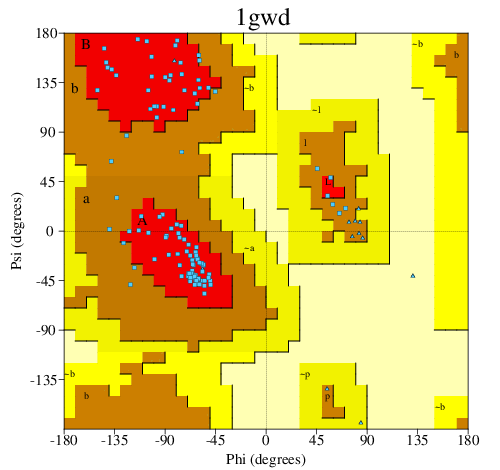
Triiodide derivatization and combinatorial counter-Ion replacement: two methods for enhancing phasing signal using laboratory cu kalpha X-Ray equipment.
A series of experiments performed at Cu Kalpha wavelength on in-house X-ray
equipment are presented which investigate two possibilities for enhancing the
experimental phasing signal by means of (i) triiodide/iodide soaks using KI/I(2)
and (ii) combinations of counter-ions introduced using the short cryosoak
method. Triiodide-derivative crystal structures for five test proteins have been
refined and reveal that iodine can bind as polyiodide and single iodide ions
through hydrophobic and hydrogen-bonding interactions both at the molecular
surface and in intramolecular and intermolecular cavities. In three cases, the
structures could be automatically determined with autoSHARP using in-house SAD
and SIRAS data. The investigation of combinatorial counter-ion replacement using
multiple salts with Na(+) and Cs(+) as cations and I(-) and Cl(-) as anions
reveals that, for the case of hen egg-white lysozyme, significant improvement in
phasing signal is obtained by the combined use of salts compared with SIRAS
methods using native and single short-soak derivative data sets.
Figure 2.
Figure 2 Region of the elastase molecule showing the common
binding site for (a) iodine and (b) xenon.
Figure 6.
Figure 6 Example of a pentaiodide molecule (sites B21-B25)
binding in a partially solvent-exposed pocket formed between two
symmetry-related molecules of XI. The pentaiodide is tethered at
each end by hydrogen bonds (yellow dashes) formed with Gln234
NE2 and Lys240 NZ. The central three atoms contact through van
der Waals interactions. The symmetry-related protein molecule is
shown in green. The anomalous difference Fourier map contoured
at 4 is
shown in red mesh.
The above figures are
reprinted
by permission from the IUCr:
Acta Crystallogr D Biol Crystallogr
(2002,
58,
976-991)
copyright 2002.


 is
shown in red mesh.
is
shown in red mesh.