|
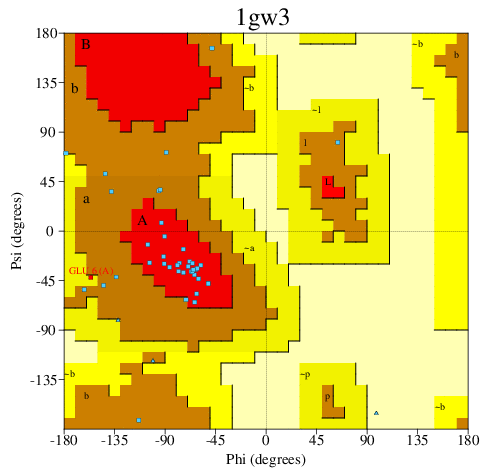
PDBsum entry 1gw3

|
|
|
|
|
|

|
|

|
|

|
|

|
|
|
 |

|

|
|
|
|
|
|
|
|
|
|
|
|
|
|
|
|
|
|
|
|
|
|
|
|
|
|
|
|
|
High density lipoproteins
|
PDB id
|
|
|
|
1gw3
|
|
|
|
|
|
|
|
|
|
|
|
|
|
|

|

|

|
|
|
|
|
|
References listed in PDB file
|
|
|
Key reference
|
|
|
Title
|
|
The helix-Hinge-Helix structural motif in human apolipoprotein a-I determined by nmr spectroscopy.
|
|
|
Authors
|
|
G.Wang,
J.T.Sparrow,
R.J.Cushley.
|
|
|
Ref.
|
|
Biochemistry, 1997,
36,
13657-13666.
[DOI no: ]
|
|
|
PubMed id
|
|
|
|
|
Note In the PDB file this reference is
annotated as "TO BE PUBLISHED".
The citation details given above were identified by an automated
search of PubMed on title and author
names, giving a
perfect match.
|
|
|
|
Abstract
|
|
|
The conformation of a synthetic peptide of 46 residues from apoA-I was
investigated by fluorescence, CD, and 2D NMR spectroscopies in lipid-mimetic
environments. ApoA-I(142-187) is mainly unstructured in water but helical in SDS
or dodecylphosphocholine (DPC), although the peptide only associates with DPC at
approximately the critical micellar concentration. Solution structures of
apoA-I(142-187) were determined by distance geometry calculations based on 450
(in DPC-d38) or 397 (in SDS-d25) NOE-derived distance restraints, respectively.
Backbone RMSDs for superimposing the two helical regions 146-162 and 168-182 are
0.98 +/- 0.22 (2.38 +/- 0.20) and 1.99 +/- 0.42 (2.02 +/- 0.21) A in DPC (SDS),
respectively. No interhelical NOE was found, suggesting that helix-helix
interactions between the two helical domains in apoA-I(142-187) are unlikely.
Similar average, curved helix-hinge-helix structures were found in both SDS and
DPC micelles with the hydrophobic residues occupying the concave face,
indicating that hydrophobic interactions dominate. Intermolecular NOESY
experiments, performed in the presence of 50% protonated SDS, confirm that the
two amphipathic helices and Y166 in the hinge all interact with the micelle. The
involvement of Y166 in lipid binding is supported by fluorescence spectroscopy
as well. On the basis of all the data above, we propose a model for the
peptide-lipid complexes wherein the curved amphipathic helix-hinge-helix
structural motif straddles the micelle. The peptide-aided signal assignment
achieved for apoA-I(122-187) (66mer) and apoA-I suggests that such a structural
motif is retained in the longer peptide and most likely in the intact protein.
|
|
|
|
|
|
|