|
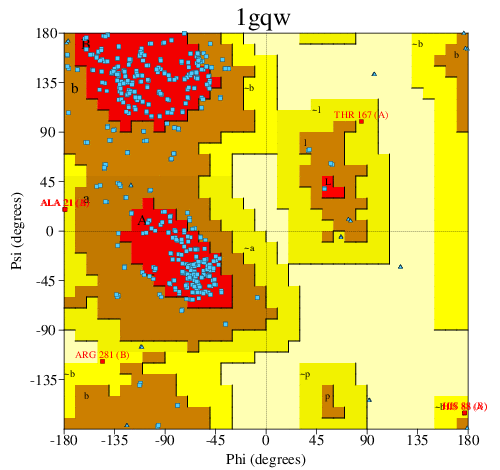
PDBsum entry 1gqw

|
|
|
|
|
|

|
|

|
|

|
|

|
|

|
|

|
|

|
|

|
|

|
|
|
 |

|

|
|
|
|
|
|
|
|
|
|
|
|
|
|
|
|
|
|
|
|
|
|
|
|
|
|
|
|
|
|
|
|
|
|
Oxidoreductase
|
PDB id
|
|
|
|
1gqw
|
|
|
|
|
|
|
|
|
|
|
|
|
|
|

|

|

|
|
|
|
|
|
|
|
 |
Contents |
 |
|
|
|
|
|
|
|
|
|
|
|
|
* Residue conservation analysis
|
|
|
|
|
References listed in PDB file
|
|
|
Key reference
|
|
|
Title
|
|
X-Ray crystal structure of escherichia coli taurine/alpha-Ketoglutarate dioxygenase complexed to ferrous iron and substrates.
|
|
|
Authors
|
|
J.M.Elkins,
M.J.Ryle,
I.J.Clifton,
J.C.Dunning hotopp,
J.S.Lloyd,
N.I.Burzlaff,
J.E.Baldwin,
R.P.Hausinger,
P.L.Roach.
|
|
|
Ref.
|
|
Biochemistry, 2002,
41,
5185-5192.
[DOI no: ]
|
|
|
PubMed id
|
|
|
|
|
|
Abstract
|
|
|
Taurine/alpha-ketoglutarate dioxygenase (TauD), a non-heme Fe(II) oxygenase,
catalyses the conversion of taurine (2-aminoethanesulfonate) to sulfite and
aminoacetaldehyde concurrent with the conversion of alpha-ketoglutarate
(alphaKG) to succinate and CO(2). The enzyme allows Escherichia coli to use
taurine, widely available in the environment, as an alternative sulfur source.
Here we describe the X-ray crystal structure of TauD complexed to Fe(II) and
both substrates, alphaKG and taurine. The tertiary structure and fold of TauD
are similar to those observed in other enzymes from the broad family of
Fe(II)/alphaKG-dependent oxygenases, with closest structural similarity to
clavaminate synthase. Using the TauD coordinates, a model was determined for the
closely related enzyme 2,4-dichlorophenoxyacetate/alphaKG dioxygenase (TfdA),
supporting predictions derived from site-directed mutagenesis and other studies
of that biodegradative protein. The TauD structure and TfdA model define the
metal ligands and the positions of nearby aromatic residues that undergo
post-translational modifications involving self-hydroxylation reactions. The
substrate binding residues of TauD were identified and those of TfdA predicted.
These results, along with sequence alignment information, reveal how TauD
selects a tetrahedral substrate anion in preference to the planar carboxylate
selected by TfdA, providing insight into the mechanism of enzyme catalysis.
|
|
|
|
|
|
|