
|
|
|
|
|
 |
Contents |
 |
|
|
|
|
|
|
|
|
|
|
|
|
|
|
* Residue conservation analysis
|
|
|
|
|
|
PDB id:
|
|
|
|
| Name: |
|
Lyase
|
|
|
Title:
|
|
Crystal structure of the 'cab' type beta class carbonic anhydrase from methanobacterium thermoautotrophicum
|
|
Structure:
|
|
Beta-carbonic anhydrase. Chain: a, b, c, d, e, f. Engineered: yes
|
|
Source:
|
|
Methanothermobacter thermautotrophicus. Organism_taxid: 145262. Expressed in: escherichia coli. Expression_system_taxid: 562
|
|
Biol. unit:
|
|
 Dimer (from
)
Dimer (from
)
|
|
Resolution:
|
|
|
2.10Å
|
R-factor:
|
0.211
|
R-free:
|
0.248
|
|
|
Authors:
|
|
P.Strop,K.S.Smith,T.M.Iverson,J.G.Ferry,D.C.Rees
|
Key ref:

|
|
P.Strop
et al.
(2001).
Crystal structure of the "cab"-type beta class carbonic anhydrase from the archaeon Methanobacterium thermoautotrophicum.
J Biol Chem,
276,
10299-10305.
PubMed id:
DOI:

|
|
|
Date:
|
|
|
31-Oct-00
|
Release date:
|
04-Apr-01
|
|
|
|
|
|
|
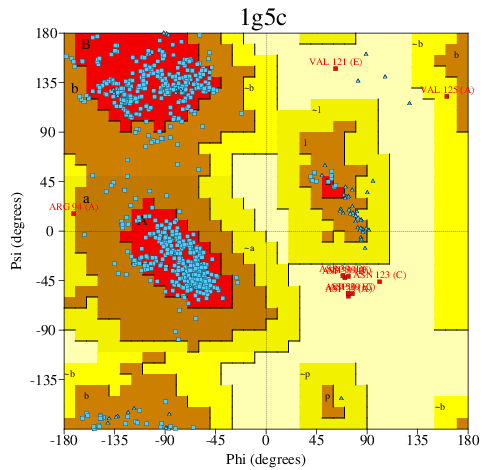
PROCHECK
|
|
|
|
|
|
Headers
|
|
|
|
References
|
|
|
|
|
|
|
|
|
|
|
|
Enzyme class:
|
|
Chains A, B, C, D, E, F:
E.C.4.2.1.1
- carbonic anhydrase.
|
|
|
|
|
|
|
Reaction:
|
|
hydrogencarbonate + H+ = CO2 + H2O
|
|
|
|
|
|
 hydrogencarbonate
|
+
|
H(+)
|
=
|
 CO2
CO2
|
+
|
H2O
|
|
|
|
|
|
|
|
|
|
Cofactor:
|
|
Zn(2+)
|
|
|
|
|
|
|
|
|
Molecule diagrams generated from .mol files obtained from the
KEGG ftp site
|
|
|
|
|
|
|
|
|
|
|
|
|
|
 |
|
|
|
|
|
|
| |
|
|
| |
|
DOI no:
|
J Biol Chem
276:10299-10305
(2001)
|
|
PubMed id:
|
|
|
|
|
|
| |
|
Crystal structure of the "cab"-type beta class carbonic anhydrase from the archaeon Methanobacterium thermoautotrophicum.
|
|
P.Strop,
K.S.Smith,
T.M.Iverson,
J.G.Ferry,
D.C.Rees.
|
|
|
|
|
| |
ABSTRACT
|
|
|
|
| |
|
|
The structure of the "cab"-type beta class carbonic anhydrase from the
archaeon Methanobacterium thermoautotrophicum (Cab) has been determined to 2.1-A
resolution using the multiwavelength anomalous diffraction phasing technique.
Cab exists as a dimer with a subunit fold similar to that observed in
"plant"-type beta class carbonic anhydrases. The active site zinc is
coordinated by protein ligands Cys(32), His(87), and Cys(90), with the
tetrahedral coordination completed by a water molecule. The major difference
between plant- and cab-type beta class carbonic anhydrases is in the
organization of the hydrophobic pocket. The structure reveals a Hepes buffer
molecule bound 8 A away from the active site zinc, which suggests a possible
proton transfer pathway from the active site to the solvent.
|
|
|
|
|
|
| |
Selected figure(s)
|
|
|
|
| |
|
|

|
|

|
|
Figure 1.
Fig. 1. Alignment of  -CA
sequences. Cab, M. thermoautotrophicum; PPnterm, P. purpureum
N-terminal domain; PPcterm, P. purpureum C-terminal domain;
P.S., P. sativum; ECcynT, E. coli. Zinc ligands are colored
yellow, the conserved Asp/Arg pair is red, and residues
differentiating cab-type and plant-type are blue. -CA
sequences. Cab, M. thermoautotrophicum; PPnterm, P. purpureum
N-terminal domain; PPcterm, P. purpureum C-terminal domain;
P.S., P. sativum; ECcynT, E. coli. Zinc ligands are colored
yellow, the conserved Asp/Arg pair is red, and residues
differentiating cab-type and plant-type are blue.
|
|
Figure 6.
Fig. 6. Stereo diagram showing the superposition of the
active site of Cab , P. sativum, and P. purpureum -CAs
including zinc, zinc-coordinating residues, and the conserved
residues differentiating between cab- and plant-type -CA. A, Cab
is shown in yellow; P. sativum -CA is shown
in green. The coordinating water molecule in Cab is shown in
red. B, Cab is shown in yellow; P. purpureum -CA is shown
in blue. The coordinating water molecule in Cab is shown in red.
|
|
|
|
|
|
| |
The above figures are
reprinted
by permission from the ASBMB:
J Biol Chem
(2001,
276,
10299-10305)
copyright 2001.
|
|
| |
Figures were
selected
by an automated process.
|
|
|
|
|
|
|
|
|
|
|
|
|
|
|
|
 |
 |
 |
|
Literature references that cite this PDB file's key reference
|
|
|
| |
PubMed id
|
|
Reference
|
|
|
|
|
|
F.Pannetier,
G.Ohanessian,
and
G.Frison
(2011).
Comparison between α- and β-carbonic anhydrases: can Zn(His)3(H2O) and Zn(His)(Cys)2(H2O) sites lead to equivalent enzymes?
|
| |
Dalton Trans,
40,
2696-2698.
|
|
|
|
|
|
|
M.J.Smeulders,
T.R.Barends,
A.Pol,
A.Scherer,
M.H.Zandvoort,
A.Udvarhelyi,
A.F.Khadem,
A.Menzel,
J.Hermans,
R.L.Shoeman,
H.J.Wessels,
L.P.van den Heuvel,
L.Russ,
I.Schlichting,
M.S.Jetten,
and
H.J.Op den Camp
(2011).
Evolution of a new enzyme for carbon disulphide conversion by an acidothermophilic archaeon.
|
| |
Nature,
478,
412-416.
|
|
|
PDB codes:
|
|
|
|
|
|
|
|
Z.Sebestyén,
K.Máthé,
A.Buvári-Barcza,
E.Vass,
F.Ruff,
J.Szemán,
and
L.Barcza
(2011).
Diverse associations in the ternary systems of β-cyclodextrin, simple carbohydrates and phenyl derivatives of inorganic oxoacids.
|
| |
Carbohydr Res,
346,
833-838.
|
|
|
|
|
|
|
J.F.Domsic,
and
R.McKenna
(2010).
Sequestration of carbon dioxide by the hydrophobic pocket of the carbonic anhydrases.
|
| |
Biochim Biophys Acta,
1804,
326-331.
|
|
|
|
|
|
|
J.G.Ferry
(2010).
The gamma class of carbonic anhydrases.
|
| |
Biochim Biophys Acta,
1804,
374-381.
|
|
|
|
|
|
|
J.G.Ferry
(2010).
How to make a living by exhaling methane.
|
| |
Annu Rev Microbiol,
64,
453-473.
|
|
|
|
|
|
|
L.Syrjänen,
M.Tolvanen,
M.Hilvo,
A.Olatubosun,
A.Innocenti,
A.Scozzafava,
J.Leppiniemi,
B.Niederhauser,
V.P.Hytönen,
T.A.Gorr,
S.Parkkila,
and
C.T.Supuran
(2010).
Characterization of the first beta-class carbonic anhydrase from an arthropod (Drosophila melanogaster) and phylogenetic analysis of beta-class carbonic anhydrases in invertebrates.
|
| |
BMC Biochem,
11,
28.
|
|
|
|
|
|
|
M.K.Fasseas,
D.Tsikou,
E.Flemetakis,
and
P.Katinakis
(2010).
Molecular and biochemical analysis of the beta class carbonic anhydrases in Caenorhabditis elegans.
|
| |
Mol Biol Rep,
37,
2941-2950.
|
|
|
|
|
|
|
R.S.Rowlett,
C.Tu,
J.Lee,
A.G.Herman,
D.A.Chapnick,
S.H.Shah,
and
P.C.Gareiss
(2009).
Allosteric site variants of Haemophilus influenzae beta-carbonic anhydrase.
|
| |
Biochemistry,
48,
6146-6156.
|
|
|
PDB codes:
|
|
|
|
|
|
|
|
S.Elleuche,
and
S.Pöggeler
(2009).
Beta-carbonic anhydrases play a role in fruiting body development and ascospore germination in the filamentous fungus Sordaria macrospora.
|
| |
PLoS ONE,
4,
e5177.
|
|
|
|
|
|
|
V.M.Krishnamurthy,
G.K.Kaufman,
A.R.Urbach,
I.Gitlin,
K.L.Gudiksen,
D.B.Weibel,
and
G.M.Whitesides
(2008).
Carbonic anhydrase as a model for biophysical and physical-organic studies of proteins and protein-ligand binding.
|
| |
Chem Rev,
108,
946.
|
|
|
|
|
|
|
Y.Xu,
L.Feng,
P.D.Jeffrey,
Y.Shi,
and
F.M.Morel
(2008).
Structure and metal exchange in the cadmium carbonic anhydrase of marine diatoms.
|
| |
Nature,
452,
56-61.
|
|
|
PDB codes:
|
|
|
|
|
|
|
|
H.Park,
B.Song,
and
F.M.Morel
(2007).
Diversity of the cadmium-containing carbonic anhydrase in marine diatoms and natural waters.
|
| |
Environ Microbiol,
9,
403-413.
|
|
|
|
|
|
|
B.W.Clare,
and
C.T.Supuran
(2006).
A perspective on quantitative structure-activity relationships and carbonic anhydrase inhibitors.
|
| |
Expert Opin Drug Metab Toxicol,
2,
113-137.
|
|
|
|
|
|
|
M.J.Bennett,
M.R.Sawaya,
and
D.Eisenberg
(2006).
Deposition diseases and 3D domain swapping.
|
| |
Structure,
14,
811-824.
|
|
|
|
|
|
|
C.L.Lawson,
B.Benoff,
T.Berger,
H.M.Berman,
and
J.Carey
(2004).
E. coli trp repressor forms a domain-swapped array in aqueous alcohol.
|
| |
Structure,
12,
1099-1108.
|
|
|
PDB code:
|
|
|
|
|
|
|
|
B.Kusian,
D.Sültemeyer,
and
B.Bowien
(2002).
Carbonic anhydrase is essential for growth of Ralstonia eutropha at ambient CO(2) concentrations.
|
| |
J Bacteriol,
184,
5018-5026.
|
|
|
|
|
|
|
K.S.Smith,
C.Ingram-Smith,
and
J.G.Ferry
(2002).
Roles of the conserved aspartate and arginine in the catalytic mechanism of an archaeal beta-class carbonic anhydrase.
|
| |
J Bacteriol,
184,
4240-4245.
|
|
|
|
|
|
|
Y.Liu,
and
D.Eisenberg
(2002).
3D domain swapping: as domains continue to swap.
|
| |
Protein Sci,
11,
1285-1299.
|
|
|
|
|
|
The most recent references are shown first.
Citation data come partly from CiteXplore and partly
from an automated harvesting procedure. Note that this is likely to be
only a partial list as not all journals are covered by
either method. However, we are continually building up the citation data
so more and more references will be included with time.
Where a reference describes a PDB structure, the PDB
codes are
shown on the right.
|
 |


 Links
Links





