|
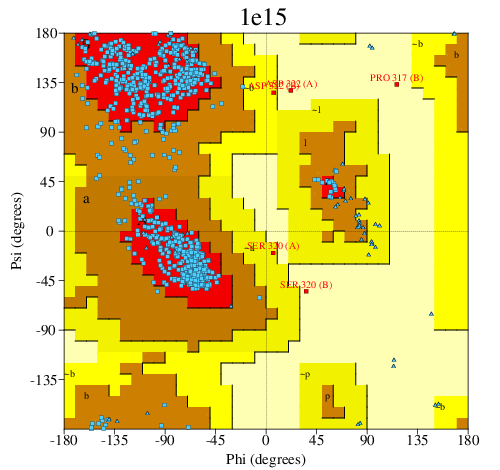
PDBsum entry 1e15

|
|
|
|
|
 |
Contents |
 |
|
|
|
|
|
|
|
|
|
|
* Residue conservation analysis
|
|
|
|
|
References listed in PDB file
|
|
|
Key reference
|
|
|
Title
|
|
Structure of a two-Domain chitotriosidase from serratia marcescens at 1.9-A resolution.
|
|
|
Authors
|
|
D.M.Van aalten,
B.Synstad,
M.B.Brurberg,
E.Hough,
B.W.Riise,
V.G.Eijsink,
R.K.Wierenga.
|
|
|
Ref.
|
|
Proc Natl Acad Sci U S A, 2000,
97,
5842-5847.
[DOI no: ]
|
|
|
PubMed id
|
|
|
|
|
|
Abstract
|
|
|
In this paper, we describe the structure of chitinase B from Serratia
marcescens, which consists of a catalytic domain with a TIM-barrel fold and a
49-residue C-terminal chitin-binding domain. This chitinase is the first
structure of a bacterial exochitinase, and it represents one of only a few
examples of a glycosyl hydrolase structure having interacting catalytic and
substrate-binding domains. The chitin-binding domain has exposed aromatic
residues that contribute to a 55-A long continuous aromatic stretch extending
into the active site. Binding of chitin oligomers is blocked beyond the -3
subsite, which explains why the enzyme has chitotriosidase activity and degrades
the chitin chain from the nonreducing end. Comparison of the chitinase B
structure with that of chitinase A explains why these enzymes act
synergistically in the degradation of chitin.
|
|
|
|

|
|

|
|
Figure 2.
Fig. 2. (A) Comparison of experimental and final maps. An
area around the active site residue Glu144 is drawn in a stick
representation. A 1  contoured
F[o], contoured
F[o],  MLPHARE map
is shown in black, calculated by using the phases at the end of
heavy atom refinement with MLPHARE. A 2F[o]-F[c], [calc] map is
shown at the end of refinement with CNS, contoured at 1.4 (in red).
(B) The two molecules in the asymmetric unit, color-coded to
identify various regions. The TIM barrel (gray), the MLPHARE map
is shown in black, calculated by using the phases at the end of
heavy atom refinement with MLPHARE. A 2F[o]-F[c], [calc] map is
shown at the end of refinement with CNS, contoured at 1.4 (in red).
(B) The two molecules in the asymmetric unit, color-coded to
identify various regions. The TIM barrel (gray), the  / /  -domain
(yellow), the support loop (red), the linker (blue), and the
ChBD (green). (C) ChiB, as in Fig. 2B, with the flexible loop
covering the active site (green), the active site residue (red
sticks), the porch loop (orange), and the exposed aromatic
residues (black sticks). (D) Superposition of the ChBD of ChiB
(blue ribbon) and the CeBD of endoglucanase Cel5 (gray ribbon).
Most of the support loop of the catalytic domain of ChiB is
shown as a dark-blue ribbon. Trp252 also is shown in magenta.
The substrate-binding residues for the CeBD are shown in yellow,
and the equivalent residues in the ChBD are shown in magenta.
The disulfide bond between the termini of the CeBD is shown in
green. Polar residues lining the path of aromatic residues in
ChiB are shown in magenta. Labels correspond to the ChiB
sequence. Note the almost exact overlap of the conserved -strands. -domain
(yellow), the support loop (red), the linker (blue), and the
ChBD (green). (C) ChiB, as in Fig. 2B, with the flexible loop
covering the active site (green), the active site residue (red
sticks), the porch loop (orange), and the exposed aromatic
residues (black sticks). (D) Superposition of the ChBD of ChiB
(blue ribbon) and the CeBD of endoglucanase Cel5 (gray ribbon).
Most of the support loop of the catalytic domain of ChiB is
shown as a dark-blue ribbon. Trp252 also is shown in magenta.
The substrate-binding residues for the CeBD are shown in yellow,
and the equivalent residues in the ChBD are shown in magenta.
The disulfide bond between the termini of the CeBD is shown in
green. Polar residues lining the path of aromatic residues in
ChiB are shown in magenta. Labels correspond to the ChiB
sequence. Note the almost exact overlap of the conserved -strands.
|
|
Figure 3.
Fig. 3. (A) Stereo view of the active site with the
modeled chitotetraose (same view as in Fig. 1C). The ChiB
backbone is shown as a yellow ribbon. The modeled chitotetraose
is shown in a stick representation, with the carbons colored
green. Side chains within 5 Å of the chitotetraose are
depicted by gray sticks, and also are indicated in Fig. 1.
Possible hydrogen bonds are drawn as black dashed lines, and the
residues involved are indicated in Fig. 1. The four water
molecules that are predicted to be replaced by the substrate are
shown as blue transparent spheres. The GlcNAc residues are
labeled from  3 to +1,
corresponding to their location with respect to the active site
residue (15). The loop around residue 316, partially covering
the active site, is shown in magenta. (B) Stereo view of the
interior of the ChiB TIM barrel. The strands forming the TIM
barrel are shown as a yellow ribbon. Side chains of residues
lining the inside of the barrel are shown as sticks. Side chains
conserved in ChiA, ChiB, and hevamine are colored magenta. Water
molecules in the structure are shown as red spheres. Hydrogen
bonds are shown as black dashed lines. Conserved residues are
labeled according to the ChiB sequence. Part of the
chitotetraose model is shown as sticks, with carbon atoms
colored orange. (C) Stereo view of a superposition of ChiA and
ChiB. Both structures are shown in a ribbon representation. ChiB
is colored yellow, except for residues that correspond to
insertions in ChiB with respect to ChiA, which are colored red.
ChiA is colored gray except for residues that correspond to
insertions in ChiA with respect to ChiB, which are colored
green. Some insertions are indicated with two-letter labels. AA,
active site covering loop in ChiA; AB, active site covering loop
in ChiB; CD, ChBD in ChiB; DL, ChBD support loop in ChiB; FD,
fibronectin domain in ChiA; LI, linker in ChiB; PO, porch loop
in ChiB. 3 to +1,
corresponding to their location with respect to the active site
residue (15). The loop around residue 316, partially covering
the active site, is shown in magenta. (B) Stereo view of the
interior of the ChiB TIM barrel. The strands forming the TIM
barrel are shown as a yellow ribbon. Side chains of residues
lining the inside of the barrel are shown as sticks. Side chains
conserved in ChiA, ChiB, and hevamine are colored magenta. Water
molecules in the structure are shown as red spheres. Hydrogen
bonds are shown as black dashed lines. Conserved residues are
labeled according to the ChiB sequence. Part of the
chitotetraose model is shown as sticks, with carbon atoms
colored orange. (C) Stereo view of a superposition of ChiA and
ChiB. Both structures are shown in a ribbon representation. ChiB
is colored yellow, except for residues that correspond to
insertions in ChiB with respect to ChiA, which are colored red.
ChiA is colored gray except for residues that correspond to
insertions in ChiA with respect to ChiB, which are colored
green. Some insertions are indicated with two-letter labels. AA,
active site covering loop in ChiA; AB, active site covering loop
in ChiB; CD, ChBD in ChiB; DL, ChBD support loop in ChiB; FD,
fibronectin domain in ChiA; LI, linker in ChiB; PO, porch loop
in ChiB.
|
|
|
|
|
|
|
|
|
|