 |
PDBsum entry 1dxl

|
|
|
|
|
|

|

|

|

|
|

|
|

|
|

|
|

|
|

|
|

|
|
|
 |

|

|
|
|
|
|
|
|
|
|
|
|
|
|
|
|
|
|
|
|
|
|
|
|
|
|
|
|
|
|
|
|
|
|
|
|
Oxidoreductase
|
PDB id
|
|
|
|
1dxl
|
|
|
|
|
|
|
|
|
|
|
|
|
|
|

|

|

|
|
|
|
|
|
|
|
 |
Contents |
 |
|
|
|
|
|
|
|
|
|
|
|
|
* Residue conservation analysis
|
|
|
|
|
|
PDB id:
|
|
|
|
| Name: |
|
Oxidoreductase
|
|
|
Title:
|
|
Dihydrolipoamide dehydrogenase of glycine decarboxylase from pisum sativum
|
|
Structure:
|
|
Dihydrolipoamide dehydrogenase. Chain: a, b, c, d. Synonym: lipoamide dehydrogenase, l protein, e3, dldh, glycine cleavage system l protein. Engineered: yes
|
|
Source:
|
|
Pisum sativum. Pea. Organism_taxid: 3888. Tissue: leaf. Organelle: mitochondria. Cellular_location: mitochondria. Expressed in: escherichia coli. Expression_system_taxid: 511693.
|
|
Biol. unit:
|
|
 Dimer (from
)
Dimer (from
)
|
|
Resolution:
|
|
|
3.15Å
|
R-factor:
|
0.226
|
R-free:
|
0.323
|
|
|
Authors:
|
|
M.Faure,C.Cohen-Addad,J.Bourguignon,D.Macherel,M.Neuburger,R.Douce
|
Key ref:

|
|
M.Faure
et al.
(2000).
Interaction between the lipoamide-containing H-protein and the lipoamide dehydrogenase (L-protein) of the glycine decarboxylase multienzyme system 2. Crystal structures of H- and L-proteins.
Eur J Biochem,
267,
2890-2898.
PubMed id:
DOI:

|
|
|
Date:
|
|
|
10-Jan-00
|
Release date:
|
20-Jul-00
|
|
|
|
|
|
|
PROCHECK
|

|
|
|
|
|
Headers
|
|
|
|
References
|
|
|
|
|
|

|
|
P31023
(DLDH_PEA) -
Dihydrolipoyl dehydrogenase, mitochondrial from Pisum sativum
|
|
|
|
Seq:
Struc:
|
|
|
|
501 a.a.
467 a.a.
|
|

|

|

|
|
|
|
|
|
|
|
|
|
|
Key: |
 |
PfamA domain |
|
|
 |
Secondary structure |
|
 |
CATH domain |
|
|
|
|
|
|
|
|
|
|
|
|
|
Enzyme class:
|
|
E.C.1.8.1.4
- dihydrolipoyl dehydrogenase.
|
|
|
|
|
|
|
Pathway:
|
|
Glycine Cleavage System
|
|
|
|
|
|
Reaction:
|
|
N6-[(R)-dihydrolipoyl]-L-lysyl-[protein] + NAD+ = N6-[(R)-lipoyl]- L-lysyl-[protein] + NADH + H+
|
|
|
|
|
|
N(6)-[(R)-dihydrolipoyl]-L-lysyl-[protein]
|
+
|
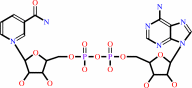 NAD(+)
|
=
|
N(6)-[(R)-lipoyl]- L-lysyl-[protein]
|
+
|
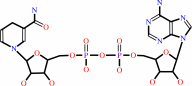 NADH
NADH
|
+
|
H(+)
|
|
|
|
|
|
|
|
|
|
Cofactor:
|
|
FAD
|
|
|
|
|
|
FAD
Bound ligand (Het Group name =
FAD)
corresponds exactly
|
|
|
|
|
|
|
Molecule diagrams generated from .mol files obtained from the
KEGG ftp site
|
|
|
|
|
|
|
|
|
|
|
|
|
|
 |
|
|
|
|
|
|
| |
|
|
| |
|
DOI no:
|
Eur J Biochem
267:2890-2898
(2000)
|
|
PubMed id:
|
|
|
|
|
|
| |
|
Interaction between the lipoamide-containing H-protein and the lipoamide dehydrogenase (L-protein) of the glycine decarboxylase multienzyme system 2. Crystal structures of H- and L-proteins.
|
|
M.Faure,
J.Bourguignon,
M.Neuburger,
D.MacHerel,
L.Sieker,
R.Ober,
R.Kahn,
C.Cohen-Addad,
R.Douce.
|
|
|
|
|
| |
ABSTRACT
|
|
|
|
| |
|
|
The glycine decarboxylase complex consists of four different component enzymes
(P-, H-, T- and L-proteins). The 14-kDa lipoamide-containing H-protein plays a
pivotal role in the complete sequence of reactions as its prosthetic group
(lipoic acid) interacts successively with the three other components of the
complex and undergoes a cycle of reductive methylamination, methylamine transfer
and electron transfer. With the aim to understand the interaction between the
H-protein and its different partners, we have previously determined the crystal
structure of the oxidized and methylaminated forms of the H-protein. In the
present study, we have crystallized the H-protein in its reduced state and the
L-protein (lipoamide dehydrogenase or dihydrolipoamide dehydrogenase). The
L-protein has been overexpressed in Escherichia coli and refolded from inclusion
bodies in an active form. Crystals were obtained from the refolded L-protein and
the structure has been determined by X-ray crystallography. This first crystal
structure of a plant dihydrolipoamide dehydrogenase is similar to other known
dihydrolipoamide dehydrogenase structures. The crystal structure of the
H-protein in its reduced form has been determined and compared to the structure
of the other forms of the protein. It is isomorphous to the structure of the
oxidized form. In contrast with methylaminated H-protein where the loaded
lipoamide arm was locked into a cavity of the protein, the reduced lipoamide arm
appeared freely exposed to the solvent. Such a freedom is required to allow its
targeting inside the hollow active site of L-protein. Our results strongly
suggest that a direct interaction between the H- and L-proteins is not necessary
for the reoxidation of the reduced lipoamide arm bound to the H-protein. This
hypothesis is supported by biochemical data [Neuburger, M., Polidori, A.M.,
Piètre, E., Faure, M., Jourdain, A., Bourguignon, J., Pucci, B. & Douce, R.
and by small angle X-ray scattering
experiments reported herein.
|
|
|
|
|
|
| |
Selected figure(s)
|
|
|
|
| |
|
|

|
|

|
|
Figure 1.
Fig. 1. Stereo view of the dihydrolipoyl H protein
structure [reduced form (H[red])]. The molecule b of the
asymmetric unit (see text) is shown with the two positions of
the reduced lipoamide arm, in the molecule a (in red) andin the
molecule b (in green). The position of the arm in its
methylaminated form is also represented (in blue) [8,9]. The
program O [18] was used for this figure and Figs 4 Go- and 6
Go-. and 6
Go-.
|
|
Figure 5.
Fig. 5 Potential surface of the L-protein and the
entrance of the dihydrolipoamide binding site. The surface is
coloured according to the charges: dark violet corresponds to
positively charged surfaces, red to negatively charged surfaces.
Yellow to yellow-green corresponds to hydrophobic surfaces. The
program GRASP was used for the drawing [35].
|
|
|
|
|
|
| |
The above figures are
reprinted
by permission from the Federation of European Biochemical Societies:
Eur J Biochem
(2000,
267,
2890-2898)
copyright 2000.
|
|
| |
Figures were
selected
by an automated process.
|
|
|
|
|
|
|
|
|
|
|
|
|
|
|
|
 |
 |
 |
|
Literature references that cite this PDB file's key reference
|
|
|
| |
PubMed id
|
|
Reference
|
|
|
|
|
|
A.Higashiura,
T.Kurakane,
M.Matsuda,
M.Suzuki,
K.Inaka,
M.Sato,
T.Kobayashi,
T.Tanaka,
H.Tanaka,
K.Fujiwara,
and
A.Nakagawa
(2010).
High-resolution X-ray crystal structure of bovine H-protein at 0.88 A resolution.
|
| |
Acta Crystallogr D Biol Crystallogr,
66,
698-708.
|
|
|
PDB code:
|
|
|
|
|
|
|
|
J.Abendroth,
M.S.McCormick,
T.E.Edwards,
B.Staker,
R.Loewen,
M.Gifford,
J.Rifkin,
C.Mayer,
W.Guo,
Y.Zhang,
P.Myler,
A.Kelley,
E.Analau,
S.N.Hewitt,
A.J.Napuli,
P.Kuhn,
R.D.Ruth,
and
L.J.Stewart
(2010).
X-ray structure determination of the glycine cleavage system protein H of Mycobacterium tuberculosis using an inverse Compton synchrotron X-ray source.
|
| |
J Struct Funct Genomics,
11,
91.
|
|
|
PDB codes:
|
|
|
|
|
|
|
|
L.J.Yan,
N.Thangthaeng,
and
M.J.Forster
(2008).
Changes in dihydrolipoamide dehydrogenase expression and activity during postnatal development and aging in the rat brain.
|
| |
Mech Ageing Dev,
129,
282-290.
|
|
|
|
|
|
|
T.Nakai,
S.Kuramitsu,
and
N.Kamiya
(2008).
Structural bases for the specific interactions between the E2 and E3 components of the Thermus thermophilus 2-oxo acid dehydrogenase complexes.
|
| |
J Biochem,
143,
747-758.
|
|
|
|
|
|
|
F.Rébeillé,
C.Alban,
J.Bourguignon,
S.Ravanel,
and
R.Douce
(2007).
The role of plant mitochondria in the biosynthesis of coenzymes.
|
| |
Photosynth Res,
92,
149-162.
|
|
|
|
|
|
|
L.J.Yan,
S.H.Yang,
H.Shu,
L.Prokai,
and
M.J.Forster
(2007).
Histochemical staining and quantification of dihydrolipoamide dehydrogenase diaphorase activity using blue native PAGE.
|
| |
Electrophoresis,
28,
1036-1045.
|
|
|
|
|
|
|
E.M.Ciszak,
A.Makal,
Y.S.Hong,
A.K.Vettaikkorumakankauv,
L.G.Korotchkina,
and
M.S.Patel
(2006).
How dihydrolipoamide dehydrogenase-binding protein binds dihydrolipoamide dehydrogenase in the human pyruvate dehydrogenase complex.
|
| |
J Biol Chem,
281,
648-655.
|
|
|
PDB code:
|
|
|
|
|
|
|
|
M.Mukherjee,
M.T.Brown,
A.G.McArthur,
and
P.J.Johnson
(2006).
Proteins of the glycine decarboxylase complex in the hydrogenosome of Trichomonas vaginalis.
|
| |
Eukaryot Cell,
5,
2062-2071.
|
|
|
|
|
|
|
D.I.Dutyshev,
E.L.Darii,
N.P.Fomenkova,
I.V.Pechik,
K.M.Polyakov,
S.V.Nikonov,
N.S.Andreeva,
and
B.S.Sukhareva
(2005).
Structure of Escherichia coli glutamate decarboxylase (GADalpha) in complex with glutarate at 2.05 angstroms resolution.
|
| |
Acta Crystallogr D Biol Crystallogr,
61,
230-235.
|
|
|
PDB code:
|
|
|
|
|
|
|
|
N.K.Lokanath,
C.Kuroishi,
N.Okazaki,
and
N.Kunishima
(2005).
Crystal structure of a component of glycine cleavage system: T-protein from Pyrococcus horikoshii OT3 at 1.5 A resolution.
|
| |
Proteins,
58,
769-773.
|
|
|
PDB code:
|
|
|
|
|
|
|
|
N.L.Klyachko,
V.A.Shchedrina,
A.V.Efimov,
S.V.Kazakov,
I.G.Gazaryan,
B.S.Kristal,
and
A.M.Brown
(2005).
pH-dependent substrate preference of pig heart lipoamide dehydrogenase varies with oligomeric state: response to mitochondrial matrix acidification.
|
| |
J Biol Chem,
280,
16106-16114.
|
|
|
|
|
|
|
T.Nakai,
N.Nakagawa,
N.Maoka,
R.Masui,
S.Kuramitsu,
and
N.Kamiya
(2005).
Structure of P-protein of the glycine cleavage system: implications for nonketotic hyperglycinemia.
|
| |
EMBO J,
24,
1523-1536.
|
|
|
PDB codes:
|
|
|
|
|
|
|
|
H.H.Lee,
D.J.Kim,
H.J.Ahn,
J.Y.Ha,
and
S.W.Suh
(2004).
Crystal structure of T-protein of the glycine cleavage system. Cofactor binding, insights into H-protein recognition, and molecular basis for understanding nonketotic hyperglycinemia.
|
| |
J Biol Chem,
279,
50514-50523.
|
|
|
PDB codes:
|
|
|
|
|
|
|
|
N.K.Lokanath,
C.Kuroishi,
N.Okazaki,
and
N.Kunishima
(2004).
Purification, crystallization and preliminary crystallographic analysis of the glycine-cleavage system component T-protein from Pyrococcus horikoshii OT3.
|
| |
Acta Crystallogr D Biol Crystallogr,
60,
1450-1452.
|
|
|
|
|
|
|
A.Picciocchi,
R.Douce,
and
C.Alban
(2003).
The plant biotin synthase reaction. Identification and characterization of essential mitochondrial accessory protein components.
|
| |
J Biol Chem,
278,
24966-24975.
|
|
|
|
|
|
|
T.Nakai,
J.Ishijima,
R.Masui,
S.Kuramitsu,
and
N.Kamiya
(2003).
Structure of Thermus thermophilus HB8 H-protein of the glycine-cleavage system, resolved by a six-dimensional molecular-replacement method.
|
| |
Acta Crystallogr D Biol Crystallogr,
59,
1610-1618.
|
|
|
PDB code:
|
|
|
|
|
|
|
|
T.Nakai,
N.Nakagawa,
N.Maoka,
R.Masui,
S.Kuramitsu,
and
N.Kamiya
(2003).
Coexpression, purification, crystallization and preliminary X-ray characterization of glycine decarboxylase (P-protein) of the glycine-cleavage system from Thermus thermophilus HB8.
|
| |
Acta Crystallogr D Biol Crystallogr,
59,
554-557.
|
|
|
|
|
|
|
A.Stahl,
P.Moberg,
J.Ytterberg,
O.Panfilov,
H.Brockenhuus Von Lowenhielm,
F.Nilsson,
and
E.Glaser
(2002).
Isolation and identification of a novel mitochondrial metalloprotease (PreP) that degrades targeting presequences in plants.
|
| |
J Biol Chem,
277,
41931-41939.
|
|
|
|
|
|
|
B.P.Mooney,
J.A.Miernyk,
and
D.D.Randall
(2002).
The complex fate of alpha-ketoacids.
|
| |
Annu Rev Plant Biol,
53,
357-375.
|
|
|
|
|
|
|
O.Roche,
and
M.J.Field
(2001).
Theoretical study of the conformation of the lipoamide arm in a mutant H protein.
|
| |
Proteins,
45,
237-240.
|
|
|
|
|
|
|
R.Douce,
J.Bourguignon,
M.Neuburger,
and
F.Rébeillé
(2001).
The glycine decarboxylase system: a fascinating complex.
|
| |
Trends Plant Sci,
6,
167-176.
|
|
|
|
|
|
The most recent references are shown first.
Citation data come partly from CiteXplore and partly
from an automated harvesting procedure. Note that this is likely to be
only a partial list as not all journals are covered by
either method. However, we are continually building up the citation data
so more and more references will be included with time.
Where a reference describes a PDB structure, the PDB
code is
shown on the right.
|
|


 Links
Links


