
|
|
|
|
|
 |
Contents |
 |
|
|
|
|
|
|
|
|
|
|
|


 214 a.a.
|
|
|
|
|
|
|
|
|
|
|


 223 a.a.
|
|
|
|
|
|
|
|
|
|
|
 51 a.a.
|
|
|
|
|
|
|
|
|
|
|
 54 a.a.
|
|
|
|
|
|
|
|
|
* Residue conservation analysis
|
|
|
|
|
|
PDB id:
|
|
|
|
| Name: |
|
Immune system
|
|
|
Title:
|
|
Structure of s. Aureus protein a bound to a human igm fab
|
|
Structure:
|
|
Igm rf 2a2. Chain: a, c, e. Fragment: fab light chain. Igm rf 2a2. Chain: b, d, f. Fragment: fab heavy chain. Immunoglobulin g binding protein a. Chain: g, h. Fragment: recombinant domain d.
|
|
Source:
|
|
Homo sapiens. Human. Organism_taxid: 9606. Other_details: fab of the v3-30/ vh1.9iii-encoded 2a2 igm rheumatoid factor produced by trypsin cleavage of the igm secreted by a hybridoma created from synovial b cells of a rheumatoid arthritis patient. Staphylococcus aureus. Organism_taxid: 1280.
|
|
Biol. unit:
|
|
 Hexamer (from
)
Hexamer (from
)
|
|
Resolution:
|
|
|
2.70Å
|
R-factor:
|
0.217
|
R-free:
|
0.281
|
|
|
Authors:
|
|
M.Graille,E.A.Stura,A.L.Corper,B.J.Sutton,M.J.Taussig, J.B.Charbonnier,G.J.Silverman
|
Key ref:

|
|
M.Graille
et al.
(2000).
Crystal structure of a Staphylococcus aureus protein A domain complexed with the Fab fragment of a human IgM antibody: structural basis for recognition of B-cell receptors and superantigen activity.
Proc Natl Acad Sci U S A,
97,
5399-5404.
PubMed id:
DOI:

|
|
|
Date:
|
|
|
15-Nov-99
|
Release date:
|
24-May-00
|
|
|
|
|
|
|
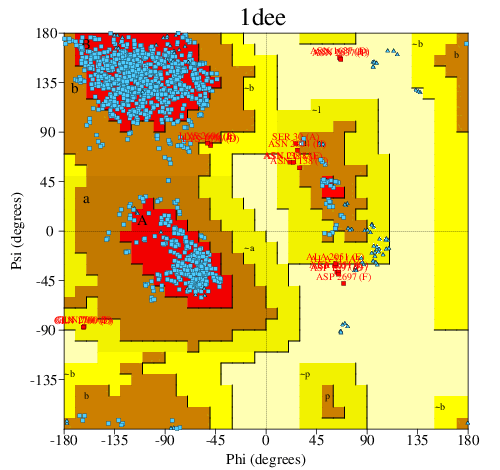
PROCHECK
|
|
|
|
|
|
Headers
|
|
|
|
References
|
|
|
|
|
|

|
|
No UniProt id for this chain
|
|
|
|
|
|
|
|
|
|
|
|
|
|
|
|

|
|
No UniProt id for this chain
|
|
|
|
|
|
|
|
|
|
|
|
|
|
|
|
|
|
|
|
|
|
|
|
|
 |
|
|
|
|
|
|
| |
|
DOI no:
|
Proc Natl Acad Sci U S A
97:5399-5404
(2000)
|
|
PubMed id:
|
|
|
|
|
|
| |
|
Crystal structure of a Staphylococcus aureus protein A domain complexed with the Fab fragment of a human IgM antibody: structural basis for recognition of B-cell receptors and superantigen activity.
|
|
M.Graille,
E.A.Stura,
A.L.Corper,
B.J.Sutton,
M.J.Taussig,
J.B.Charbonnier,
G.J.Silverman.
|
|
|
|
|
| |
ABSTRACT
|
|
|
|
| |
|
|
Staphylococcus aureus produces a virulence factor, protein A (SpA), that
contains five homologous Ig-binding domains. The interactions of SpA with the
Fab region of membrane-anchored Igs can stimulate a large fraction of B cells,
contributing to lymphocyte clonal selection. To understand the molecular basis
for this activity, we have solved the crystal structure of the complex between
domain D of SpA and the Fab fragment of a human IgM antibody to 2.7-A
resolution. In the complex, helices II and III of domain D interact with the
variable region of the Fab heavy chain (V(H)) through framework residues,
without the involvement of the hypervariable regions implicated in antigen
recognition. The contact residues are highly conserved in human V(H)3 antibodies
but not in other families. The contact residues from domain D also are conserved
among all SpA Ig-binding domains, suggesting that each could bind in a similar
manner. Features of this interaction parallel those reported for staphylococcal
enterotoxins that are superantigens for many T cells. The structural homology
between Ig V(H) regions and the T-cell receptor V(beta) regions facilitates
their comparison, and both types of interactions involve lymphocyte receptor
surface remote from the antigen binding site. However, T-cell superantigens
reportedly interact through hydrogen bonds with T-cell receptor V(beta) backbone
atoms in a primary sequence-independent manner, whereas SpA relies on a
sequence-restricted conformational binding with residue side chains, suggesting
that this common bacterial pathogen has adopted distinct molecular recognition
strategies for affecting large sets of B and T lymphocytes.
|
|
|
|
|
|
| |
Selected figure(s)
|
|
|
|
| |
|
|

|
|

|
|
Figure 1.
Fig. 1. Schematic representation of the complex between
SpA domain D and Fab 2A2 from a human IgM. (A) Side view showing
SpA domain D (red) bound to the framework region of the Fab
heavy chain (cyan). The V[L] domain, which is not involved in
this interaction, is shown in dark blue. The CDR loops as
defined by Chothia and Lesk (33) are highlighted in magenta. (B)
Ribbon representation of the V[H] region of Fab showing the
positions of the residues that interact with domain D. (C)
Schematic diagram detailing the residues of SpA domain D and Fab
2A2 involved in the interaction. Kabat numbering is used for the
V[H] residues (blue); domain D is numbered (in brown) with the
convention used for SpA domains (34). Contact residues are
identified if 20 Å2 or more of their surface are buried in
the interface and if they make at least one van der Waals
contact. All figures were generated by using MOLMOL (35).
|
|
Figure 2.
Fig. 2. Interactions of individual SpA domains. (A)
Alignment of the amino acid sequences of the five SpA domains.
Domain D residues involved in interaction with Fab 2A2 are
highlighted in cyan. With the exception of Gln-32 (pink), there
is no overlap between the residues involved in Fab interaction
and those mediating Fc  binding (2)
(gray highlight). The engineered domain Z differs by the key
mutation Gly-29 in Ala and does not bind Fab. The residues
involved in the dimer of domain D observed in the asymmetric
unit are indicated by red and green boxes. (B) Cross-linking of
a V[H]3 Fab (cyan surface) and a Fc (gray
surface) by a single domain of SpA (red ribbon). This model is
based on the superposition of helix I and II of SpA domains in
the Fab-domain D complex reported here and in the previously
determined Fc -domain B
complex (2) (rmsd of 0.73 Å for 140 backbone atoms). (C)
Interface between domain D monomers. Schematic view of the
interaction between the two domains D observed in the asymmetric
unit, dom-D1 (red ribbon) and dom-D2 (green ribbon). Contact
residues from both domains are shown in stick representation. binding (2)
(gray highlight). The engineered domain Z differs by the key
mutation Gly-29 in Ala and does not bind Fab. The residues
involved in the dimer of domain D observed in the asymmetric
unit are indicated by red and green boxes. (B) Cross-linking of
a V[H]3 Fab (cyan surface) and a Fc (gray
surface) by a single domain of SpA (red ribbon). This model is
based on the superposition of helix I and II of SpA domains in
the Fab-domain D complex reported here and in the previously
determined Fc -domain B
complex (2) (rmsd of 0.73 Å for 140 backbone atoms). (C)
Interface between domain D monomers. Schematic view of the
interaction between the two domains D observed in the asymmetric
unit, dom-D1 (red ribbon) and dom-D2 (green ribbon). Contact
residues from both domains are shown in stick representation.
|
|
|
|
| |
Figures were
selected
by an automated process.
|
|
|
|
|
|
|
|
|
|
|
|
|
|
|
|
 |
 |
 |
|
Literature references that cite this PDB file's key reference
|
|
|
| |
PubMed id
|
|
Reference
|
|
|
|
|
|
E.V.Sidorin,
and
T.F.Solov'eva
(2011).
IgG-Binding Proteins of Bacteria.
|
| |
Biochemistry (Mosc),
76,
295-308.
|
|
|
|
|
|
|
H.K.Kim,
A.G.Cheng,
H.Y.Kim,
D.M.Missiakas,
and
O.Schneewind
(2010).
Nontoxigenic protein A vaccine for methicillin-resistant Staphylococcus aureus infections in mice.
|
| |
J Exp Med,
207,
1863-1870.
|
|
|
|
|
|
|
S.Birtalan,
R.D.Fisher,
and
S.S.Sidhu
(2010).
The functional capacity of the natural amino acids for molecular recognition.
|
| |
Mol Biosyst,
6,
1186-1194.
|
|
|
|
|
|
|
A.Chene,
D.Donati,
J.Orem,
E.R.Mbidde,
F.Kironde,
M.Wahlgren,
and
M.T.Bejarano
(2009).
Endemic Burkitt's lymphoma as a polymicrobial disease: new insights on the interaction between Plasmodium falciparum and Epstein-Barr virus.
|
| |
Semin Cancer Biol,
19,
411-420.
|
|
|
|
|
|
|
D.M.Czajkowsky,
and
Z.Shao
(2009).
The human IgM pentamer is a mushroom-shaped molecule with a flexural bias.
|
| |
Proc Natl Acad Sci U S A,
106,
14960-14965.
|
|
|
|
|
|
|
H.F.Chambers
(2009).
Pathogenesis of staphylococcal infection: a manner of expression.
|
| |
J Infect Dis,
199,
291-293.
|
|
|
|
|
|
|
P.Speziale,
G.Pietrocola,
S.Rindi,
M.Provenzano,
G.Provenza,
A.Di Poto,
L.Visai,
and
C.R.Arciola
(2009).
Structural and functional role of Staphylococcus aureus surface components recognizing adhesive matrix molecules of the host.
|
| |
Future Microbiol,
4,
1337-1352.
|
|
|
|
|
|
|
D.R.Buckler,
A.Park,
M.Viswanathan,
R.M.Hoet,
and
R.C.Ladner
(2008).
Screening isolates from antibody phage-display libraries.
|
| |
Drug Discov Today,
13,
318-324.
|
|
|
|
|
|
|
H.Yang,
J.Cao,
L.Q.Li,
X.Zhou,
Q.L.Chen,
W.T.Liao,
Z.M.Wen,
S.H.Jiang,
R.Xu,
J.A.Jia,
X.Pan,
Z.T.Qi,
and
W.Pan
(2008).
Evolutional selection of a combinatorial phage library displaying randomly-rearranged various single domains of immunoglobulin (Ig)-binding proteins (IBPs) with four kinds of Ig molecules.
|
| |
BMC Microbiol,
8,
137.
|
|
|
|
|
|
|
K.Ishii,
C.Lin,
D.L.Siegel,
and
J.R.Stanley
(2008).
Isolation of pathogenic monoclonal anti-desmoglein 1 human antibodies by phage display of pemphigus foliaceus autoantibodies.
|
| |
J Invest Dermatol,
128,
939-948.
|
|
|
|
|
|
|
M.M.Refaat,
T.M.Ahmed,
Z.A.Ashour,
and
M.Y.Atia
(2008).
Immunological role of nasal staphylococcus aureus carriage in patients with persistent allergic rhinitis.
|
| |
Pan Afr Med J,
1,
3.
|
|
|
|
|
|
|
M.Otto
(2008).
Targeted immunotherapy for staphylococcal infections : focus on anti-MSCRAMM antibodies.
|
| |
BioDrugs,
22,
27-36.
|
|
|
|
|
|
|
S.H.Jiang,
J.F.Wang,
R.Xu,
Y.J.Liu,
X.N.Wang,
J.Cao,
P.Zhao,
Y.J.Shen,
T.Yang,
H.Yang,
J.A.Jia,
Q.L.Chen,
and
W.Pan
(2008).
Alternate arrangement of PpL B3 domain and SpA D domain creates synergistic double-site binding to VH3 and Vkappa regions of fab.
|
| |
DNA Cell Biol,
27,
423-431.
|
|
|
|
|
|
|
X.L.Sun,
L.Yang,
and
E.L.Chaikof
(2008).
Chemoselective immobilization of biomolecules through aqueous Diels-Alder and PEG chemistry.
|
| |
Tetrahedron Lett,
49,
2510-2513.
|
|
|
|
|
|
|
D.Qin,
X.He,
K.Wang,
X.J.Zhao,
W.Tan,
and
J.Chen
(2007).
Fluorescent Nanoparticle-Based Indirect Immunofluorescence Microscopy for Detection of Mycobacterium tuberculosis.
|
| |
J Biomed Biotechnol,
2007,
89364.
|
|
|
|
|
|
|
S.Planque,
Y.Mitsuda,
H.Taguchi,
M.Salas,
M.K.Morris,
Y.Nishiyama,
R.Kyle,
P.Okhuysen,
M.Escobar,
R.Hunter,
H.W.Sheppard,
C.Hanson,
and
S.Paul
(2007).
Characterization of gp120 hydrolysis by IgA antibodies from humans without HIV infection.
|
| |
AIDS Res Hum Retroviruses,
23,
1541-1554.
|
|
|
|
|
|
|
T.Schountz,
C.H.Calisher,
T.R.Richens,
A.A.Rich,
J.B.Doty,
M.T.Hughes,
and
B.J.Beaty
(2007).
Rapid field immunoassay for detecting antibody to Sin Nombre virus in deer mice.
|
| |
Emerg Infect Dis,
13,
1604-1607.
|
|
|
|
|
|
|
G.J.Silverman,
and
C.S.Goodyear
(2006).
Confounding B-cell defences: lessons from a staphylococcal superantigen.
|
| |
Nat Rev Immunol,
6,
465-475.
|
|
|
|
|
|
|
M.O'Seaghdha,
C.J.van Schooten,
S.W.Kerrigan,
J.Emsley,
G.J.Silverman,
D.Cox,
P.J.Lenting,
and
T.J.Foster
(2006).
Staphylococcus aureus protein A binding to von Willebrand factor A1 domain is mediated by conserved IgG binding regions.
|
| |
FEBS J,
273,
4831-4841.
|
|
|
|
|
|
|
M.Samuelsson,
J.Jendholm,
S.Amisten,
S.L.Morrison,
A.Forsgren,
and
K.Riesbeck
(2006).
The IgD CH1 region contains the binding site for the human respiratory pathogen Moraxella catarrhalis IgD-binding protein MID.
|
| |
Eur J Immunol,
36,
2525-2534.
|
|
|
|
|
|
|
M.Tsuiji,
S.Yurasov,
K.Velinzon,
S.Thomas,
M.C.Nussenzweig,
and
H.Wardemann
(2006).
A checkpoint for autoreactivity in human IgM+ memory B cell development.
|
| |
J Exp Med,
203,
393-400.
|
|
|
|
|
|
|
A.C.Roque,
M.A.Taipa,
and
C.R.Lowe
(2005).
Synthesis and screening of a rationally designed combinatorial library of affinity ligands mimicking protein L from Peptostreptococcus magnus.
|
| |
J Mol Recognit,
18,
213-224.
|
|
|
|
|
|
|
D.Agardh,
I.Dahlbom,
T.Daniels,
E.Lörinc,
S.A.Ivarsson,
A.Lernmark,
and
T.Hansson
(2005).
Autoantibodies against soluble and immobilized human recombinant tissue transglutaminase in children with celiac disease.
|
| |
J Pediatr Gastroenterol Nutr,
41,
322-327.
|
|
|
|
|
|
|
G.J.Silverman,
C.S.Goodyear,
and
D.L.Siegel
(2005).
On the mechanism of staphylococcal protein A immunomodulation.
|
| |
Transfusion,
45,
274-280.
|
|
|
|
|
|
|
H.Riechelmann,
A.Essig,
T.Deutschle,
A.Rau,
B.Rothermel,
and
M.Weschta
(2005).
Nasal carriage of Staphylococcus aureus in house dust mite allergic patients and healthy controls.
|
| |
Allergy,
60,
1418-1423.
|
|
|
|
|
|
|
J.E.Butler,
N.Wertz,
J.Sun,
and
R.E.Sacco
(2005).
Comparison of the expressed porcine Vbeta and Jbeta repertoire of thymocytes and peripheral T cells.
|
| |
Immunology,
114,
184-193.
|
|
|
|
|
|
|
K.J.Rhee,
P.J.Jasper,
P.Sethupathi,
M.Shanmugam,
D.Lanning,
and
K.L.Knight
(2005).
Positive selection of the peripheral B cell repertoire in gut-associated lymphoid tissues.
|
| |
J Exp Med,
201,
55-62.
|
|
|
|
|
|
|
T.J.Foster
(2005).
Immune evasion by staphylococci.
|
| |
Nat Rev Microbiol,
3,
948-958.
|
|
|
|
|
|
|
V.Granata,
N.G.Housden,
S.Harrison,
C.Jolivet-Reynaud,
M.G.Gore,
and
E.A.Stura
(2005).
Comparison of the crystallization and crystal packing of two Fab single-site mutant protein L complexes.
|
| |
Acta Crystallogr D Biol Crystallogr,
61,
750-754.
|
|
|
PDB code:
|
|
|
|
|
|
|
|
B.H.Normark,
S.Normark,
and
A.Norrby-Teglund
(2004).
Staphylococcal protein A inflames the lungs.
|
| |
Nat Med,
10,
780-781.
|
|
|
|
|
|
|
D.Donati,
L.P.Zhang,
A.Chêne,
Q.Chen,
K.Flick,
M.Nyström,
M.Wahlgren,
and
M.T.Bejarano
(2004).
Identification of a polyclonal B-cell activator in Plasmodium falciparum.
|
| |
Infect Immun,
72,
5412-5418.
|
|
|
|
|
|
|
D.Zheng,
J.M.Aramini,
and
G.T.Montelione
(2004).
Validation of helical tilt angles in the solution NMR structure of the Z domain of Staphylococcal protein A by combined analysis of residual dipolar coupling and NOE data.
|
| |
Protein Sci,
13,
549-554.
|
|
|
PDB code:
|
|
|
|
|
|
|
|
J.D.Kotz,
C.J.Bond,
and
A.G.Cochran
(2004).
Phage-display as a tool for quantifying protein stability determinants.
|
| |
Eur J Biochem,
271,
1623-1629.
|
|
|
|
|
|
|
J.Freedman,
and
M.B.Garvey
(2004).
Immunoadsorption of factor VIII inhibitors.
|
| |
Curr Opin Hematol,
11,
327-333.
|
|
|
|
|
|
|
M.I.Gómez,
A.Lee,
B.Reddy,
A.Muir,
G.Soong,
A.Pitt,
A.Cheung,
and
A.Prince
(2004).
Staphylococcus aureus protein A induces airway epithelial inflammatory responses by activating TNFR1.
|
| |
Nat Med,
10,
842-848.
|
|
|
|
|
|
|
M.Linhult,
S.Gülich,
T.Gräslund,
A.Simon,
M.Karlsson,
A.Sjöberg,
K.Nord,
and
S.Hober
(2004).
Improving the tolerance of a protein a analogue to repeated alkaline exposures using a bypass mutagenesis approach.
|
| |
Proteins,
55,
407-416.
|
|
|
|
|
|
|
M.Viau,
N.S.Longo,
P.E.Lipsky,
L.Björck,
and
M.Zouali
(2004).
Specific in vivo deletion of B-cell subpopulations expressing human immunoglobulins by the B-cell superantigen protein L.
|
| |
Infect Immun,
72,
3515-3523.
|
|
|
|
|
|
|
R.L.Stanfield,
M.K.Gorny,
C.Williams,
S.Zolla-Pazner,
and
I.A.Wilson
(2004).
Structural rationale for the broad neutralization of HIV-1 by human monoclonal antibody 447-52D.
|
| |
Structure,
12,
193-204.
|
|
|
PDB code:
|
|
|
|
|
|
|
|
C.Bachert,
T.van Zele,
P.Gevaert,
L.De Schrijver,
and
P.Van Cauwenberge
(2003).
Superantigens and nasal polyps.
|
| |
Curr Allergy Asthma Rep,
3,
523-531.
|
|
|
|
|
|
|
C.S.Goodyear,
and
G.J.Silverman
(2003).
Death by a B cell superantigen: In vivo VH-targeted apoptotic supraclonal B cell deletion by a Staphylococcal Toxin.
|
| |
J Exp Med,
197,
1125-1139.
|
|
|
|
|
|
|
M.Högbom,
M.Eklund,
P.A.Nygren,
and
P.Nordlund
(2003).
Structural basis for recognition by an in vitro evolved affibody.
|
| |
Proc Natl Acad Sci U S A,
100,
3191-3196.
|
|
|
PDB code:
|
|
|
|
|
|
|
|
C.Bachert,
P.Gevaert,
and
P.van Cauwenberge
(2002).
Staphylococcus aureus enterotoxins: a key in airway disease?
|
| |
Allergy,
57,
480-487.
|
|
|
|
|
|
|
J.Rönnmark,
H.Grönlund,
M.Uhlén,
and
P.A.Nygren
(2002).
Human immunoglobulin A (IgA)-specific ligands from combinatorial engineering of protein A.
|
| |
Eur J Biochem,
269,
2647-2655.
|
|
|
|
|
|
|
M.Eklund,
L.Axelsson,
M.Uhlén,
and
P.A.Nygren
(2002).
Anti-idiotypic protein domains selected from protein A-based affibody libraries.
|
| |
Proteins,
48,
454-462.
|
|
|
|
|
|
|
P.A.Ramsland,
and
W.Farrugia
(2002).
Crystal structures of human antibodies: a detailed and unfinished tapestry of immunoglobulin gene products.
|
| |
J Mol Recognit,
15,
248-259.
|
|
|
|
|
|
|
P.V.Afonin,
A.V.Fokin,
I.N.Tsygannik,
I.Y.Mikhailova,
L.V.Onoprienko,
I.I.Mikhaleva,
V.T.Ivanov,
T.Y.Mareeva,
V.A.Nesmeyanov,
N.Li,
W.A.Pangborn,
W.L.Duax,
and
V.Z.Pletnev
(2001).
Crystal structure of an anti-interleukin-2 monoclonal antibody Fab complexed with an antigenic nonapeptide.
|
| |
Protein Sci,
10,
1514-1521.
|
|
|
PDB code:
|
|
|
|
|
|
|
|
U.Lazdina,
T.Cao,
J.Steinbergs,
M.Alheim,
P.Pumpens,
D.L.Peterson,
D.R.Milich,
G.Leroux-Roels,
and
M.Sällberg
(2001).
Molecular basis for the interaction of the hepatitis B virus core antigen with the surface immunoglobulin receptor on naive B cells.
|
| |
J Virol,
75,
6367-6374.
|
|
|
|
|
|
|
A.Osei,
M.M.Uttenreuther-Fischer,
H.Lerch,
G.Gaedicke,
and
P.Fischer
(2000).
Restricted VH3 gene usage in phage-displayed Fab that are selected by intravenous immunoglobulin.
|
| |
Arthritis Rheum,
43,
2722-2732.
|
|
|
|
|
|
|
G.J.Silverman,
S.P.Cary,
D.C.Dwyer,
L.Luo,
R.Wagenknecht,
and
V.E.Curtiss
(2000).
A B cell superantigen-induced persistent "Hole" in the B-1 repertoire.
|
| |
J Exp Med,
192,
87-98.
|
|
|
|
|
|
|
R.Morales,
G.Kachalova,
F.Vellieux,
M.H.Charon,
and
M.Frey
(2000).
Crystallographic studies of the interaction between the ferredoxin-NADP+ reductase and ferredoxin from the cyanobacterium Anabaena: looking for the elusive ferredoxin molecule.
|
| |
Acta Crystallogr D Biol Crystallogr,
56,
1408-1412.
|
|
|
PDB code:
|
|
|
|
|
|
|
The most recent references are shown first.
Citation data come partly from CiteXplore and partly
from an automated harvesting procedure. Note that this is likely to be
only a partial list as not all journals are covered by
either method. However, we are continually building up the citation data
so more and more references will be included with time.
Where a reference describes a PDB structure, the PDB
code is
shown on the right.
|

| |


 Links
Links


