|
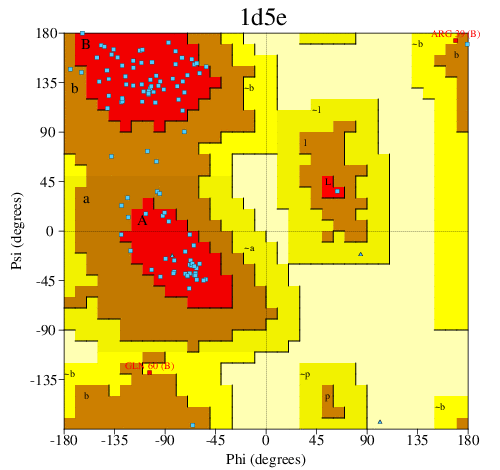
PDBsum entry 1d5e

|
|
|
|
|
 |
Contents |
 |
|
|
|
|
|
|
|
|
|
|
|
|
* Residue conservation analysis
|
|
|
|
|
References listed in PDB file
|
|
|
Key reference
|
|
|
Title
|
|
Thermodynamic and structural studies of cavity formation in proteins suggest that loss of packing interactions rather than the hydrophobic effect dominates the observed energetics.
|
|
|
Authors
|
|
G.S.Ratnaparkhi,
R.Varadarajan.
|
|
|
Ref.
|
|
Biochemistry, 2000,
39,
12365-12374.
[DOI no: ]
|
|
|
PubMed id
|
|
|
|
|
|
Abstract
|
|
|
The hydrophobic effect is widely believed to be an important determinant of
protein stability. However, it is difficult to obtain unambiguous experimental
estimates of the contribution of the hydrophobic driving force to the overall
free energy of folding. Thermodynamic and structural studies of large to small
substitutions in proteins are the most direct method of measuring this
contribution. We have substituted the buried residue Phe8 in RNase S with
alanine, methionine, and norleucine. Binding thermodynamics and structures were
characterized by titration calorimetry and crystallography, respectively. The
crystal structures of the RNase S F8A, F8M, and F8Nle mutants indicate that the
protein tolerates the changes without any main chain adjustments. The
correlation of structural and thermodynamic parameters associated with large to
small substitutions was analyzed for nine mutants of RNase S as well as 32
additional cavity-containing mutants of T4 lysozyme, human lysozyme, and
barnase. Such substitutions were typically found to result in negligible changes
in DeltaC(p)() and positive values of both DeltaDeltaH degrees and DeltaDeltaS
of folding. Enthalpic effects were dominant, and the sign of DeltaDeltaS is the
opposite of that expected from the hydrophobic effect. Values of DeltaDeltaG
degrees and DeltaDeltaH degrees correlated better with changes in packing
parameters such as residue depth or occluded surface than with the change in
accessible surface area upon folding. These results suggest that the loss of
packing interactions rather than the hydrophobic effect is a dominant
contributor to the observed energetics for large to small substitutions. Hence,
estimates of the magnitude of the hydrophobic driving force derived from earlier
mutational studies are likely to be significantly in excess of the actual value.
|
|
|
Secondary reference #1
|
|
|
Title
|
|
X-Ray crystallographic studies of the denaturation of ribonuclease s.
|
|
|
Authors
|
|
G.S.Ratnaparkhi,
R.Varadarajan.
|
|
|
Ref.
|
|
Proteins, 1999,
36,
282-294.
[DOI no: ]
|
|
|
PubMed id
|
|
|
|
|
|
|
|
|
|

|
|

|
|
Figure 5.
Figure 5. Analysis of water in the high resolution structures.
A: RMSD plot. B:  B-factor
plot. B-factor
plot.
|
|
Figure 6.
Figure 6. Ribbon diagram of RNase S coloured according to value
of B
factor of the main-chain atoms for (A) 5 M and (B) pH 2*
structure. Regions of high, intermediate and low B
(Å^2) are colored red, white, and blue respectively (scale
inset). The figure was generated using the program INSIGHT-II.
|
|
|
|
|
|
The above figures are
reproduced from the cited reference
with permission from John Wiley & Sons, Inc.
|
|
|
Secondary reference #2
|
|
|
Title
|
|
Crystallographic structures of ribonuclease s variants with nonpolar substitution at position 13: packing and cavities.
|
|
|
Authors
|
|
R.Varadarajan,
F.M.Richards.
|
|
|
Ref.
|
|
Biochemistry, 1992,
31,
12315-12327.
[DOI no: ]
|
|
|
PubMed id
|
|
|
|
|
|
|
|
|
Secondary reference #3
|
|
|
Title
|
|
Thermodynamic and structural consequences of changing a sulfur atom to a methylene group in the m13nle mutation in ribonuclease-S.
|
|
|
Authors
|
|
J.Thomson,
G.S.Ratnaparkhi,
R.Varadarajan,
J.M.Sturtevant,
F.M.Richards.
|
|
|
Ref.
|
|
Biochemistry, 1994,
33,
8587-8593.
[DOI no: ]
|
|
|
PubMed id
|
|
|
|
|
|
|
|
|
|
|
|
|