|
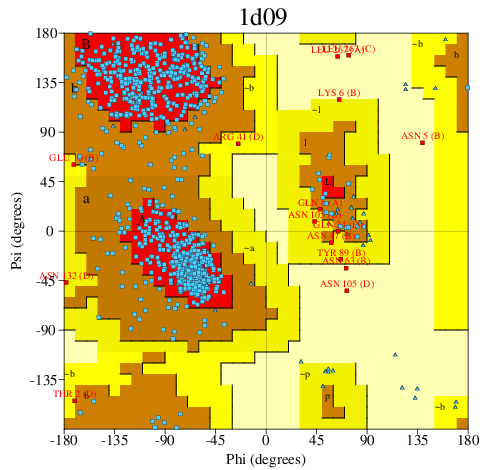
PDBsum entry 1d09

|
|
|
|
|
 |
Contents |
 |
|
|
|
|
|
|
|
|
|
|
|
|
|
|
* Residue conservation analysis
|
|
|
|
|
References listed in PDB file
|
|
|
Key reference
|
|
|
Title
|
|
Insights into the mechanisms of catalysis and heterotropic regulation of escherichia coli aspartate transcarbamoylase based upon a structure of the enzyme complexed with the bisubstrate analogue n-Phosphonacetyl-L-Aspartate at 2.1 a.
|
|
|
Authors
|
|
L.Jin,
B.Stec,
W.N.Lipscomb,
E.R.Kantrowitz.
|
|
|
Ref.
|
|
Proteins, 1999,
37,
729-742.
[DOI no: ]
|
|
|
PubMed id
|
|
|
|
|
|
Abstract
|
|
|
A high-resolution structure of Escherichia coli aspartate transcarbamoylase has
been determined to 2.1 A; resolution in the presence of the bisubstrate analog
N-phosphonacetyl-L-aspartate (PALA). The structure was refined to a free
R-factor of 23.4% and a working R-factor of 20.3%. The PALA molecule is
completely saturated with interactions to side chain and backbone groups in the
active site, including two interactions that are contributed from the 80s loop
of the adjacent catalytic chain. The charge neutralization of the bound PALA
molecule (and presumably the substrates as well) induced by the electrostatic
field of the highly positively charged active site is an important factor in the
high binding affinity of PALA and must be important for catalysis. The
higher-resolution structure reported here departs in a number of ways from the
previously determined structure at lower resolution. These modifications include
alterations in the backbone conformation of the C-terminal of the catalytic
chains, the N- and C-termini of the regulatory chains, and two loops of the
regulatory chain. The high-resolution of this structure has allowed a more
detailed description of the binding of PALA to the active site of the enzyme and
has allowed a detailed model of the tetrahedral intermediate to be constructed.
This model becomes the basis of a description of the catalytic mechanism of the
transcarbamoylase reaction. The R-structural state of the enzyme-PALA complex is
an excellent representation of the form of the enzyme that occurs at the moment
in the catalytic cycle when the tetrahedral intermediate is formed. Finally,
improved electron density in the N-terminal region of the regulatory chain
(residues 1 to 7) has allowed tracing of the entire regulatory chain. The
N-terminal segments of the R1 and R6 chains are located in close proximity to
each other and to the regulatory site. This portion of the molecule may be
involved in the observed asymmetry between the regulatory binding sites as well
as in the heterotropic response of the enzyme.
|
|
|
|

|
|

|
|
Figure 1.
Figure 1. Schematic diagram of the PALA binding site in the C1
chain of aspartate transcarbamoylase. Shown are all of the
residues that have hydrogen bonding interactions (dashed lines)
with PALA. The only substantial difference between the C1 and C6
active sites is a reorientation of the side chain of Arg54.
|
|
Figure 6.
Figure 6. Stereo view of the C1 catalytic chain of aspartate
transcarbamoylase with the tetrahedral intermediate modeled into
the active site. Shown are all the side chains that make direct
contact with the intermediate from the C1 chain as well as Ser80
and Lys84 from the adjacent catalytic chain. Hydrogen bonds are
shown as dashed lines.
|
|
|
|
|
|
The above figures are
reprinted
by permission from John Wiley & Sons, Inc.:
Proteins
(1999,
37,
729-742)
copyright 1999.
|
|
|
Secondary reference #1
|
|
|
Title
|
|
Complex of n-Phosphonacetyl-L-Aspartate with aspartate carbamoyltransferase. X-Ray refinement, Analysis of conformational changes and catalytic and allosteric mechanisms.
|
|
|
Authors
|
|
H.M.Ke,
W.N.Lipscomb,
Y.J.Cho,
R.B.Honzatko.
|
|
|
Ref.
|
|
J Mol Biol, 1988,
204,
725-747.
|
|
|
PubMed id
|
|
|
|
|
|
|
|
|
|
|
|
|