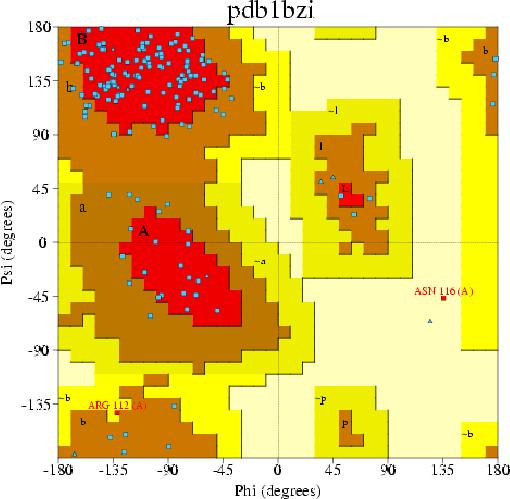
A molecular model of the complex between Fas and its ligand was generated to
better understand the location and putative effects of site-specific mutations,
analyze interactions at the Fas-FasL interface, and identify contact residues.
The modeling study was conservative in the sense that regions in Fas and its
ligand which could not be predicted with confidence were omitted from the model
to ensure accuracy of the analysis. Using the model, it was possible to map four
of five N-linked glycosylation sites in Fas and FasL and to study 10 of 11
residues previously identified by mutagenesis as important for binding.
Interactions involving six of these residues could be analyzed in detail and
their importance for binding was rationalized based on the model. The predicted
structure of the Fas-FasL interface was consistent with the experimentally
established importance of these residues for binding. In addition, five
previously not targeted residues were identified and predicted to contribute to
binding via electrostatic interactions. Despite its limitations, the study
provided a much improved basis to understand the role of Fas and FasL residues
for binding compared to previous residue mapping studies using only a molecular
model of Fas.