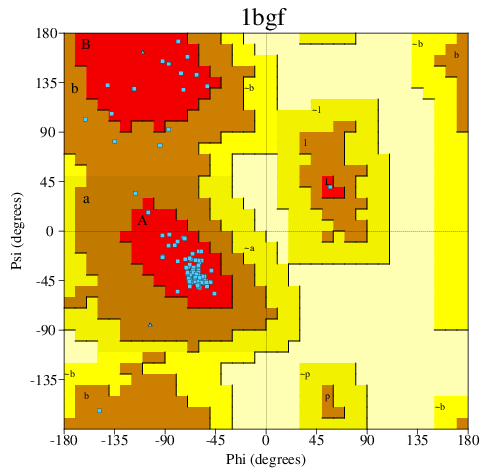
|
PDBsum entry 1bgf

|
|
|
|
|
|

|

|

|

|
|

|
|

|
|

|
|
|
 |

|

|
|
|
|
|
|
|
|
|
|
|
|
|
|
|
|
|
|
|
|
|
|
|
|
|
|
|
|
|
|
|
|
Transcription factor
|
PDB id
|
|
|
|
1bgf
|
|
|
|
|
|
|
|
|
|
|
|
|
|
|

|

|

|
|
|
|
|
|
|
|
 |
Contents |
 |
|
|
|
|
|
|
|
|
|
|
* Residue conservation analysis
|
|
|
|
|
|
|
|
|
|
|
|
|
|
|
 |
|
|
|
|
|
|
| |
|
DOI no:
|
Science
279:1048-1052
(1998)
|
|
PubMed id:
|
|
|
|
|
|
| |
|
Structure of the amino-terminal protein interaction domain of STAT-4.
|
|
U.Vinkemeier,
I.Moarefi,
J.E.Darnell,
J.Kuriyan.
|
|
|
|
|
| |
ABSTRACT
|
|
|
|
| |
|
|
STATs (signal transducers and activators of transcription) are a family of
transcription factors that are specifically activated to regulate gene
transcription when cells encounter cytokines and growth factors. The crystal
structure of an NH2-terminal conserved domain (N-domain) comprising the first
123 residues of STAT-4 was determined at 1.45 angstroms. The domain consists of
eight helices that are assembled into a hook-like structure. The N-domain has
been implicated in several protein-protein interactions affecting transcription,
and it enables dimerized STAT molecules to polymerize and to bind DNA
cooperatively. The structure shows that N-domains can interact through an
extensive interface formed by polar interactions across one face of the hook.
Mutagenesis of an invariant tryptophan residue at the heart of this interface
abolished cooperative DNA binding by the full-length protein in vitro and
reduced the transcriptional response after cytokine stimulation in vivo.
|
|
|
|
|
|
| |
Selected figure(s)
|
|
|
|
| |
|
|

|
|

|
|
Figure 2.
Fig. 2. Tertiary structure of the N-domain of STAT-4. (A)
Overall representation of two monomers (green and gray) in the
crystallographic^ dimer, viewed approximately orthogonal to the
molecular twofold^ axis, which is vertical. The ring-shaped
NH[2]-terminal element is colored red in one monomer. (B)
Orthogonal view of one^ of the N-domains shown in (A), depicting
details of the architecture^ of the ring-shaped element. Side
chains that participate in a^ charge-stabilized hydrogen-bond
network are shown in a ball-and-stick representation. The side
chain and backbone carbonyl of buried^ R31 are shown in magenta.
For clarity, the indole ring of the^ invariant residue W4 that
seals off this arrangement on the proximal side is drawn with
thinner bonds. The blue sphere denotes a buried^ water molecule.
Hydrogen bonds are indicated by dotted lines. Oxygen, nitrogen,
and carbon atoms are red, blue, and yellow, respectively. Q3-N
marks the position of the backbone amide group of residue Q3.
The light-red segment of helix  2
highlights its 3[10] helical conformation. Fig. 2 and Fig. 3, B
and C were created^ with the program RIBBONS, version 2.0 (28). 2
highlights its 3[10] helical conformation. Fig. 2 and Fig. 3, B
and C were created^ with the program RIBBONS, version 2.0 (28).
|
|
Figure 3.
Fig. 3. Structure of the dimer of N-domains. (A) Surface
representation of the N-domain dimer indicating the
wedge-shaped^ groove and the dimerization interface. Shown are
two monomers of a dimer with the left one rotated 90° around
the vertical axis away from the original position in the dimer.
Note the hook-like^ appearance of the monomer with the
coiled-coil of helices 6 and^
7 pointing
out of the planar surface formed by the ring-shaped^ element
comprising the NH[2]-terminal 40 residues. Residues from three
separate regions of the N-domain make direct or water-mediated^
contacts in the dimer and are color-coded according to their
position. Interface residues at the NH[2]-terminus are in green,
those in helices 3 and 4 are in
blue, and amino acids located in helix 6 are
yellow. The position of the critical W37 is highlighted^ in red.
The figure was created using GRASP (29). (B) A view at the
dimerization interface with amino acids represented^ as
ball-and-stick models and the c backbone
as a ribbon. The^ monomer is in the same orientation as the one
on the right side^ of (A). Side chains are colored as in (A);
the backbone ribbon is colored as in Fig. 2B, with the first 40
residues highlighted^ in red. L33 makes a backbone carbonyl
group contact, and its position is represented by the filled
circle. In the STAT-4 recombinant N-domain used for
crystallization, M1 was replaced with G plus four additional
small amino acids, one of which (G1) is visible^ in the electron
density map. In the crystals, the NH[2]-terminus of G1 is part
of the dimer interface, possibly substituting for the native M1.
(C) Close-up stereoview of the intermolecular hydrogen-bonding
network in the dimer. Selected side chains surrounding the
conserved W37 (magenta) in helices 4 and 6 of two
monomers (green and gray) are shown. W37 makes direct (E66  ) and
water-mediated^ contacts (Q63 ). Water
molecules are depicted as blue spheres. ) and
water-mediated^ contacts (Q63 ). Water
molecules are depicted as blue spheres.
|
|
|
|
|
|
| |
The above figures are
reprinted
by permission from the AAAs:
Science
(1998,
279,
1048-1052)
copyright 1998.
|
|
| |
Figures were
selected
by an automated process.
|
|
|
|
|
|
|
|
|
|
|
|
|
|
|
|
 |
 |
 |
|
Literature references that cite this PDB file's key reference
|
|
|
| |
PubMed id
|
|
Reference
|
|
|
|
|
|
T.Kawata
(2011).
STAT signaling in Dictyostelium development.
|
| |
Dev Growth Differ,
53,
548-557.
|
|
|
|
|
|
|
J.D.Nardozzi,
K.Lott,
and
G.Cingolani
(2010).
Phosphorylation meets nuclear import: a review.
|
| |
Cell Commun Signal,
8,
32.
|
|
|
|
|
|
|
M.V.Kumar,
and
R.Swaminathan
(2010).
A novel approach to segregate and identify functional loop regions in protein structures using their Ramachandran maps.
|
| |
Proteins,
78,
900-916.
|
|
|
|
|
|
|
J.Wang,
X.Zuo,
P.Yu,
I.J.Byeon,
J.Jung,
X.Wang,
M.Dyba,
S.Seifert,
C.D.Schwieters,
J.Qin,
A.M.Gronenborn,
and
Y.X.Wang
(2009).
Determination of multicomponent protein structures in solution using global orientation and shape restraints.
|
| |
J Am Chem Soc,
131,
10507-10515.
|
|
|
PDB codes:
|
|
|
|
|
|
|
|
P.Bernadó,
Y.Pérez,
J.Blobel,
J.Fernández-Recio,
D.I.Svergun,
and
M.Pons
(2009).
Structural characterization of unphosphorylated STAT5a oligomerization equilibrium in solution by small-angle X-ray scattering.
|
| |
Protein Sci,
18,
716-726.
|
|
|
|
|
|
|
J.W.Kornfeld,
F.Grebien,
M.A.Kerenyi,
K.Friedbichler,
B.Kovacic,
B.Zankl,
A.Hoelbl,
H.Nivarti,
H.Beug,
V.Sexl,
M.Muller,
L.Kenner,
E.W.Mullner,
F.Gouilleux,
and
R.Moriggl
(2008).
The different functions of Stat5 and chromatin alteration through Stat5 proteins.
|
| |
Front Biosci,
13,
6237-6254.
|
|
|
|
|
|
|
J.Yang,
and
G.R.Stark
(2008).
Roles of unphosphorylated STATs in signaling.
|
| |
Cell Res,
18,
443-451.
|
|
|
|
|
|
|
N.Wenta,
H.Strauss,
S.Meyer,
and
U.Vinkemeier
(2008).
Tyrosine phosphorylation regulates the partitioning of STAT1 between different dimer conformations.
|
| |
Proc Natl Acad Sci U S A,
105,
9238-9243.
|
|
|
|
|
|
|
S.C.Shih,
I.Stoica,
and
N.K.Goto
(2008).
Investigation of the utility of selective methyl protonation for determination of membrane protein structures.
|
| |
J Biomol NMR,
42,
49-58.
|
|
|
|
|
|
|
S.Dziennis,
and
N.J.Alkayed
(2008).
Role of signal transducer and activator of transcription 3 in neuronal survival and regeneration.
|
| |
Rev Neurosci,
19,
341-361.
|
|
|
|
|
|
|
S.Ray,
C.Lee,
T.Hou,
I.Boldogh,
and
A.R.Brasier
(2008).
Requirement of histone deacetylase1 (HDAC1) in signal transducer and activator of transcription 3 (STAT3) nucleocytoplasmic distribution.
|
| |
Nucleic Acids Res,
36,
4510-4520.
|
|
|
|
|
|
|
T.Berg
(2008).
Signal transducers and activators of transcription as targets for small organic molecules.
|
| |
Chembiochem,
9,
2039-2044.
|
|
|
|
|
|
|
T.Hou,
S.Ray,
C.Lee,
and
A.R.Brasier
(2008).
The STAT3 NH2-terminal domain stabilizes enhanceosome assembly by interacting with the p300 bromodomain.
|
| |
J Biol Chem,
283,
30725-30734.
|
|
|
|
|
|
|
B.B.Zeisig,
C.Kwok,
A.Zelent,
P.Shankaranarayanan,
H.Gronemeyer,
S.Dong,
and
C.W.So
(2007).
Recruitment of RXR by homotetrameric RARalpha fusion proteins is essential for transformation.
|
| |
Cancer Cell,
12,
36-51.
|
|
|
|
|
|
|
C.D.Krause,
and
S.Pestka
(2007).
Historical developments in the research of interferon receptors.
|
| |
Cytokine Growth Factor Rev,
18,
473-482.
|
|
|
|
|
|
|
D.R.Tyler,
M.E.Persky,
L.A.Matthews,
S.Chan,
and
J.D.Farrar
(2007).
Pre-assembly of STAT4 with the human IFN-alpha/beta receptor-2 subunit is mediated by the STAT4 N-domain.
|
| |
Mol Immunol,
44,
1864-1872.
|
|
|
|
|
|
|
G.Li,
Z.Wang,
Y.Zhang,
Z.Kang,
E.Haviernikova,
Y.Cui,
L.Hennighausen,
R.Moriggl,
D.Wang,
W.Tse,
and
K.D.Bunting
(2007).
STAT5 requires the N-domain to maintain hematopoietic stem cell repopulating function and appropriate lymphoid-myeloid lineage output.
|
| |
Exp Hematol,
35,
1684-1694.
|
|
|
|
|
|
|
C.Mertens,
M.Zhong,
R.Krishnaraj,
W.Zou,
X.Chen,
and
J.E.Darnell
(2006).
Dephosphorylation of phosphotyrosine on STAT1 dimers requires extensive spatial reorientation of the monomers facilitated by the N-terminal domain.
|
| |
Genes Dev,
20,
3372-3381.
|
|
|
|
|
|
|
C.P.Lim,
and
X.Cao
(2006).
Structure, function, and regulation of STAT proteins.
|
| |
Mol Biosyst,
2,
536-550.
|
|
|
|
|
|
|
K.Liddiard,
J.S.Welch,
J.Lozach,
S.Heinz,
C.K.Glass,
and
D.R.Greaves
(2006).
Interleukin-4 induction of the CC chemokine TARC (CCL17) in murine macrophages is mediated by multiple STAT6 sites in the TARC gene promoter.
|
| |
BMC Mol Biol,
7,
45.
|
|
|
|
|
|
|
L.Zhang,
D.B.Badgwell,
J.J.Bevers,
K.Schlessinger,
P.J.Murray,
D.E.Levy,
and
S.S.Watowich
(2006).
IL-6 signaling via the STAT3/SOCS3 pathway: functional analysis of the conserved STAT3 N-domain.
|
| |
Mol Cell Biochem,
288,
179-189.
|
|
|
|
|
|
|
A.Prabhu,
E.Coutinho,
and
S.Srivastava
(2005).
The amino-terminal domain of human signal transducers and activators of transcription 1: overexpression, purification and characterization.
|
| |
J Biosci,
30,
611-618.
|
|
|
|
|
|
|
M.M.Brierley,
and
E.N.Fish
(2005).
Stats: multifaceted regulators of transcription.
|
| |
J Interferon Cytokine Res,
25,
733-744.
|
|
|
|
|
|
|
M.Zhong,
M.A.Henriksen,
K.Takeuchi,
O.Schaefer,
B.Liu,
J.ten Hoeve,
Z.Ren,
X.Mao,
X.Chen,
K.Shuai,
and
J.E.Darnell
(2005).
Implications of an antiparallel dimeric structure of nonphosphorylated STAT1 for the activation-inactivation cycle.
|
| |
Proc Natl Acad Sci U S A,
102,
3966-3971.
|
|
|
|
|
|
|
R.Moriggl,
V.Sexl,
L.Kenner,
C.Duntsch,
K.Stangl,
S.Gingras,
A.Hoffmeyer,
A.Bauer,
R.Piekorz,
D.Wang,
K.D.Bunting,
E.F.Wagner,
K.Sonneck,
P.Valent,
J.N.Ihle,
and
H.Beug
(2005).
Stat5 tetramer formation is associated with leukemogenesis.
|
| |
Cancer Cell,
7,
87-99.
|
|
|
|
|
|
|
S.Ray,
I.Boldogh,
and
A.R.Brasier
(2005).
STAT3 NH2-terminal acetylation is activated by the hepatic acute-phase response and required for IL-6 induction of angiotensinogen.
|
| |
Gastroenterology,
129,
1616-1632.
|
|
|
|
|
|
|
T.J.Mitchell,
and
S.John
(2005).
Signal transducer and activator of transcription (STAT) signalling and T-cell lymphomas.
|
| |
Immunology,
114,
301-312.
|
|
|
|
|
|
|
T.Tanaka,
M.A.Soriano,
and
M.J.Grusby
(2005).
SLIM is a nuclear ubiquitin E3 ligase that negatively regulates STAT signaling.
|
| |
Immunity,
22,
729-736.
|
|
|
|
|
|
|
W.Xu,
J.S.Nair,
A.Malhotra,
and
J.J.Zhang
(2005).
B cell antigen receptor signaling enhances IFN-gamma-induced Stat1 target gene expression through calcium mobilization and activation of multiple serine kinase pathways.
|
| |
J Interferon Cytokine Res,
25,
113-124.
|
|
|
|
|
|
|
X.Mao,
and
X.Chen
(2005).
Crystallization and X-ray crystallographic analysis of human STAT1.
|
| |
Acta Crystallogr Sect F Struct Biol Cryst Commun,
61,
666-668.
|
|
|
|
|
|
|
X.Mao,
Z.Ren,
G.N.Parker,
H.Sondermann,
M.A.Pastorello,
W.Wang,
J.S.McMurray,
B.Demeler,
J.E.Darnell,
and
X.Chen
(2005).
Structural bases of unphosphorylated STAT1 association and receptor binding.
|
| |
Mol Cell,
17,
761-771.
|
|
|
PDB code:
|
|
|
|
|
|
|
|
C.M.Horvath
(2004).
Silencing STATs: lessons from paramyxovirus interferon evasion.
|
| |
Cytokine Growth Factor Rev,
15,
117-127.
|
|
|
|
|
|
|
K.Paukku,
and
O.Silvennoinen
(2004).
STATs as critical mediators of signal transduction and transcription: lessons learned from STAT5.
|
| |
Cytokine Growth Factor Rev,
15,
435-455.
|
|
|
|
|
|
|
L.S.Berenson,
N.Ota,
and
K.M.Murphy
(2004).
Issues in T-helper 1 development--resolved and unresolved.
|
| |
Immunol Rev,
202,
157-174.
|
|
|
|
|
|
|
M.Soler-Lopez,
C.Petosa,
M.Fukuzawa,
R.Ravelli,
J.G.Williams,
and
C.W.Müller
(2004).
Structure of an activated Dictyostelium STAT in its DNA-unbound form.
|
| |
Mol Cell,
13,
791-804.
|
|
|
PDB codes:
|
|
|
|
|
|
|
|
N.M.Heller,
S.Matsukura,
S.N.Georas,
M.R.Boothby,
C.Stellato,
and
R.P.Schleimer
(2004).
Assessment of signal transducer and activator of transcription 6 as a target of glucocorticoid action in human airway epithelial cells.
|
| |
Clin Exp Allergy,
34,
1690-1700.
|
|
|
|
|
|
|
T.Meissner,
E.Krause,
I.Lödige,
and
U.Vinkemeier
(2004).
Arginine methylation of STAT1: a reassessment.
|
| |
Cell,
119,
587.
|
|
|
|
|
|
|
J.Mudter,
and
M.F.Neurath
(2003).
The role of signal transducers and activators of transcription in T inflammatory bowel diseases.
|
| |
Inflamm Bowel Dis,
9,
332-337.
|
|
|
|
|
|
|
M.Albrecht,
D.Hoffmann,
B.O.Evert,
I.Schmitt,
U.Wüllner,
and
T.Lengauer
(2003).
Structural modeling of ataxin-3 reveals distant homology to adaptins.
|
| |
Proteins,
50,
355-370.
|
|
|
|
|
|
|
T.Hoey,
S.Zhang,
N.Schmidt,
Q.Yu,
S.Ramchandani,
X.Xu,
L.K.Naeger,
Y.L.Sun,
and
M.H.Kaplan
(2003).
Distinct requirements for the naturally occurring splice forms Stat4alpha and Stat4beta in IL-12 responses.
|
| |
EMBO J,
22,
4237-4248.
|
|
|
|
|
|
|
X.Chen,
R.Bhandari,
U.Vinkemeier,
F.Van Den Akker,
J.E.Darnell,
and
J.Kuriyan
(2003).
A reinterpretation of the dimerization interface of the N-terminal domains of STATs.
|
| |
Protein Sci,
12,
361-365.
|
|
|
|
|
|
|
C.W.Schindler
(2002).
Series introduction. JAK-STAT signaling in human disease.
|
| |
J Clin Invest,
109,
1133-1137.
|
|
|
|
|
|
|
D.E.Levy,
and
J.E.Darnell
(2002).
Stats: transcriptional control and biological impact.
|
| |
Nat Rev Mol Cell Biol,
3,
651-662.
|
|
|
|
|
|
|
J.P.Parisien,
J.F.Lau,
J.J.Rodriguez,
C.M.Ulane,
and
C.M.Horvath
(2002).
Selective STAT protein degradation induced by paramyxoviruses requires both STAT1 and STAT2 but is independent of alpha/beta interferon signal transduction.
|
| |
J Virol,
76,
4190-4198.
|
|
|
|
|
|
|
M.A.Henriksen,
A.Betz,
M.V.Fuccillo,
and
J.E.Darnell
(2002).
Negative regulation of STAT92E by an N-terminally truncated STAT protein derived from an alternative promoter site.
|
| |
Genes Dev,
16,
2379-2389.
|
|
|
|
|
|
|
R.N.Cooney
(2002).
Suppressors of cytokine signaling (SOCS): inhibitors of the JAK/STAT pathway.
|
| |
Shock,
17,
83-90.
|
|
|
|
|
|
|
C.J.DaFonseca,
F.Shu,
and
J.J.Zhang
(2001).
Identification of two residues in MCM5 critical for the assembly of MCM complexes and Stat1-mediated transcription activation in response to IFN-gamma.
|
| |
Proc Natl Acad Sci U S A,
98,
3034-3039.
|
|
|
|
|
|
|
M.Gadina,
D.Hilton,
J.A.Johnston,
A.Morinobu,
A.Lighvani,
Y.J.Zhou,
R.Visconti,
and
J.J.O'Shea
(2001).
Signaling by type I and II cytokine receptors: ten years after.
|
| |
Curr Opin Immunol,
13,
363-373.
|
|
|
|
|
|
|
S.J.Benkovic,
A.M.Valentine,
and
F.Salinas
(2001).
Replisome-mediated DNA replication.
|
| |
Annu Rev Biochem,
70,
181-208.
|
|
|
|
|
|
|
W.J.Leonard
(2001).
Cytokines and immunodeficiency diseases.
|
| |
Nat Rev Immunol,
1,
200-208.
|
|
|
|
|
|
|
W.J.Leonard
(2001).
Role of Jak kinases and STATs in cytokine signal transduction.
|
| |
Int J Hematol,
73,
271-277.
|
|
|
|
|
|
|
C.Bousquet,
M.C.Zatelli,
and
S.Melmed
(2000).
Direct regulation of pituitary proopiomelanocortin by STAT3 provides a novel mechanism for immuno-neuroendocrine interfacing.
|
| |
J Clin Invest,
106,
1417-1425.
|
|
|
|
|
|
|
C.M.Horvath
(2000).
STAT proteins and transcriptional responses to extracellular signals.
|
| |
Trends Biochem Sci,
25,
496-502.
|
|
|
|
|
|
|
D.E.Richards,
J.Peng,
and
N.P.Harberd
(2000).
Plant GRAS and metazoan STATs: one family?
|
| |
Bioessays,
22,
573-577.
|
|
|
|
|
|
|
E.Soldaini,
S.John,
S.Moro,
J.Bollenbacher,
U.Schindler,
and
W.J.Leonard
(2000).
DNA binding site selection of dimeric and tetrameric Stat5 proteins reveals a large repertoire of divergent tetrameric Stat5a binding sites.
|
| |
Mol Cell Biol,
20,
389-401.
|
|
|
|
|
|
|
J.J.O'Shea,
R.Visconti,
T.P.Cheng,
and
M.Gadina
(2000).
Jaks and stats as therapeutic targets.
|
| |
Ann Rheum Dis,
59,
i115-i118.
|
|
|
|
|
|
|
J.Liao,
Y.Fu,
and
K.Shuai
(2000).
Distinct roles of the NH2- and COOH-terminal domains of the protein inhibitor of activated signal transducer and activator of transcription (STAT) 1 (PIAS1) in cytokine-induced PIAS1-Stat1 interaction.
|
| |
Proc Natl Acad Sci U S A,
97,
5267-5272.
|
|
|
|
|
|
|
M.Chatterjee-Kishore,
F.van den Akker,
and
G.R.Stark
(2000).
Association of STATs with relatives and friends.
|
| |
Trends Cell Biol,
10,
106-111.
|
|
|
|
|
|
|
M.Chatterjee-Kishore,
K.L.Wright,
J.P.Ting,
and
G.R.Stark
(2000).
How Stat1 mediates constitutive gene expression: a complex of unphosphorylated Stat1 and IRF1 supports transcription of the LMP2 gene.
|
| |
EMBO J,
19,
4111-4122.
|
|
|
|
|
|
|
R.A.Ortmann,
T.Cheng,
R.Visconti,
D.M.Frucht,
and
J.J.O'Shea
(2000).
Janus kinases and signal transducers and activators of transcription: their roles in cytokine signaling, development and immunoregulation.
|
| |
Arthritis Res,
2,
16-32.
|
|
|
|
|
|
|
T.L.Murphy,
E.D.Geissal,
J.D.Farrar,
and
K.M.Murphy
(2000).
Role of the Stat4 N domain in receptor proximal tyrosine phosphorylation.
|
| |
Mol Cell Biol,
20,
7121-7131.
|
|
|
|
|
|
|
T.Zhang,
W.H.Kee,
K.T.Seow,
W.Fung,
and
X.Cao
(2000).
The coiled-coil domain of Stat3 is essential for its SH2 domain-mediated receptor binding and subsequent activation induced by epidermal growth factor and interleukin-6.
|
| |
Mol Cell Biol,
20,
7132-7139.
|
|
|
|
|
|
|
A.C.Oates,
P.Wollberg,
S.J.Pratt,
B.H.Paw,
S.L.Johnson,
R.K.Ho,
J.H.Postlethwait,
L.I.Zon,
and
A.F.Wilks
(1999).
Zebrafish stat3 is expressed in restricted tissues during embryogenesis and stat1 rescues cytokine signaling in a STAT1-deficient human cell line.
|
| |
Dev Dyn,
215,
352-370.
|
|
|
|
|
|
|
E.Yang,
Z.Wen,
R.L.Haspel,
J.J.Zhang,
and
J.E.Darnell
(1999).
The linker domain of Stat1 is required for gamma interferon-driven transcription.
|
| |
Mol Cell Biol,
19,
5106-5112.
|
|
|
|
|
|
|
L.Chen
(1999).
Combinatorial gene regulation by eukaryotic transcription factors.
|
| |
Curr Opin Struct Biol,
9,
48-55.
|
|
|
|
|
|
|
M.H.Heim
(1999).
The Jak-STAT pathway: cytokine signalling from the receptor to the nucleus.
|
| |
J Recept Signal Transduct Res,
19,
75.
|
|
|
|
|
|
|
M.Zhu,
S.John,
M.Berg,
and
W.J.Leonard
(1999).
Functional association of Nmi with Stat5 and Stat1 in IL-2- and IFNgamma-mediated signaling.
|
| |
Cell,
96,
121-130.
|
|
|
|
|
|
|
S.John,
U.Vinkemeier,
E.Soldaini,
J.E.Darnell,
and
W.J.Leonard
(1999).
The significance of tetramerization in promoter recruitment by Stat5.
|
| |
Mol Cell Biol,
19,
1910-1918.
|
|
|
|
|
|
|
W.J.Leonard,
K.Imada,
H.Nakajima,
A.Puel,
E.Soldaini,
and
S.John
(1999).
Signaling via the IL-2 and IL-7 receptors from the membrane to the nucleus.
|
| |
Cold Spring Harb Symp Quant Biol,
64,
417-424.
|
|
|
|
|
|
|
D.Rhodes,
and
J.W.Schwabe
(1998).
Signal transduction: fast lane to transcriptional activation.
|
| |
Curr Biol,
8,
R765-R767.
|
|
|
|
|
|
|
S.Becker,
B.Groner,
and
C.W.Müller
(1998).
Three-dimensional structure of the Stat3beta homodimer bound to DNA.
|
| |
Nature,
394,
145-151.
|
|
|
PDB code:
|
|
|
|
|
|
|
|
T.Hoey,
and
U.Schindler
(1998).
STAT structure and function in signaling.
|
| |
Curr Opin Genet Dev,
8,
582-587.
|
|
|
|
|
|
|
X.Chen,
U.Vinkemeier,
Y.Zhao,
D.Jeruzalmi,
J.E.Darnell,
and
J.Kuriyan
(1998).
Crystal structure of a tyrosine phosphorylated STAT-1 dimer bound to DNA.
|
| |
Cell,
93,
827-839.
|
|
|
PDB code:
|
|
|
|
|
|
|
The most recent references are shown first.
Citation data come partly from CiteXplore and partly
from an automated harvesting procedure. Note that this is likely to be
only a partial list as not all journals are covered by
either method. However, we are continually building up the citation data
so more and more references will be included with time.
Where a reference describes a PDB structure, the PDB
codes are
shown on the right.
|
|


 Links
Links