|
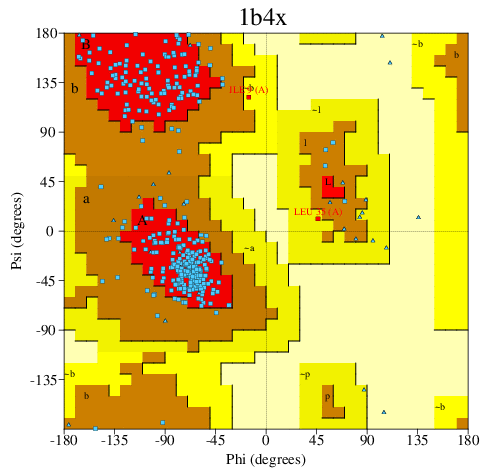
PDBsum entry 1b4x

|
|
|
|
|
 |
Contents |
 |
|
|
|
|
|
|
|
|
|
|
|
|
* Residue conservation analysis
|
|
|
|
|
References listed in PDB file
|
|
|
Key reference
|
|
|
Title
|
|
The role of residues outside the active site: structural basis for function of c191 mutants of escherichia coli aspartate aminotransferase.
|
|
|
Authors
|
|
C.J.Jeffery,
L.M.Gloss,
G.A.Petsko,
D.Ringe.
|
|
|
Ref.
|
|
Protein Eng, 2000,
13,
105-112.
|
|
|
PubMed id
|
|
|
|
|
|
Abstract
|
|
|
In previous kinetic studies of Escherichia coli aspartate aminotransferase, it
was determined that some substitutions of conserved cysteine 191, which is
located outside of the active site, altered the kinetic parameters of the enzyme
(Gloss,L.M., Spencer,D. E. and Kirsch,J.F., 1996, Protein Struct. Funct. Genet.,
24, 195-208). The mutations resulted in an alkaline shift of 0.6-0.8 pH units
for the pK(a) of the internal aldimine between the PLP cofactor and Lys258. The
change in the pK(a) affected the pH dependence of the k(cat)/K(m) (aspartate)
values for the mutant enzymes. To help to understand these observations, crystal
structures of five mutant forms of E.coli aspartate aminotransferase (the
maleate complexes of C191S, C191F, C191Y and C191W, and C191S without maleate)
were determined at about 2 A resolution in the presence of the pyridoxal
phosphate cofactor. The overall three-dimensional fold of each mutant enzyme is
the same as that of the wild-type protein, but there is a rotation of the
mutated side chain around its C(alpha)-C(beta) bond. This side chain rotation
results in a change in the pattern of hydrogen bonding connecting the mutant
residue and the protonated Schiff base of the cofactor, which could account for
the altered pK(a) of the Schiff base imine nitrogen that was reported
previously. These results demonstrate how residues outside the active site can
be important in helping determine the subtleties of the active site amino acid
geometries and interactions and how mutations outside the active site can have
effects on catalysis. In addition, these results help explain the surprising
result previously reported that, for some mutant proteins, replacement of a
buried cysteine with an aromatic side chain did not destabilize the protein
fold. Instead, rotation around the C(alpha)-C(beta) bond allowed each large
aromatic side chain to become buried in a nearby pocket without large changes in
the enzyme's backbone geometry.
|
|
|
|
|
|
|