 |
PDBsum entry 1b4d

|
|
|
|
|
 |
Contents |
 |
|
|
|
|
|
|
|
|
|
|
|
|
* Residue conservation analysis
|
|
|
|
|
|
PDB id:
|
|
|
|
| Name: |
|
Transferase
|
|
|
Title:
|
|
Amidocarbamate inhibitor of glycogen phosphorylase
|
|
Structure:
|
|
Protein (glycogen phosphorylase b). Chain: a. Ec: 2.4.1.1
|
|
Source:
|
|
Oryctolagus cuniculus. Rabbit. Organism_taxid: 9986. Tissue: muscle
|
|
Biol. unit:
|
|
 Dimer (from
)
Dimer (from
)
|
|
Resolution:
|
|
|
2.00Å
|
R-factor:
|
0.182
|
R-free:
|
0.229
|
|
|
Authors:
|
|
K.E.Tsitsanou,N.G.Oikonomakos,S.E.Zographos,V.T.Skamnaki,M.Gregoriou, K.A.Watson,L.N.Johnson,G.W.J.Fleet
|
|
Key ref:
|
|
K.E.Tsitsanou
et al.
(1999).
Effects of commonly used cryoprotectants on glycogen phosphorylase activity and structure.
Protein Sci,
8,
741-749.
PubMed id:
DOI:
|
|
|
Date:
|
|
|
18-Dec-98
|
Release date:
|
23-Dec-98
|
|
|
|
|
|
|
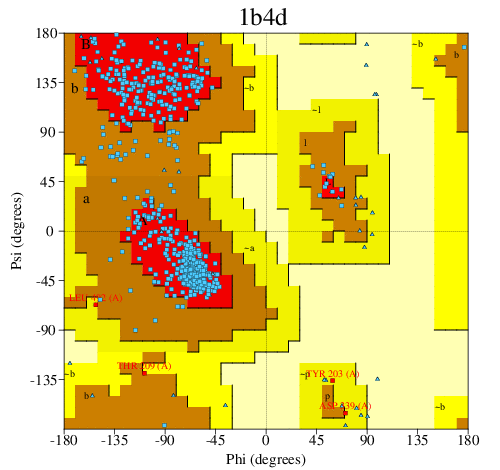
PROCHECK
|
|
|
|
|
|
Headers
|
|
|
|
References
|
|
|
|
|
|

|
|
P00489
(PYGM_RABIT) -
Glycogen phosphorylase, muscle form from Oryctolagus cuniculus
|
|
|
|
Seq:
Struc:
|
|
|
|
843 a.a.
804 a.a.*
|
|

|

|

|
|
|
|
|
|
|
|
|
|
|
Key: |
 |
PfamA domain |
|
|
 |
Secondary structure |
|
 |
CATH domain |
|
|
*
PDB and UniProt seqs differ
at 1 residue position (black
cross)
|
|
|
|
|
|
|
|
|
|
|
|
|
Enzyme class:
|
|
E.C.2.4.1.1
- glycogen phosphorylase.
|
|
|
|
|
|
|
Pathway:
|
|
Glycogen
|
|
|
|
|
|
Reaction:
|
|
[(1->4)-alpha-D-glucosyl](n) + phosphate = [(1->4)-alpha-D-glucosyl](n-1) + alpha-D-glucose 1-phosphate
|
|
|
|
|
|
[(1->4)-alpha-D-glucosyl](n)
|
+
|
 phosphate
|
=
|
[(1->4)-alpha-D-glucosyl](n-1)
|
+
|
alpha-D-glucose 1-phosphate
Bound ligand (Het Group name = )
matches with 50.00% similarity
|
|
|
|
|
|
|
|
|
|
|
|
|
Molecule diagrams generated from .mol files obtained from the
KEGG ftp site
|
|
|
|
|
|
|
|
|
|
|
|
|
|
 |
|
|
|
|
|
|
| |
|
|
| |
|
DOI no:
|
Protein Sci
8:741-749
(1999)
|
|
PubMed id:
|
|
|
|
|
|
| |
|
Effects of commonly used cryoprotectants on glycogen phosphorylase activity and structure.
|
|
K.E.Tsitsanou,
N.G.Oikonomakos,
S.E.Zographos,
V.T.Skamnaki,
M.Gregoriou,
K.A.Watson,
L.N.Johnson,
G.W.Fleet.
|
|
|
|
|
| |
ABSTRACT
|
|
|
|
| |
|
|
The effects of a number of cryoprotectants on the kinetic and structural
properties of glycogen phosphorylase b have been investigated. Kinetic studies
showed that glycerol, one of the most commonly used cryoprotectants in X-ray
crystallographic studies, is a competitive inhibitor with respect to substrate
glucose-1-P with an apparent Ki value of 3.8% (v/v). Cryogenic experiments, with
the enzyme, have shown that glycerol binds at the catalytic site and competes
with glucose analogues that bind at the catalytic site, thus preventing the
formation of complexes. This necessitated a change in the conditions for
cryoprotection in crystallographic binding experiments with glycogen
phosphorylase. It was found that 2-methyl-2,4-pentanediol (MPD), polyethylene
glycols (PEGs) of various molecular weights, and dimethyl sulfoxide (DMSO)
activated glycogen phosphorylase b to different extents, by stabilizing its most
active conformation, while sucrose acted as a noncompetitive inhibitor and
ethylene glycol as an uncompetitive inhibitor with respect to glucose-1-P. A
parallel experimental investigation by X-ray crystallography showed that, at 100
K, both MPD and DMSO do not bind at the catalytic site, do not induce any
significant conformational change on the enzyme molecule, and hence, are more
suitable cryoprotectants than glycerol for binding studies with glycogen
phosphorylase.
|
|
|
|
|
|
|
|
|
|
|
|
|
|
|
|
|
|
 |
 |
 |
|
Literature references that cite this PDB file's key reference
|
|
|
| |
PubMed id
|
|
Reference
|
|
|
|
|
|
A.D.Hill,
and
P.J.Reilly
(2008).
A Gibbs free energy correlation for automated docking of carbohydrates.
|
| |
J Comput Chem,
29,
1131-1141.
|
|
|
|
|
|
|
T.B.Eronina,
N.A.Chebotareva,
and
B.I.Kurganov
(2005).
Influence of osmolytes on inactivation and aggregation of muscle glycogen phosphorylase b by guanidine hydrochloride. Stimulation of protein aggregation under crowding conditions.
|
| |
Biochemistry (Mosc),
70,
1020-1026.
|
|
|
|
|
|
|
F.Movahedzadeh,
D.A.Smith,
R.A.Norman,
P.Dinadayala,
J.Murray-Rust,
D.G.Russell,
S.L.Kendall,
S.C.Rison,
M.S.McAlister,
G.J.Bancroft,
N.Q.McDonald,
M.Daffe,
Y.Av-Gay,
and
N.G.Stoker
(2004).
The Mycobacterium tuberculosis ino1 gene is essential for growth and virulence.
|
| |
Mol Microbiol,
51,
1003-1014.
|
|
|
|
|
|
|
C.Charron,
A.Kadri,
M.C.Robert,
R.Giegé,
and
B.Lorber
(2002).
Crystallization in the presence of glycerol displaces water molecules in the structure of thaumatin.
|
| |
Acta Crystallogr D Biol Crystallogr,
58,
2060-2065.
|
|
|
PDB codes:
|
|
|
|
|
|
|
|
D.J.Derbyshire,
D.J.Ellar,
and
J.Li
(2001).
Crystallization of the Bacillus thuringiensis toxin Cry1Ac and its complex with the receptor ligand N-acetyl-D-galactosamine.
|
| |
Acta Crystallogr D Biol Crystallogr,
57,
1938-1944.
|
|
|
|
|
|
|
N.A.Chebotareva,
S.E.Harding,
and
D.J.Winzor
(2001).
Ultracentrifugal studies of the effect of molecular crowding by trimethylamine N-oxide on the self-association of muscle glycogen phosphorylase b.
|
| |
Eur J Biochem,
268,
506-513.
|
|
|
|
|
|
|
E.Garman
(1999).
Cool data: quantity AND quality.
|
| |
Acta Crystallogr D Biol Crystallogr,
55,
1641-1653.
|
|
|
|
|
|
|
N.G.Oikonomakos,
K.E.Tsitsanou,
S.E.Zographos,
V.T.Skamnaki,
S.Goldmann,
and
H.Bischoff
(1999).
Allosteric inhibition of glycogen phosphorylase a by the potential antidiabetic drug 3-isopropyl 4-(2-chlorophenyl)-1,4-dihydro-1-ethyl-2-methyl-pyridine-3,5,6-tricarbo xylate.
|
| |
Protein Sci,
8,
1930-1945.
|
|
|
PDB codes:
|
|
|
|
|
|
|
The most recent references are shown first.
Citation data come partly from CiteXplore and partly
from an automated harvesting procedure. Note that this is likely to be
only a partial list as not all journals are covered by
either method. However, we are continually building up the citation data
so more and more references will be included with time.
Where a reference describes a PDB structure, the PDB
codes are
shown on the right.
|
|


 Links
Links



