|
PDBsum entry 1aj3
|
|
|
|
References listed in PDB file
|
 |
|
Key reference
|
|
|
Title
|
|
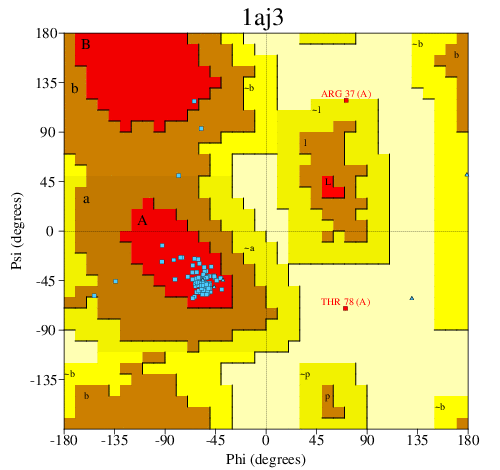
Solution structure of the spectrin repeat: a left-Handed antiparallel triple-Helical coiled-Coil.
|
|
|
Authors
|
|
J.Pascual,
M.Pfuhl,
D.Walther,
M.Saraste,
M.Nilges.
|
|
|
Ref.
|
|
J Mol Biol, 1997,
273,
740-751.
[DOI no: ]
|
|
|
PubMed id
|
|
|
|
|
Note In the PDB file this reference is
annotated as "TO BE PUBLISHED".
The citation details given above were identified by an automated
search of PubMed on title and author
names, giving a
percentage match of
71%.
|
|
|
|
Abstract
|
|
|
Cytoskeletal proteins belonging to the spectrin family have an elongated
structure composed of repetitive units. The three-dimensional solution structure
of the 16th repeat from chicken brain alpha-spectrin (R16) has been determined
by NMR spectroscopy and distance geometry-simulated annealing calculations. We
used a total of 1035 distance restraints, which included 719 NOE-based values
obtained by applying the ambiguous restraints for iterative assignment (ARIA)
method. In addition, we performed a direct refinement against 1H-chemical
shifts. The final ensemble of 20 structures shows an average RMSD of 1.52 A from
the mean for the backbone atoms, excluding loops and N and C termini. R16 is
made up of three antiparallel alpha-helices separated by two loops, and folds
into a left-handed coiled-coil. The basic unit of spectrin is an antiparallel
heterodimer composed of two homologous chains, beta and alpha. These assemble a
tetramer via a mechanism that relies on the completion of a single repeat by
association of the partial repeats located at the C terminus of the beta-chain
(two helices) and at the N terminus of the alpha-chain (one helix). This
tetramer is the assemblage able to cross-link actin filaments. Model building by
homology of the "tetramerization" repeat from human erythrocyte spectrin
illuminates the possible role of point mutations which cause hemolytic anemias.
|
|
|
|

|
|

|
|
Figure 2.
Figure 2. View of the backbone average structure of R16
(from His10 to Gln107). From the N to the C terminus, helix A is
colored green, the AB loop red, helix B yellow, the BC turn red,
and helix C cyan. Some of the side-chains of residues implicated
in interhelical contacts are shown in white and labeled
according to the one letter code for amino acid residues and in
parenthesis according to the helices nomenclature.
|
|
Figure 8.
Figure 8. Model of the arrangement of the conserved
side-chains A29, B7, and C25 of the “tetramerization” repeat
colored in green interacting via an intermolecular salt bridge
as well as a model for the effect of the Arg to Ser (colored in
red) mutation in C25 that prevents the tetramerization. The
inset the backbone of the model for the tetramerization repeat;
helices A and B from the β-chain are in white and helix C from
the α-chain is in cyan. Notice the absence of the BC loop. Each
triangle points towards the C terminus of its respective helix.
|
|
|
|
|
|
The above figures are
reprinted
by permission from Elsevier:
J Mol Biol
(1997,
273,
740-751)
copyright 1997.
|
|
|
|
|
|
|