|
PDBsum entry 1a2b

|
|
|
|
|
|

|

|

|

|
|

|
|

|
|

|
|

|
|

|
|

|
|
|
 |

|

|
|
|
|
|
|
|
|
|
|
|
|
|
|
|
|
|
|
|
|
|
|
|
|
|
|
|
|
|
|
|
|
|
|
|
Oncogene protein
|
PDB id
|
|
|
|
1a2b
|
|
|
|
|
|
|
|
|
|
|
|
|
|
|

|

|

|
|
|
|
|
|
|
|
 |
Contents |
 |
|
|
|
|
|
|
|
|
|
|
|
|
|
|
* Residue conservation analysis
|
|
|
|
|
|
|
|
|
|
|
Enzyme class:
|
|
E.C.3.6.5.2
- small monomeric GTPase.
|
|
|
|
|
|
|
Reaction:
|
|
GTP + H2O = GDP + phosphate + H+
|
|
|
|
|
|
GTP
Bound ligand (Het Group name = )
matches with 93.94% similarity
|
+
|
H2O
|
=
|
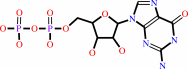 GDP
GDP
|
+
|
 phosphate
|
+
|
H(+)
|
|
|
|
|
|
|
|
|
|
|
|
|
Molecule diagrams generated from .mol files obtained from the
KEGG ftp site
|
|
|
|
|
|
|
|
|
|
|
|
|
|
 |
|
|
|
|
|
|
| |
|
|
| |
|
DOI no:
|
J Biol Chem
273:9656-9666
(1998)
|
|
PubMed id:
|
|
|
|
|
|
| |
|
Crystal structure of human RhoA in a dominantly active form complexed with a GTP analogue.
|
|
K.Ihara,
S.Muraguchi,
M.Kato,
T.Shimizu,
M.Shirakawa,
S.Kuroda,
K.Kaibuchi,
T.Hakoshima.
|
|
|
|
|
| |
ABSTRACT
|
|
|
|
| |
|
|
The 2.4-A resolution crystal structure of a dominantly active form of the small
guanosine triphosphatase (GTPase) RhoA, RhoAV14, complexed with the
nonhydrolyzable GTP analogue, guanosine 5'-3-O-(thio)triphosphate (GTPgammaS),
reveals a fold similar to RhoA-GDP, which has been recently reported (Wei, Y.,
Zhang, Y., Derewenda, U., Liu, X., Minor, W., Nakamoto, R. K., Somlyo, A. V.,
Somlyo, A. P., and Derewenda, Z. S. (1997) Nat. Struct. Biol. 4, 699-703), but
shows large conformational differences localized in switch I and switch II.
These changes produce hydrophobic patches on the molecular surface of switch I,
which has been suggested to be involved in its effector binding. Compared with
H-Ras and other GTPases bound to GTP or GTP analogues, the significant
conformational differences are located in regions involving switches I and II
and part of the antiparallel beta-sheet between switches I and II. Key residues
that produce these conformational differences were identified. In addition to
these differences, RhoA contains four insertion or deletion sites with an extra
helical subdomain that seems to be characteristic of members of the Rho family,
including Rac1, but with several variations in details. These sites also display
large displacements from those of H-Ras. The ADP-ribosylation residue, Asn41, by
C3-like exoenzymes stacks on the indole ring of Trp58 with a hydrogen bond to
the main chain of Glu40. The recognition of the guanosine moiety of GTPgammaS by
the GTPase contains water-mediated hydrogen bonds, which seem to be common in
the Rho family. These structural differences provide an insight into specific
interaction sites with the effectors, as well as with modulators such as guanine
nucleotide exchange factor (GEF) and guanine nucleotide dissociation inhibitor
(GDI).
|
|
|
|
|
|
| |
Selected figure(s)
|
|
|
|
| |
|
|

|
|

|
|
Figure 4.
Fig. 4. GTP  S bound to
RhoA^V14. A cartoon of GTP S binding
to RhoA^V14 with Mg2+ and water molecules. All dashed lines
correspond to hydrogen bonding interactions (distance less than
3.5 Å), and the corresponding distances (Å) are
indicated. The residues whose main chains participate in the
hydrogen bonding are represented by rectangles, and the residues
whose side chains participate in the hydrogen bonding are
represented by ovals. The coordination bonds to the Mg2+ ion are
indicated by arrows. The possible hydrogen bond between Gln63
and Wat-3 has a longer distance (3.8 Å). The hydrogen
bonds observed in the current structure but not in H-Ras are
highlighted in red. S bound to
RhoA^V14. A cartoon of GTP S binding
to RhoA^V14 with Mg2+ and water molecules. All dashed lines
correspond to hydrogen bonding interactions (distance less than
3.5 Å), and the corresponding distances (Å) are
indicated. The residues whose main chains participate in the
hydrogen bonding are represented by rectangles, and the residues
whose side chains participate in the hydrogen bonding are
represented by ovals. The coordination bonds to the Mg2+ ion are
indicated by arrows. The possible hydrogen bond between Gln63
and Wat-3 has a longer distance (3.8 Å). The hydrogen
bonds observed in the current structure but not in H-Ras are
highlighted in red.
|
|
Figure 6.
Fig. 6. Molecular surface of RhoA^V14. Residues whose
mutations abolish the interaction with GEF are in yellow. Asn41
is also highlighted in green. Switches I and II are shown in red
and blue, respectively. This surface also contains most of the
residues corresponding to the effector-binding residues as seen
in the complex between the Ras-binding domain of Raf1 and a
double mutant Rap1A (E30D/K31E), which mimics Ras.
|
|
|
|
|
|
| |
The above figures are
reprinted
by permission from the ASBMB:
J Biol Chem
(1998,
273,
9656-9666)
copyright 1998.
|
|
| |
Figures were
selected
by an automated process.
|
|
|
|
|
|
|
|
|
|
|
|
|
|
|
|
 |
 |
 |
|
Literature references that cite this PDB file's key reference
|
|
|
| |
PubMed id
|
|
Reference
|
|
|
|
|
|
J.Heo
(2011).
Redox control of GTPases: from molecular mechanisms to functional significance in health and disease.
|
| |
Antioxid Redox Signal,
14,
689-724.
|
|
|
|
|
|
|
V.Zazueta-Novoa,
G.Martínez-Cadena,
G.M.Wessel,
R.Zazueta-Sandoval,
L.Castellano,
and
J.García-Soto
(2011).
Concordance and interaction of guanine nucleotide dissociation inhibitor (RhoGDI) with RhoA in oogenesis and early development of the sea urchin.
|
| |
Dev Growth Differ,
53,
427-439.
|
|
|
|
|
|
|
M.Della Peruta,
C.Giagulli,
C.Laudanna,
A.Scarpa,
and
C.Sorio
(2010).
RHOA and PRKCZ control different aspects of cell motility in pancreatic cancer metastatic clones.
|
| |
Mol Cancer,
9,
61.
|
|
|
|
|
|
|
M.Yamashita,
K.Kurokawa,
Y.Sato,
A.Yamagata,
H.Mimura,
A.Yoshikawa,
K.Sato,
A.Nakano,
and
S.Fukai
(2010).
Structural basis for the Rho- and phosphoinositide-dependent localization of the exocyst subunit Sec3.
|
| |
Nat Struct Mol Biol,
17,
180-186.
|
|
|
PDB code:
|
|
|
|
|
|
|
|
N.Zhang,
J.Liang,
Y.Tian,
L.Yuan,
L.Wu,
S.Miao,
S.Zong,
and
L.Wang
(2010).
A novel testis-specific GTPase serves as a link to proteasome biogenesis: functional characterization of RhoS/RSA-14-44 in spermatogenesis.
|
| |
Mol Biol Cell,
21,
4312-4324.
|
|
|
|
|
|
|
M.Zheng,
T.Cierpicki,
K.Momotani,
M.V.Artamonov,
U.Derewenda,
J.H.Bushweller,
A.V.Somlyo,
and
Z.S.Derewenda
(2009).
On the mechanism of autoinhibition of the RhoA-specific nucleotide exchange factor PDZRhoGEF.
|
| |
BMC Struct Biol,
9,
36.
|
|
|
|
|
|
|
D.Komander,
R.Garg,
P.T.Wan,
A.J.Ridley,
and
D.Barford
(2008).
Mechanism of multi-site phosphorylation from a ROCK-I:RhoE complex structure.
|
| |
EMBO J,
27,
3175-3185.
|
|
|
PDB code:
|
|
|
|
|
|
|
|
M.J.Phillips,
G.Calero,
B.Chan,
S.Ramachandran,
and
R.A.Cerione
(2008).
Effector proteins exert an important influence on the signaling-active state of the small GTPase Cdc42.
|
| |
J Biol Chem,
283,
14153-14164.
|
|
|
PDB code:
|
|
|
|
|
|
|
|
M.Soundararajan,
A.Turnbull,
O.Fedorov,
C.Johansson,
and
D.A.Doyle
(2008).
RhoB can adopt a Mg2+ free conformation prior to GEF binding.
|
| |
Proteins,
72,
498-505.
|
|
|
|
|
|
|
C.L.Reyes,
E.Rutenber,
P.Walter,
and
R.M.Stroud
(2007).
X-ray structures of the signal recognition particle receptor reveal targeting cycle intermediates.
|
| |
PLoS ONE,
2,
e607.
|
|
|
PDB codes:
|
|
|
|
|
|
|
|
G.W.Feigenson
(2007).
Phase boundaries and biological membranes.
|
| |
Annu Rev Biophys Biomol Struct,
36,
63-77.
|
|
|
|
|
|
|
M.Vogelsgesang,
A.Pautsch,
and
K.Aktories
(2007).
C3 exoenzymes, novel insights into structure and action of Rho-ADP-ribosylating toxins.
|
| |
Naunyn Schmiedebergs Arch Pharmacol,
374,
347-360.
|
|
|
|
|
|
|
S.Gras,
V.Chaumont,
B.Fernandez,
P.Carpentier,
F.Charrier-Savournin,
S.Schmitt,
C.Pineau,
D.Flament,
A.Hecker,
P.Forterre,
J.Armengaud,
and
D.Housset
(2007).
Structural insights into a new homodimeric self-activated GTPase family.
|
| |
EMBO Rep,
8,
569-575.
|
|
|
PDB codes:
|
|
|
|
|
|
|
|
A.F.Roth,
J.Wan,
A.O.Bailey,
B.Sun,
J.A.Kuchar,
W.N.Green,
B.S.Phinney,
J.R.Yates,
and
N.G.Davis
(2006).
Global analysis of protein palmitoylation in yeast.
|
| |
Cell,
125,
1003-1013.
|
|
|
|
|
|
|
A.Yanuar,
S.Sakurai,
K.Kitano,
and
T.Hakoshima
(2006).
Crystal structure of human Rad GTPase of the RGK-family.
|
| |
Genes Cells,
11,
961-968.
|
|
|
PDB code:
|
|
|
|
|
|
|
|
D.E.Voth,
and
J.D.Ballard
(2005).
Clostridium difficile toxins: mechanism of action and role in disease.
|
| |
Clin Microbiol Rev,
18,
247-263.
|
|
|
|
|
|
|
L.Hemsath,
R.Dvorsky,
D.Fiegen,
M.F.Carlier,
and
M.R.Ahmadian
(2005).
An electrostatic steering mechanism of Cdc42 recognition by Wiskott-Aldrich syndrome proteins.
|
| |
Mol Cell,
20,
313-324.
|
|
|
PDB code:
|
|
|
|
|
|
|
|
Q.Zhong,
J.Gvozdenovic-Jeremic,
P.Webster,
J.Zhou,
and
M.L.Greenberg
(2005).
Loss of function of KRE5 suppresses temperature sensitivity of mutants lacking mitochondrial anionic lipids.
|
| |
Mol Biol Cell,
16,
665-675.
|
|
|
|
|
|
|
R.Dvorsky,
and
M.R.Ahmadian
(2004).
Always look on the bright site of Rho: structural implications for a conserved intermolecular interface.
|
| |
EMBO Rep,
5,
1130-1136.
|
|
|
|
|
|
|
K.Longenecker,
P.Read,
S.K.Lin,
A.P.Somlyo,
R.K.Nakamoto,
and
Z.S.Derewenda
(2003).
Structure of a constitutively activated RhoA mutant (Q63L) at 1.55 A resolution.
|
| |
Acta Crystallogr D Biol Crystallogr,
59,
876-880.
|
|
|
PDB code:
|
|
|
|
|
|
|
|
K.Riento,
R.M.Guasch,
R.Garg,
B.Jin,
and
A.J.Ridley
(2003).
RhoE binds to ROCK I and inhibits downstream signaling.
|
| |
Mol Cell Biol,
23,
4219-4229.
|
|
|
|
|
|
|
M.Abe,
H.Qadota,
A.Hirata,
and
Y.Ohya
(2003).
Lack of GTP-bound Rho1p in secretory vesicles of Saccharomyces cerevisiae.
|
| |
J Cell Biol,
162,
85-97.
|
|
|
|
|
|
|
M.Geyer,
C.Wilde,
J.Selzer,
K.Aktories,
and
H.R.Kalbitzer
(2003).
Glucosylation of Ras by Clostridium sordellii lethal toxin: consequences for effector loop conformations observed by NMR spectroscopy.
|
| |
Biochemistry,
42,
11951-11959.
|
|
|
|
|
|
|
P.J.Budge,
J.Lebowitz,
and
B.S.Graham
(2003).
Antiviral activity of RhoA-derived peptides against respiratory syncytial virus is dependent on formation of peptide dimers.
|
| |
Antimicrob Agents Chemother,
47,
3470-3477.
|
|
|
|
|
|
|
C.Wilde,
I.Just,
and
K.Aktories
(2002).
Structure-function analysis of the Rho-ADP-ribosylating exoenzyme C3stau2 from Staphylococcus aureus.
|
| |
Biochemistry,
41,
1539-1544.
|
|
|
|
|
|
|
D.H.Roh,
B.Bowers,
H.Riezman,
and
E.Cabib
(2002).
Rho1p mutations specific for regulation of beta(1-->3)glucan synthesis and the order of assembly of the yeast cell wall.
|
| |
Mol Microbiol,
44,
1167-1183.
|
|
|
|
|
|
|
H.Garavini,
K.Riento,
J.P.Phelan,
M.S.McAlister,
A.J.Ridley,
and
N.H.Keep
(2002).
Crystal structure of the core domain of RhoE/Rnd3: a constitutively activated small G protein.
|
| |
Biochemistry,
41,
6303-6310.
|
|
|
PDB code:
|
|
|
|
|
|
|
|
R.Thapar,
A.E.Karnoub,
and
S.L.Campbell
(2002).
Structural and biophysical insights into the role of the insert region in Rac1 function.
|
| |
Biochemistry,
41,
3875-3883.
|
|
|
|
|
|
|
X.Li,
X.Bu,
B.Lu,
H.Avraham,
R.A.Flavell,
and
B.Lim
(2002).
The hematopoiesis-specific GTP-binding protein RhoH is GTPase deficient and modulates activities of other Rho GTPases by an inhibitory function.
|
| |
Mol Cell Biol,
22,
1158-1171.
|
|
|
|
|
|
|
A.E.Karnoub,
C.J.Der,
and
S.L.Campbell
(2001).
The insert region of Rac1 is essential for membrane ruffling but not cellular transformation.
|
| |
Mol Cell Biol,
21,
2847-2857.
|
|
|
|
|
|
|
A.G.Spencer,
S.Orita,
C.J.Malone,
and
M.Han
(2001).
A RHO GTPase-mediated pathway is required during P cell migration in Caenorhabditis elegans.
|
| |
Proc Natl Acad Sci U S A,
98,
13132-13137.
|
|
|
|
|
|
|
F.Rivero,
H.Dislich,
G.Glöckner,
and
A.A.Noegel
(2001).
The Dictyostelium discoideum family of Rho-related proteins.
|
| |
Nucleic Acids Res,
29,
1068-1079.
|
|
|
|
|
|
|
H.Zong,
K.Kaibuchi,
and
L.A.Quilliam
(2001).
The insert region of RhoA is essential for Rho kinase activation and cellular transformation.
|
| |
Mol Cell Biol,
21,
5287-5298.
|
|
|
|
|
|
|
S.Padmanabhan,
and
D.M.Freymann
(2001).
The conformation of bound GMPPNP suggests a mechanism for gating the active site of the SRP GTPase.
|
| |
Structure,
9,
859-867.
|
|
|
PDB codes:
|
|
|
|
|
|
|
|
Z.Zhu,
J.J.Dumas,
S.E.Lietzke,
and
D.G.Lambright
(2001).
A helical turn motif in Mss4 is a critical determinant of Rab binding and nucleotide release.
|
| |
Biochemistry,
40,
3027-3036.
|
|
|
PDB code:
|
|
|
|
|
|
|
|
B.Prakash,
L.Renault,
G.J.Praefcke,
C.Herrmann,
and
A.Wittinghofer
(2000).
Triphosphate structure of guanylate-binding protein 1 and implications for nucleotide binding and GTPase mechanism.
|
| |
EMBO J,
19,
4555-4564.
|
|
|
PDB code:
|
|
|
|
|
|
|
|
C.Busch,
and
K.Aktories
(2000).
Microbial toxins and the glycosylation of rho family GTPases.
|
| |
Curr Opin Struct Biol,
10,
528-535.
|
|
|
|
|
|
|
G.R.Hoffman,
N.Nassar,
and
R.A.Cerione
(2000).
Structure of the Rho family GTP-binding protein Cdc42 in complex with the multifunctional regulator RhoGDI.
|
| |
Cell,
100,
345-356.
|
|
|
PDB code:
|
|
|
|
|
|
|
|
P.W.Read,
X.Liu,
K.Longenecker,
C.G.Dipierro,
L.A.Walker,
A.V.Somlyo,
A.P.Somlyo,
and
R.K.Nakamoto
(2000).
Human RhoA/RhoGDI complex expressed in yeast: GTP exchange is sufficient for translocation of RhoA to liposomes.
|
| |
Protein Sci,
9,
376-386.
|
|
|
|
|
|
|
T.Uno,
A.Nakasuji,
W.Hara,
and
Y.Aizono
(2000).
Molecular cloning of a cDNA for a small GTP binding protein, BRho, from the embryo of Bombyx mori and its characterization after expression and purification.
|
| |
Arch Insect Biochem Physiol,
43,
165-172.
|
|
|
|
|
|
|
I.R.Vetter,
A.Arndt,
U.Kutay,
D.Görlich,
and
A.Wittinghofer
(1999).
Structural view of the Ran-Importin beta interaction at 2.3 A resolution.
|
| |
Cell,
97,
635-646.
|
|
|
PDB code:
|
|
|
|
|
|
|
|
J.Ménétrey,
and
J.Cherfils
(1999).
Structure of the small G protein Rap2 in a non-catalytic complex with GTP.
|
| |
Proteins,
37,
465-473.
|
|
|
PDB code:
|
|
|
|
|
|
|
|
K.Longenecker,
P.Read,
U.Derewenda,
Z.Dauter,
X.Liu,
S.Garrard,
L.Walker,
A.V.Somlyo,
R.K.Nakamoto,
A.P.Somlyo,
and
Z.S.Derewenda
(1999).
How RhoGDI binds Rho.
|
| |
Acta Crystallogr D Biol Crystallogr,
55,
1503-1515.
|
|
|
PDB code:
|
|
|
|
|
|
|
|
M.G.Rudolph,
A.Wittinghofer,
and
I.R.Vetter
(1999).
Nucleotide binding to the G12V-mutant of Cdc42 investigated by X-ray diffraction and fluorescence spectroscopy: two different nucleotide states in one crystal.
|
| |
Protein Sci,
8,
778-787.
|
|
|
PDB code:
|
|
|
|
|
|
|
|
M.K.Pastey,
J.E.Crowe,
and
B.S.Graham
(1999).
RhoA interacts with the fusion glycoprotein of respiratory syncytial virus and facilitates virus-induced syncytium formation.
|
| |
J Virol,
73,
7262-7270.
|
|
|
|
|
|
|
R.Maesaki,
K.Ihara,
T.Shimizu,
S.Kuroda,
K.Kaibuchi,
and
T.Hakoshima
(1999).
The structural basis of Rho effector recognition revealed by the crystal structure of human RhoA complexed with the effector domain of PKN/PRK1.
|
| |
Mol Cell,
4,
793-803.
|
|
|
PDB code:
|
|
|
|
|
|
|
|
S.Müller,
C.von Eichel-Streiber,
and
M.Moos
(1999).
Impact of amino acids 22-27 of Rho-subfamily GTPases on glucosylation by the large clostridial cytotoxins TcsL-1522, TcdB-1470 and TcdB-8864.
|
| |
Eur J Biochem,
266,
1073-1080.
|
|
|
|
|
|
|
V.Benard,
G.M.Bokoch,
and
B.A.Diebold
(1999).
Potential drug targets: small GTPases that regulate leukocyte function.
|
| |
Trends Pharmacol Sci,
20,
365-370.
|
|
|
|
|
|
|
R.Treisman,
A.S.Alberts,
and
E.Sahai
(1998).
Regulation of SRF activity by Rho family GTPases.
|
| |
Cold Spring Harb Symp Quant Biol,
63,
643-651.
|
|
|
|
|
|
The most recent references are shown first.
Citation data come partly from CiteXplore and partly
from an automated harvesting procedure. Note that this is likely to be
only a partial list as not all journals are covered by
either method. However, we are continually building up the citation data
so more and more references will be included with time.
Where a reference describes a PDB structure, the PDB
code is
shown on the right.
|
|


 Links
Links