 |
PDBsum entry 7o2i

|
|
|
|
|
|

|

|

|

|
|

|
|

|
|

|
|

|
|

|
|

|
|
|
 |

|

|
|
|
|
|
|
|
|
|
|
|
|
|
|
|
|
|
|
|
|
|
|
|
|
|
|
|
|
|
|
|
|
|
|
|
RNA binding protein
|
PDB id
|
|
|
|
7o2i
|
|
|
|
|
|
|
|
|
|
|
|
|
|
|

|

|

|
|
|
|
|
|
|
PDB id:
|
|
|
|
| Name: |
|
RNA binding protein
|
|
|
Title:
|
|
Mettl3-mettl14 heterodimer bound to the sam competitive small molecule inhibitor stm2457
|
|
Structure:
|
|
N6-adenosine-methyltransferase catalytic subunit. Chain: a. Synonym: methyltransferase-like protein 3,hmettl3,n6-adenosine- methyltransferase 70 kda subunit,mt-a70. Engineered: yes. N6-adenosine-methyltransferase non-catalytic subunit. Chain: b. Synonym: methyltransferase-like protein 14,hmettl14. Engineered: yes
|
|
Source:
|
|
Homo sapiens. Human. Organism_taxid: 9606. Gene: mettl3, mta70. Expressed in: spodoptera frugiperda. Expression_system_taxid: 7108. Expression_system_cell_line: 21. Gene: mettl14, kiaa1627. Expression_system_cell_line: 21
|
|
Resolution:
|
|
|
3.00Å
|
R-factor:
|
0.186
|
R-free:
|
0.263
|
|
|
Authors:
|
|
E.S.Pilka,W.Blackaby,D.Hardick,C.Harper,D.Hewstone,M.Ridgill,B.Rotty, O.Rausch
|
|
Key ref:
|
|
E.Yankova
et al.
(2021).
Small-molecule inhibition of METTL3 as a strategy against myeloid leukaemia.
Nature,
593,
597-601.
PubMed id:
DOI:
|
|
|
Date:
|
|
|
30-Mar-21
|
Release date:
|
14-Apr-21
|
|
|
|
|
|
|
PROCHECK
|

|
|
|
|
|
Headers
|
|
|
|
References
|
|
|
|
|
|
|
|
|
|
|
|
Enzyme class:
|
|
Chain A:
E.C.2.1.1.348
- mRNA m(6)A methyltransferase.
|
|
|
|
|
|
|
Reaction:
|
|
an adenosine in mRNA + S-adenosyl-L-methionine = an N6-methyladenosine in mRNA + S-adenosyl-L-homocysteine + H+
|
|
|
|
|
|
adenosine in mRNA
|
+
|
 S-adenosyl-L-methionine
|
=
|
N(6)-methyladenosine in mRNA
|
+
|
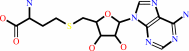 S-adenosyl-L-homocysteine
|
+
|
H(+)
|
|
|
|
|
|
|
|
|
|
|
|
|
Molecule diagrams generated from .mol files obtained from the
KEGG ftp site
|
|
|
|
|
|
|
|
|
|
|
|
|
|
 |
|
|
|
|
|
|
| |
|
|
| |
|
DOI no:
|
Nature
593:597-601
(2021)
|
|
PubMed id:
|
|
|
|
|
|
| |
|
Small-molecule inhibition of METTL3 as a strategy against myeloid leukaemia.
|
|
E.Yankova,
W.Blackaby,
M.Albertella,
J.Rak,
E.De Braekeleer,
G.Tsagkogeorga,
E.S.Pilka,
D.Aspris,
D.Leggate,
A.G.Hendrick,
N.A.Webster,
B.Andrews,
R.Fosbeary,
P.Guest,
N.Irigoyen,
M.Eleftheriou,
M.Gozdecka,
J.M.L.Dias,
A.J.Bannister,
B.Vick,
I.Jeremias,
G.S.Vassiliou,
O.Rausch,
K.Tzelepis,
T.Kouzarides.
|
|
|
|
|
| |
ABSTRACT
|
|
|
|
| |
|
|
N6-methyladenosine (m6A) is an abundant internal RNA
modification1,2 that is catalysed predominantly by the METTL3-METTL14
methyltransferase complex3,4. The m6A methyltransferase
METTL3 has been linked to the initiation and maintenance of acute myeloid
leukaemia (AML), but the potential of therapeutic applications targeting this
enzyme remains unknown5-7. Here we present the identification and
characterization of STM2457, a highly potent and selective first-in-class
catalytic inhibitor of METTL3, and a crystal structure of STM2457 in complex
with METTL3-METTL14. Treatment of tumours with STM2457 leads to reduced AML
growth and an increase in differentiation and apoptosis. These cellular effects
are accompanied by selective reduction of m6A levels on known
leukaemogenic mRNAs and a decrease in their expression consistent with a
translational defect. We demonstrate that pharmacological inhibition of METTL3
in vivo leads to impaired engraftment and prolonged survival in various mouse
models of AML, specifically targeting key stem cell subpopulations of AML.
Collectively, these results reveal the inhibition of METTL3 as a potential
therapeutic strategy against AML, and provide proof of concept that the
targeting of RNA-modifying enzymes represents a promising avenue for anticancer
therapy.
|
|
|
|
|
|
|
|
|
|
|
|
|
|
|
|
|
|
 |
 |
 |
|
|


 Links
Links


