 |
PDBsum entry 7a6c

|
|
|
|
|
|

|

|

|

|
|

|
|

|
|

|
|

|
|

|
|
|
 |

|

|
|
|
|
|
|
|
|
|
|
|
|
|
|
|
|
|
|
|
|
|
|
|
|
|
|
|
|
|
|
|
|
|
|
Transport protein
|
PDB id
|
|
|
|
7a6c
|
|
|
|
|
|
|
|
|
|
|
|
|
|
|

|

|

|
|
|
|
|
|
|
|
 |
Contents |
 |
|
|
|
|
|
|
|
|
|
|
|
 1164 a.a.
|
|
|
|
|
|
|
|
|
|
|
 214 a.a.
|
|
|
|
|
|
|
|
|
|
|
 218 a.a.
|
|
|
|
|
|
|
|
|
|
|
|
|
PDB id:
|
|
|
|
| Name: |
|
Transport protein
|
|
|
Title:
|
|
Nanodisc reconstituted human abcb1 in complex with mrk16 fab and elacridar
|
|
Structure:
|
|
Multidrug resistance protein 1. Chain: a. Synonym: atp-binding cassette sub-family b member 1,p-glycoprotein 1. Engineered: yes. If kappa light chain. Chain: b. Engineered: yes. Mrk16 fab-fragment heavy chain. Chain: c.
|
|
Source:
|
|
Homo sapiens. Human. Organism_taxid: 9606. Gene: abcb1, mdr1, pgy1. Expressed in: homo sapiens. Expression_system_taxid: 9606. Mus musculus. Mouse. Organism_taxid: 10090.
|
|
Authors:
|
|
K.Nosol,K.P.Locher
|
|
Key ref:
|
|
K.Nosol
et al.
(2020).
Cryo-EM structures reveal distinct mechanisms of inhibition of the human multidrug transporter ABCB1.
Proc Natl Acad Sci U S A,
117,
26245-26253.
PubMed id:
DOI:
|
|
|
Date:
|
|
|
25-Aug-20
|
Release date:
|
14-Oct-20
|
|
|
|
|
|
|
PROCHECK
|

|
|
|
|
|
Headers
|
|
|
|
References
|
|
|
|
|
|

|
|
P08183
(MDR1_HUMAN) -
ATP-dependent translocase ABCB1 from Homo sapiens
|
|
|
|
Seq:
Struc:
|
|
|
|
1280 a.a.
1164 a.a.*
|
|

|

|

|
|
|
|
|
|
|
|
|
|
|
|
|
|
|
|
|
Enzyme class 2:
|
|
Chain A:
E.C.7.6.2.1
- P-type phospholipid transporter.
|
|
|
|
|
|
|
Reaction:
|
|
ATP + H2O + phospholipidSide 1 = ADP + phosphate + phospholipidSide 2
|
|
|
|
|
|
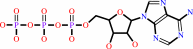 ATP
ATP
|
+
|
H2O
|
+
|
phospholipidSide 1
|
=
|
 ADP
ADP
|
+
|
 phosphate
|
+
|
phospholipidSide 2
|
|
|
|
|
|
|
|
|
|
Enzyme class 3:
|
|
Chain A:
E.C.7.6.2.2
- ABC-type xenobiotic transporter.
|
|
|
|
|
|
|
Reaction:
|
|
ATP + H2O + xenobioticSide 1 = ADP + phosphate + xenobioticSide 2
|
|
|
|
|
|
ATP
|
+
|
H2O
|
+
|
xenobioticSide 1
|
=
|
ADP
|
+
|
phosphate
|
+
|
xenobioticSide 2
|
|
|
|
|
|
|
|
|
|
|
|
|
Note, where more than one E.C. class is given (as above), each may
correspond to a different protein domain or, in the case of polyprotein
precursors, to a different mature protein.
|
|
|
|
Molecule diagrams generated from .mol files obtained from the
KEGG ftp site
|
|
|
|
|
|
|
|
|
|
|
|
|
|
 |
|
|
|
|
|
|
| |
|
|
| |
|
DOI no:
|
Proc Natl Acad Sci U S A
117:26245-26253
(2020)
|
|
PubMed id:
|
|
|
|
|
|
| |
|
Cryo-EM structures reveal distinct mechanisms of inhibition of the human multidrug transporter ABCB1.
|
|
K.Nosol,
K.Romane,
R.N.Irobalieva,
A.Alam,
J.Kowal,
N.Fujita,
K.P.Locher.
|
|
|
|
|
| |
ABSTRACT
|
|
|
|
| |
|
|
ABCB1 detoxifies cells by exporting diverse xenobiotic compounds, thereby
limiting drug disposition and contributing to multidrug resistance in cancer
cells. Multiple small-molecule inhibitors and inhibitory antibodies have been
developed for therapeutic applications, but the structural basis of their
activity is insufficiently understood. We determined cryo-EM structures of
nanodisc-reconstituted, human ABCB1 in complex with the Fab fragment of the
inhibitory, monoclonal antibody MRK16 and bound to a substrate (the antitumor
drug vincristine) or to the potent inhibitors elacridar, tariquidar, or
zosuquidar. We found that inhibitors bound in pairs, with one molecule lodged in
the central drug-binding pocket and a second extending into a phenylalanine-rich
cavity that we termed the "access tunnel." This finding explains how
inhibitors can act as substrates at low concentration, but interfere with the
early steps of the peristaltic extrusion mechanism at higher concentration. Our
structural data will also help the development of more potent and selective
ABCB1 inhibitors.
|
|
|
|
|
|
|
|
|
|
|
|
|
|
|
|
|
|
 |
 |
 |
|
| |


 Links
Links


