 |
PDBsum entry 6ynh

|
|
|
|
|
|

|

|

|

|
|

|
|

|
|

|
|

|
|

|
|

|
|
|
 |

|

|
|
|
|
|
|
|
|
|
|
|
|
|
|
|
|
|
|
|
|
|
|
|
|
|
|
|
|
|
|
|
|
|
|
|
Biosynthetic protein
|
PDB id
|
|
|
|
6ynh
|
|
|
|
|
|
|
|
|
|
|
|
|
|
|

|

|

|
|
|
|
|
|
|
|
|
Enzyme class 1:
|
|
E.C.1.2.1.12
- glyceraldehyde-3-phosphate dehydrogenase (phosphorylating).
|
|
|
|
|
|
|
Pathway:
|
|
Glyceraldehyde-3-phosphate Dehydrogenase (phosphorylating)
|
|
|
|
|
|
Reaction:
|
|
D-glyceraldehyde 3-phosphate + phosphate + NAD+ = (2R)-3-phospho- glyceroyl phosphate + NADH + H+
|
|
|
|
|
|
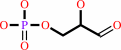 D-glyceraldehyde 3-phosphate
|
+
|
 phosphate
|
+
|
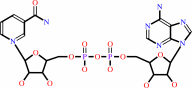 NAD(+)
|
=
|
(2R)-3-phospho- glyceroyl phosphate
|
+
|
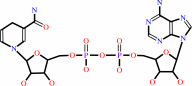 NADH
NADH
|
+
|
H(+)
|
|
|
|
|
|
|
|
|
|
Enzyme class 2:
|
|
E.C.2.6.99.-
- ?????
|
|
|
|
|
|
|
|
|
|
Note, where more than one E.C. class is given (as above), each may
correspond to a different protein domain or, in the case of polyprotein
precursors, to a different mature protein.
|
|
|
|
Molecule diagrams generated from .mol files obtained from the
KEGG ftp site
|
|
|
|
|
|
|
|
|
|
|
|
|
|
 |
|
|
|
|
|
|
| |
|
|
| |
|
DOI no:
|
Wellcome Open Res
5:114
(2020)
|
|
PubMed id:
|
|
|
|
|
|
| |
|
Partial catalytic Cys oxidation of human GAPDH to Cys-sulfonic acid.
|
|
A.Lia,
A.Dowle,
C.Taylor,
A.Santino,
P.Roversi.
|
|
|
|
|
| |
ABSTRACT
|
|
|
|
| |
|
|
Background: n-Glyceraldehyde-3-phosphate dehydrogenase (GAPDH) catalyses
the NAD +-dependent oxidative phosphorylation of
n-glyceraldehyde-3-phosphate to 1,3-diphospho-n-glycerate and its reverse
reaction in glycolysis and gluconeogenesis. Methods: Four distinct
crystal structures of human n-Glyceraldehyde-3-phosphate dehydrogenase (
HsGAPDH) have been determined from protein purified from the supernatant
of HEK293F human epithelial kidney cells. Results: X-ray crystallography
and mass-spectrometry indicate that the catalytic cysteine of the protein (
HsGAPDH Cys152) is partially oxidised to cysteine S-sulfonic acid. The
average occupancy for the Cys152-S-sulfonic acid modification over the 20
crystallographically independent copies of HsGAPDH across three of the
crystal forms obtained is 0.31±0.17. Conclusions: The modification
induces no significant structural changes on the tetrameric enzyme, and only
makes aspecific contacts to surface residues in the active site, in keeping with
the hypothesis that the oxidising conditions of the secreted mammalian cell
expression system result in HsGAPDH catalytic cysteine S-sulfonic acid
modification and irreversible inactivation of the enzyme.
|
|
|
|
|
|
|
|
|
|
|
|
|
|
|
|
|
|
 |
 |
 |
|


 Links
Links


