 |
PDBsum entry 6u4z
 |
|
|
|
|
|
|
Enzyme class:
|
|
E.C.5.1.3.11
- cellobiose epimerase.
|
|
|
|
|
|
|
Reaction:
|
|
D-cellobiose = beta-D-glucosyl-(1->4)-D-mannopyranose
|
|
|
|
|
|
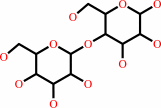 Cellobiose
|
=
|
4-O-beta-D-glucopyranosyl-D-mannose
|
|
|
|
|
|
|
|
|
|
Cofactor:
|
|
NAD
|
|
|
|
|
|
|
|
|
|
|
|
Molecule diagrams generated from .mol files obtained from the
KEGG ftp site
|
|
|
|
|
|
|
|
|
|
|
|
|
|
 |
|
|
|
|
|
|
| |
|
|
| |
|
DOI no:
|
J Mol Biol
432:1083-1097
(2020)
|
|
PubMed id:
|
|
|
|
|
|
| |
|
Analysis of Active Site Architecture and Reaction Product Linkage Chemistry Reveals a Conserved Cleavage Substrate for an Endo-alpha-mannanase within Diverse Yeast Mannans.
|
|
D.R.Jones,
X.Xing,
J.P.Tingley,
L.Klassen,
M.L.King,
T.W.Alexander,
D.W.Abbott.
|
|
|
|
|
| |
ABSTRACT
|
|
|
|
| |
|
|
Yeast α-mannan (YM) is a densely branched N-linked glycan that decorates the
surface of yeast cell walls. Owing to the high degree of branching, cleavage of
the backbone of YM appears to rely on the coupled action of side-chain-cleaving
enzymes. Upon examining the genome sequences of bovine-adapted Bacteroides
thetaiotaomicron strains, isolated for their ability to degrade YM, we have
identified a tandem pair of genes inserted into an orphan pathway predicted to
be involved in YM metabolism. Here, we investigated the activity of one of these
enzymes, a predicted endo-mannanase from glycoside hydrolase (GH) family 76
(BtGH76-MD40). Purified recombinant BtGH76-MD40 displayed activity on
structurally distinct YMs from Saccharomyces cerevisiae and Schizosaccharomyces
pombe. Linkage analysis of released oligosaccharide products from S. cerevisiae
and S. pombe mannan determined BtGH76-MD40 targets a specific linkage that is
conserved in structurally diverse YM substrates. In addition, using two
differential derivatization methods, we have shown that there is an absolute
requirement for undecorated d-mannopyranose in the -1 subsite. Determination of
the BtGH76-MD40 X-ray crystal structure and structural superimposition and
molecular docking of a branched alpha-mannopentatose substrate supported these
findings. In contrast, BtGH76-MD40 can accommodate extended side chains in
the +1 and -2 subsites, highlighting that a single alpha-1,6-mannosyl residue
is a prerequisite for activity, and cleavage occurs at the reducing end of the
undecorated monosaccharide. Collectively these results demonstrate how
acquisition of new enzymes within extant pathways contributes to the functional
abilities of saccharolytic bacteria persisting in complex digestive ecosystems.
|
|
|
|
|
|
|
|
|
|
|
|
|
|
|
|
|
|
 |
 |
 |
|


 Links
Links


