 |
PDBsum entry 6q3c
 |
|
|
|
|
|
|
Enzyme class:
|
|
E.C.2.7.11.22
- cyclin-dependent kinase.
|
|
|
|
|
|
|
Reaction:
|
|
|
1.
|
L-seryl-[protein] + ATP = O-phospho-L-seryl-[protein] + ADP + H+
|
|
2.
|
L-threonyl-[protein] + ATP = O-phospho-L-threonyl-[protein] + ADP + H+
|
|
|
|
|
|
|
L-seryl-[protein]
|
+
|
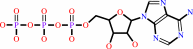 ATP
ATP
|
=
|
O-phospho-L-seryl-[protein]
|
+
|
 ADP
ADP
|
+
|
H(+)
|
|
|
|
|
|
|
L-threonyl-[protein]
|
+
|
ATP
|
=
|
O-phospho-L-threonyl-[protein]
|
+
|
ADP
|
+
|
H(+)
|
|
|
|
|
|
|
|
|
|
|
|
|
Molecule diagrams generated from .mol files obtained from the
KEGG ftp site
|
|
|
|
|
|
|
|
|
|
|
|
|
|
 |
|
|
|
|
|
|
| |
|
|
| |
|
DOI no:
|
J Med Chem
62:3741-3752
(2019)
|
|
PubMed id:
|
|
|
|
|
|
| |
|
FragLites-Minimal, Halogenated Fragments Displaying Pharmacophore Doublets. An Efficient Approach to Druggability Assessment and Hit Generation.
|
|
D.J.Wood,
J.D.Lopez-Fernandez,
L.E.Knight,
I.Al-Khawaldeh,
C.Gai,
S.Lin,
M.P.Martin,
D.C.Miller,
C.Cano,
J.A.Endicott,
I.R.Hardcastle,
M.E.M.Noble,
M.J.Waring.
|
|
|
|
|
| |
ABSTRACT
|
|
|
|
| |
|
|
Identifying ligand binding sites on proteins is a critical step in target-based
drug discovery. Current approaches to this require resource-intensive screening
of large libraries of lead-like or fragment molecules. Here, we describe an
efficient and effective experimental approach to mapping interaction sites using
a set of halogenated compounds expressing paired hydrogen-bonding motifs, termed
FragLites. The FragLites identify productive drug-like interactions, which are
identified sensitively and unambiguously by X-ray crystallography, exploiting
the anomalous scattering of the halogen substituent. This mapping of protein
interaction surfaces provides an assessment of druggability and can identify
efficient start points for the de novo design of hit molecules incorporating the
interacting motifs. The approach is illustrated by mapping cyclin-dependent
kinase 2, which successfully identifies orthosteric and allosteric sites. The
hits were rapidly elaborated to develop efficient lead-like molecules. Hence,
the approach provides a new method of identifying ligand sites, assessing
tractability and discovering new leads.
|
|
|
|
|
|
|
|
|
|
|
|
|
|
|
|
|
|
 |
 |
 |
|


 Links
Links


