 |
PDBsum entry 6pyp

|
|
|
|
|
|

|

|

|

|
|

|
|

|
|

|
|

|
|

|
|
|
 |

|

|
|
|
|
|
|
|
|
|
|
|
|
|
|
|
|
|
|
|
|
|
|
|
|
|
|
|
|
|
|
|
|
|
|
Oxidoreductase
|
PDB id
|
|
|
|
6pyp
|
|
|
|
|
|
|
|
|
|
|
|
|
|
|

|

|

|
|
|
|
|
|
|
|
|
Enzyme class:
|
|
E.C.1.1.1.8
- glycerol-3-phosphate dehydrogenase (NAD(+)).
|
|
|
|
|
|
|
Reaction:
|
|
sn-glycerol 3-phosphate + NAD+ = dihydroxyacetone phosphate + NADH + H+
|
|
|
|
|
|
sn-glycerol 3-phosphate
Bound ligand (Het Group name = )
corresponds exactly
|
+
|
NAD(+)
Bound ligand (Het Group name = )
matches with 50.00% similarity
|
=
|
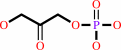 dihydroxyacetone phosphate
|
+
|
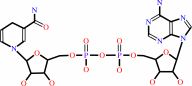 NADH
NADH
|
+
|
H(+)
|
|
|
|
|
|
|
|
|
|
|
|
|
Molecule diagrams generated from .mol files obtained from the
KEGG ftp site
|
|
|
|
|
|
|
|
|
|
|
|
|
|
 |
|
|
|
|
|
|
| |
|
|
| |
|
DOI no:
|
ACS Catal
10:11253-11267
(2020)
|
|
PubMed id:
|
|
|
|
|
|
| |
|
Modeling the Role of a Flexible Loop and Active Site Side Chains in Hydride Transfer Catalyzed by Glycerol-3-phosphate Dehydrogenase.
|
|
A.R.Mhashal,
A.Romero-Rivera,
L.S.Mydy,
J.R.Cristobal,
A.M.Gulick,
J.P.Richard,
S.C.L.Kamerlin.
|
|
|
|
|
| |
ABSTRACT
|
|
|
|
| |
|
|
Glycerol-3-phosphate dehydrogenase is a biomedically important enzyme that plays
a crucial role in lipid biosynthesis. It is activated by a ligand-gated
conformational change that is necessary for the enzyme to reach a catalytically
competent conformation capable of efficient transition-state stabilization.
While the human form (hlGPDH) has been the subject of extensive
structural and biochemical studies, corresponding computational studies to
support and extend experimental observations have been lacking. We perform here
detailed empirical valence bond and Hamiltonian replica exchange molecular
dynamics simulations of wild-type hlGPDH and its variants, as well as
providing a crystal structure of the binary hlGPDH·NAD R269A variant
where the enzyme is present in the open conformation. We estimated the
activation free energies for the hydride transfer reaction in wild-type and
substituted hlGPDH and investigated the effect of mutations on catalysis
from a detailed structural study. In particular, the K120A and R269A variants
increase both the volume and solvent exposure of the active site, with
concomitant loss of catalytic activity. In addition, the R269 side chain
interacts with both the Q295 side chain on the catalytic loop, and the substrate
phosphodianion. Our structural data and simulations illustrate the critical role
of this side chain in facilitating the closure of hlGPDH into a
catalytically competent conformation, through modulating the flexibility of a
key catalytic loop (292-LNGQKL-297). This, in turn, rationalizes a tremendous
41,000 fold decrease experimentally in the turnover number,
kcat, upon truncating this residue, as loop closure is
essential for both correct positioning of key catalytic residues in the active
site, as well as sequestering the active site from the solvent. Taken together,
our data highlight the importance of this ligand-gated conformational change in
catalysis, a feature that can be exploited both for protein engineering and for
the design of allosteric inhibitors targeting this biomedically important enzyme.
|
|
|
|
|
|
|
|
|
|
|
|
|
|
|
|
|
|
 |
 |
 |
|


 Links
Links


